
Summary of Bootload an Arduino with a ZIF Socket
This article explains how using a Zero Insertion Force (ZIF) socket simplifies bootloading multiple Arduino chips by preventing pin damage during insertion and removal. This method is ideal for mass-producing electronics kits or frequently reprogramming chips between circuits without the risk of bending pins.
Parts used in Bootload an Arduino with a ZIF Socket:
- Arduino chips
- ZIF socket
Bootloading an Arduino with a ZIF socket allows you to easily program a lot of chips at once without worrying about mangling the pins. The reason for this is that ZIF stands for “zero insertion force,” and as the name implies, ZIF sockets don’t require any force to take the chip in or out.
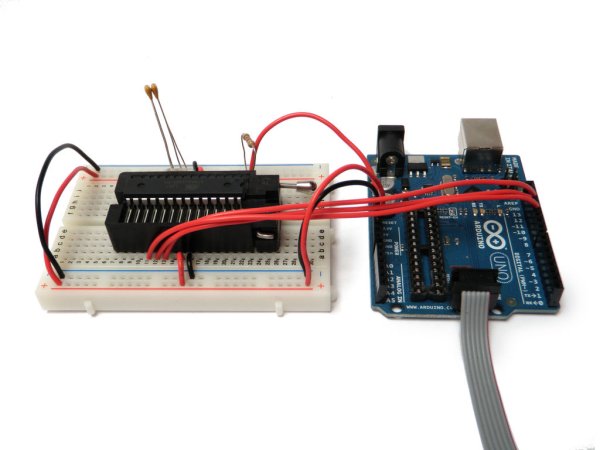
This means that you do not have to worry about any of the pins bending when you take the chip in and out of the socket. This is particularly useful if you need to bootload a lot of Arduino chips at once for inclusion in an electronics kit or if you need to repeatedly program a chip and transfer it back and forth between a separate circuit board.
For more detail: Bootload an Arduino with a ZIF Socket
- How does a ZIF socket help when bootloading Arduino chips?
A ZIF socket allows you to program many chips at once without worrying about mangling the pins. - What does ZIF stand for?
ZIF stands for zero insertion force. - Why is a ZIF socket useful for repeated programming?
It allows you to repeatedly program a chip and transfer it back and forth between a separate circuit board without pin damage. - Does inserting a chip into a ZIF socket require force?
No, ZIF sockets do not require any force to take the chip in or out. - Can I use this method for electronics kits?
Yes, it is particularly useful if you need to bootload a lot of Arduino chips at once for inclusion in an electronics kit. - What happens to the pins if you do not use a ZIF socket?
You might worry about any of the pins bending when you take the chip in and out. - Is this method suitable for bulk processing?
Yes, it enables easy programming of a lot of chips at once.
