
Summary of POV Cylinder with Arduino Due
This project is a Persistence of Vision (POV) cylinder using an Arduino Due to display animated GIFs on a rotating styrofoam cylinder with RGB LED strips, controlled via Bluetooth from a PC. The rotor spins up to 1300 RPM, creating a 151×40 pixel display using LPD8806-based LED strips; images are stored in the Arduino’s memory.
Parts used in the POV Cylinder:
- Arduino Due
- HC06 Bluetooth module
- 4 RGB LED strips (LPD8806 based)
- Styrofoam cylinder (200 mm diameter, 200 mm height)
- Plywood circular disks (2)
- Threaded bars (3 for chassis)
- Threaded bar for shaft
- Ball bearings (2)
- Shaft
- Electric motor
- Crown gears (2)
- Toothed belt
- Aluminium circular disks (2)
- Adhesive/glue
Story
Introduction
This is my first Arduino project. My work was inspired by several maker projects that created Persistence of Vision Displays [2,3,4].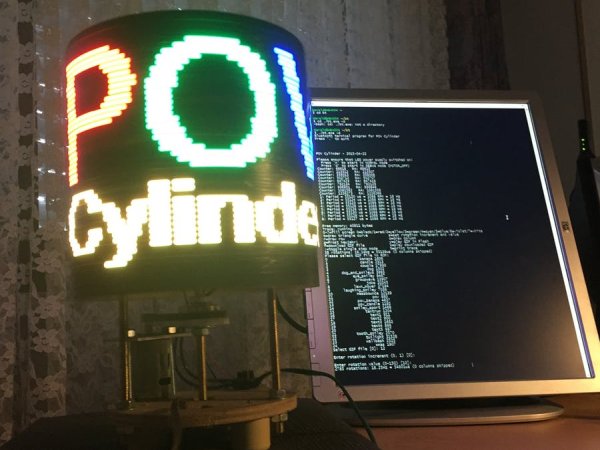
Persistence of vision (POV) refers to the optical illusion whereby multiple discrete images blend into a single image in the human mind and believed to be the explanation for motion perception in cinema and animated films [1].
The projects [2,3,4] implement POV globe displays, using discrete LEDs and discrete shift registers. Instead my device is using a rotating cylinder and off-the-shelf RGB LED strips as POV Display.
The main features of my POV Cylinder are:
- POV (Persistence of Vision) Display
- Displays animated GIF pictures on a rotating cylinder
- The GIF pictures are stored in Arduino’s RAM or Flash
- Communication with PC via Bluetooth
- Cylinder Diameter: 200 mm
- Cylinder Height: 200 mm
- Cylinder material: Styrofoam
- Cylinder weight: 420 g
- 4 RGB LED Strips based on LPD8806
- Screen size 151 x 40 pixels
- Based on Arduino Due
- Includes HC06 Bluetooth module
- Controlled via Bluetooth from a PC
Mechanical Construction
The mechanical construction is shown in the drawing below.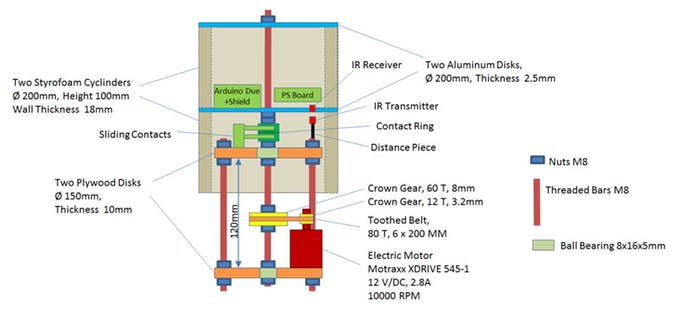
The device comprises a chassis and a rotor. The chassis consists of two circular plywood disks which are connected via three threaded bars. The distance between the disks is 120 mm. In the middle there are two ball bearings and the shaft. For the shaft also a threaded bar is used. The shaft is driven by an electric motor via two crown gears and a toothed belt. The rotation speed is up to 1300 RPM (22 Hz).
The rotor consists of two styrofoam cylinders and two circular aluminium disks. The styrofoam cylinders are glued to the lower disk. The upper disk can be removed. It is used to attach the rotor to the shaft.
For more detail: POV Cylinder with Arduino Due
- What is the display resolution of the POV Cylinder?
The screen size is 151 x 40 pixels. - What microcontroller is used in the project?
The project is based on an Arduino Due. - How are images sent to the device from a PC?
Communication with the PC is via an HC06 Bluetooth module. - What type of LEDs are used for the POV display?
Four RGB LED strips based on the LPD8806 are used. - Where are the GIF pictures stored?
The GIF pictures are stored in the Arduino's RAM or Flash. - What are the physical dimensions of the cylinder?
The cylinder diameter is 200 mm and height is 200 mm. - How is the rotor driven and what is the maximum speed?
The shaft is driven by an electric motor via two crown gears and a toothed belt, with rotation speed up to 1300 RPM (22 Hz). - What materials make up the rotor and chassis?
The rotor uses styrofoam cylinders and aluminium disks; the chassis uses plywood disks connected by threaded bars. - How is the rotor attached to the shaft?
The upper aluminium disk of the rotor can be removed and is used to attach the rotor to the shaft. - What is the weight of the cylinder?
The cylinder weight is 420 g.
