
Summary of Anti-Theft Alert System using ATmega8 Microcontroller
This project describes a vibration and theft alert system using an ATMEGA8 microcontroller. It interfaces a tilt sensor to detect movement, triggering an op-amp that signals the microcontroller. Upon detecting vibration, the system activates a buzzer for alerts. Security is enhanced by interfacing five buttons to create a unique code combination required to silence the alarm, ensuring only authorized personnel can turn it off.
Parts used in the Theft Alert System:
- ATMEGA8 microcontroller
- Power supply (5v)
- AVR-ISP PROGRAMMER
- 1000uF capacitor
- LED
- 220Ω resistor
- LDR (Light Dependent Resistor)
- 10KΩ resistor
- 1KΩ resistor
- 2n3906 transistor
- Buzzer
- Motion sensor module (HC-SR501)
- Buttons (5 pieces)
- 2WATT LED
- TIP122 transistor
In this project we are going to make a vibration alert system with ATMEGA8 microcontroller. This can also be used as a theft alert system, for that we are going to interface tilt sensor with ATMEGA8. A tilt sensor is shown in below figure.
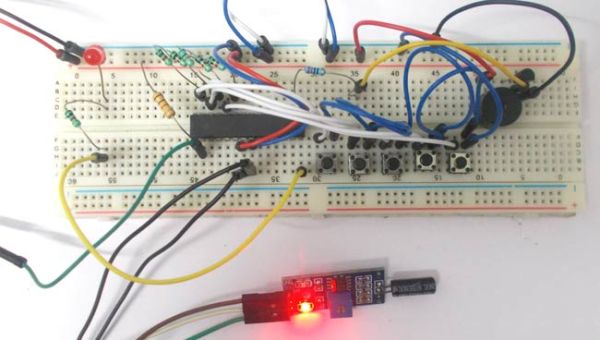
We can see there is a cylinder in the picture, in that cylinder there will be a freely moving metal ball. At the bottom of the cylinder there will be two metal contacts. So when the sensor is moved the free falling ball makes contact with conductors at bottom making a short circuit. This short circuit will be sensed by op-amp in the control circuit. As a response to the tilt the op-amp shows a high output.
We are going to give the tilt sensor signal to ATMEGA8 for appropriate response.
Components Required
Hardware: ATMEGA8 microcontroller, power supply (5v), AVR-ISP PROGRAMMER, 1000uF capacitor, LED, 220Ω resistor, LDR (Light Dependent Resistor), 10KΩ resistor, 1KΩ resistor, 2n3906 transistor, buzzer, Any motion sensor module (HC-SR501), 1KΩresistor(5 pieces), Buttons (5 pieces), 2WATT LED, TIP122 transistor.
Software: Atmel studio 6.1, progisp or flash magic.
Circuit Diagram and Explanation

As shown in circuit, there is no need to connect an external crystal here. Because the ATMEGA works on internal 1MHz, Resistor-Capacitor oscillator on default. Only when the accuracy of clock is needed, as application of high precision counting, external crystal is attaches. When the controller is first bought, it is fused to work on internal crystal by default.
The ATMEGA8 fuse bits are not touched here, as we don’t need accuracy the default 1MHZ internal clock is enough in this circuit.
Once there is vibration the sensor sends high pulse to ATMEGA8. Once high pulse is received the controller will be programmed to send a alert by turning the buzzer ON which makes noise.
After that only the authorized persons can turn off the alarm. There will be 5 keys interfaced to ATMEGA with this there will be 4999 combinations possibility. On all those combinations only one combination can turn off the alarm. This correct code will be programmed in the controller. So only the person with code can turn OFF alarm which was set during vibration.
Hence we will have a THEFT ALERT system by using ATmega8 Microcontroller.
For more detail: Anti-Theft Alert System using ATmega8 Microcontroller
- How does the tilt sensor work?
A metal ball inside a cylinder falls to touch two metal contacts at the bottom when moved, creating a short circuit sensed by an op-amp. - What happens when the sensor detects vibration?
The sensor sends a high pulse to the ATMEGA8, which programs the controller to turn the buzzer ON. - Does this circuit require an external crystal?
No, the ATMEGA8 works on its internal 1MHz Resistor-Capacitor oscillator by default without needing an external crystal. - How many keys are interfaced to the controller?
Five keys are interfaced to the ATMEGA8 to allow for code entry. - What is the total number of possible combinations?
There are 4999 combinations possible with the five keys, but only one specific code turns off the alarm. - Can anyone turn off the alarm after it triggers?
No, only authorized persons who know the correct code programmed into the controller can turn off the alarm. - What software is required for this project?
The project requires Atmel studio 6.1 along with progisp or flash magic software.
