
Summary of Electronic Voting Machine using Internal EEPROM of AVR
This article describes an Electronic Voting Machine (EVM) project using an AVR microcontroller to replace manual paper voting. The system features a control unit, ballot unit, and keypad, enabling single-vote casting per user with real-time LCD feedback. Votes are stored in the AVR's internal EEPROM, ensuring data retention without power. Results can be retrieved later via serial communication with a PC using Hyperterminal, making the process faster and eco-friendly compared to traditional methods.
Parts used in the Electronic Voting Machine:
- AVR microcontroller
- Internal EEPROM
- Control unit
- Ballet unit
- Keypad
- LCD display
- PC for serial communication
The microcontroller based voting machines made the process of voting and counting the voted lot easier than before. Previously the votes were marked in paper which are then stored safely in a box and inside a well secure room for days. The process of separating the votes and counting them manually may take a lot of days. But after finding the electronic voting machine the votes can be marked without using papers, which makes the voting process eco-friendly. Moreover it makes the counting process faster and the results can be announced in a comparatively shorter period of time.


There should be a controller inside the Electronic Voting Machine (EVM) which controls the process and there should be storage medium where the details of the vote are stored. There should be a ballet unit which is been used in such a way that the one who came to cast the vote can do only one vote. There should be a keypad also which can be used by those who wish to cast a vote. In this project the AVR microcontroller is used to demonstrate the working of a simplest voting machine which can communicate with a PC serially and which can store the count of votes in its internal memory.
This project is all about how we can make use of internal EEPROM of the AVR for storing data for future purpose. In this project we are making an Electronic Voting Machine (EVM) using the EEPROM of the AVR. As in the case of normal EVM, there is a control unit and a ballet unit. The ballet unit can be used to cast the vote only after it is enabled by pressing a key in the control unit. After casting a single vote the ballet unit will get disabled again. Each and every time a user press a key the LCD displays which candidate he voted for.

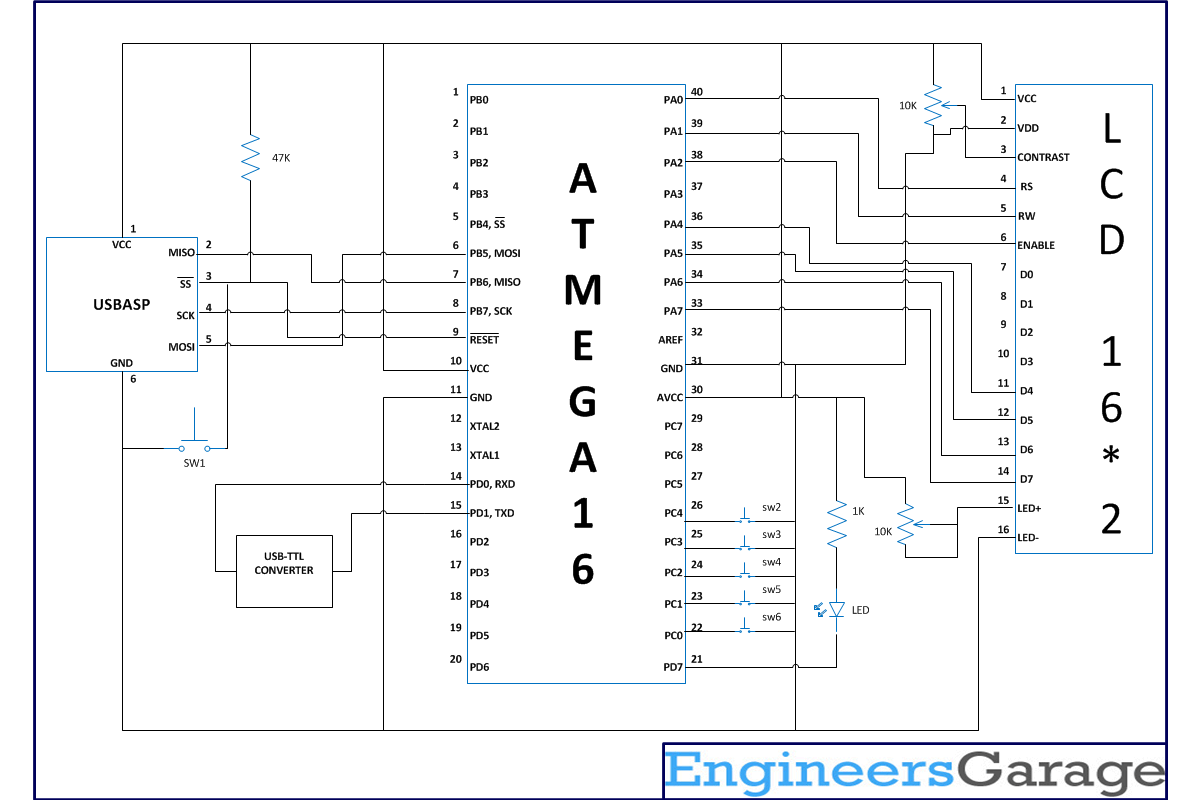
The interesting part is that each and every time a vote being casted, the count will get updated automatically in the internal EEPROM. Hence once the polling is done we can disconnect the unit from power supply and keep it safe till the day of counting. We can power up the board and even after a long period of time we can read out the number of votes casted for each candidate by connecting the EVM to the through hyperterminal.
For more detail: Electronic Voting Machine using Internal EEPROM of AVR
- How does this EVM improve upon paper-based voting?
The electronic machine makes the process eco-friendly by eliminating paper and significantly speeds up the counting process. - Can users cast multiple votes with this system?
No, the ballot unit allows a voter to cast only one vote before it gets disabled again. - What component is used to store vote data permanently?
The project uses the internal EEPROM of the AVR microcontroller to store the count of votes. - Does the data persist if the power is disconnected?
Yes, the vote counts remain stored in the EEPROM even after disconnecting the unit from the power supply. - How can the final results be read out after polling?
You can power up the board and connect the EVM to a PC through Hyperterminal to read the number of votes. - What provides visual feedback to the voter?
An LCD display shows which candidate the user voted for every time they press a key. - Is the ballot unit always active?
No, the ballot unit must be enabled by pressing a key in the control unit before a vote can be cast. - What type of microcontroller is demonstrated in this project?
The project demonstrates the working of a simplest voting machine using an AVR microcontroller.
