
Summary of Introduction to Arduino UNO (uses AVR ATmega328)
Arduino is an open-source embedded platform featuring hardware boards and software tools. This article details popular boards like Uno, Mega, and Due, highlighting their microcontrollers and specifications. It also introduces the Arduino IDE and programming language. The text specifically focuses on the Arduino Uno, describing its ATmega328P microcontroller, memory capacity, pin configuration (digital, analog, PWM), crystal frequency, and physical dimensions to help beginners get started.
Parts used in the Arduino Project:
- Arduino Uno
- ATmega328 AVR microcontroller
- Arduino IDE
- Arduino Programming Language
- 16 MHz crystal
- On-chip ADC
- Digital IO pins
- Analogue input pins
- PWM outputs
Overview
Arduino is an Open Source embedded development platform which is easy-to-use. It comprises of Hardware boards and Software tools. Examples of some of the most popular Arduino Hardware boards are ,
Arduino Uno
This board is designed around the ATmega328 AVR microcontroller. It is an 8 bit microcontroller with 32KB of flash, 2KB of SRAM, 1KB of EEPROM, timers, ADC, I2C, SPI, and UART peripherals.
Arduino Mega
This board is designed around the ATmega2560 AVR microcontroller. It is an 8 bit microcontroller with 256KB of flash, 8KB of SRAM, 4KB of EEPROM, timers, ADC, DAC, I2C, SPI, UART, and touch peripherals.
Arduino Due
This board is designed around the SAM3X8E Smart ARM (SAM) microcontroller. It has a 32 bit ARM Cortex M3 processor with 512KB of flash, 100KB of SRAM, Ethernet, CAN, USB minihost, highspeed SD/SDIO/MMC, USART, SPI, TWI, ADC, DAC, timers, temperature sensor and touch peripherals.
Arduino Software tools
Arduino IDE
This is an Integrated Development Environment which offers compilation-to-download functionality with a rich set of library functions.
Arduino Programming Language
A fancy name for a – simplified C language based programming platform with a rich set of libraries for accessing microcontroller features and third party hardware chips!
Because of simplicity, Arduino platform quickly became famous. This blog post collects all the trivial information necessary for you to get started with Arduino Uno.
Arduino Uno Pinout
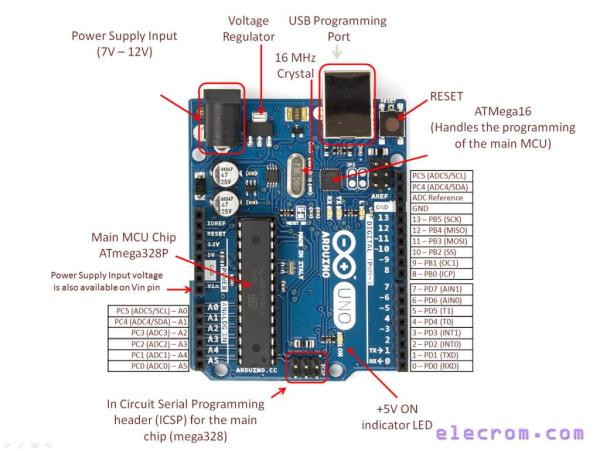
Arduino Uno is based on ATmega328P Atmel AVR family microcontroller (MCU). This MCU has 32KB of flash, 2KB of SRAM and 1 KB of EEPROM. It has 14 digital IO pins (PORTD – 8pins, PORTC – 6 pins, PORTB – 5pins), 6 Analogue input pins, which can be sampled using on-chip ADC. It also has 6 PWM outputs multiplexed on to the digital IO pins. A 16 MHz crystal is installed on the board.
Arduino Uno dimensions measure 68.6 mm X 53.4 mm.
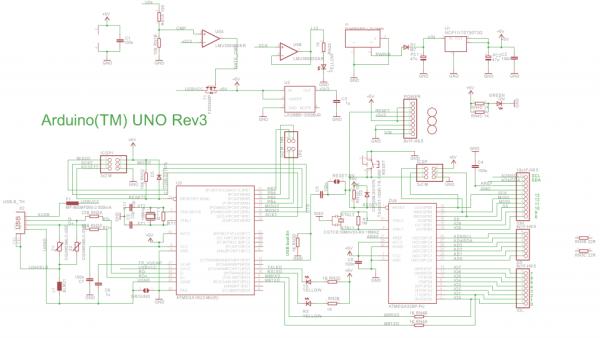
Following figure shows the Arduino Uno R3 pinout (i.e. Pin mapping from AVR pins to Arduino headers) and other hardware details of the board.
Read More: Introduction to Arduino UNO (uses AVR ATmega328)
- What is Arduino?
Arduino is an Open Source embedded development platform that comprises hardware boards and software tools. - Which microcontroller does the Arduino Uno use?
The Arduino Uno is based on the ATmega328P Atmel AVR family microcontroller. - How much flash memory does the Arduino Uno have?
The Arduino Uno has 32KB of flash memory. - Does the Arduino Uno have digital IO pins?
Yes, the Arduino Uno has 14 digital IO pins. - What is the frequency of the crystal installed on the Arduino Uno?
A 16 MHz crystal is installed on the board. - Can the Arduino Uno perform PWM output?
Yes, it has 6 PWM outputs multiplexed onto the digital IO pins. - What are the dimensions of the Arduino Uno?
The Arduino Uno measures 68.6 mm by 53.4 mm. - What type of programming language does Arduino use?
It uses a simplified C language based programming platform with a rich set of libraries.
