
Summary of LTC nano-power buck-boost DC/DC
### Summary An ideal Energy Harvesting (EH) power supply requires battery redundancy when ambient energy is unavailable and aims to extend battery life by harvesting from thermal, vibration, or solar sources. Key features include a versatile front end converting both AC and DC transducers across wide voltage ranges, an input prioritizer to select between ambient and battery power, and a synchronous buck-boost converter with low quiescent current. The system must maintain regulated output during power transitions and offer selectable output voltages with solid current capability.
Parts used in the Energy Harvesting Power Supply:
- Battery for redundancy
- AC energy transducers (piezo, magnetic)
- DC energy transducers (solar)
- Input prioritizer
- Synchronous buck-boost converter
- LTC nano-power buck-boost DC/DC chip
What are the key needs of an Energy Harvesting (EH) power supply? Well, first of all, battery redundancy power needs to be available at times when the ambient power is not available. Of course, we want to extend battery life by harvesting ambient energy from thermal, vibration, solar, etc.
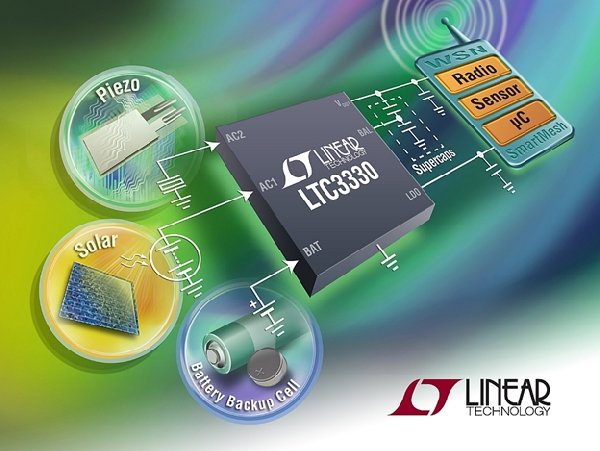
To make the front end of our power supply more versatile, it would be useful to be able to convert both AC (piezo, magnetic, etc.) or DC (solar) energy transducers with a fairly wide voltage range and also to have an input prioritizer that could decide whether to use the energy harvesting input or the battery input.
A synchronous buck-boost would make a versatile power converter, and low quiescent current is a plus. Keeping the output regulated would be important when transitioning between ambient and battery power and vice-versa. A good, solid current output capability with possibility of different selectable output voltages would top off the wish list.
For more detail: LTC nano-power buck-boost DC/DC
- Why is battery redundancy needed?
Battery redundancy ensures power is available when ambient energy sources are not present. - How can battery life be extended?
Battery life extends by harvesting ambient energy from thermal, vibration, or solar sources. - What types of transducers can the front end convert?
The front end converts both AC transducers like piezo and magnetic, as well as DC transducers like solar. - What determines whether to use ambient or battery power?
An input prioritizer decides whether to utilize the energy harvesting input or the battery input. - Why is a synchronous buck-boost converter preferred?
A synchronous buck-boost makes the power converter more versatile for various applications. - Is low quiescent current important?
Yes, low quiescent current is considered a plus for the power supply design. - What happens during transitions between power sources?
Keeping the output regulated is important when transitioning between ambient and battery power. - Can the output voltage be changed?
Yes, the system offers the possibility of different selectable output voltages.
