
Summary of Miniscope v2d
Miniscope v2d is a low-cost, dual-channel oscilloscope and arbitrary waveform generator utilizing the STM32F303CBT6 microcontroller. It features four ADCs, a 12-bit DAC with two channels, and four opamps in PGA mode. Key improvements over version 2c include software-controlled USB pull-up resistors for easier firmware switching via DFU and faster ADC sampling speeds of up to 7.2 MSPS in 8-bit mode.
Parts used in the Miniscope v2d:
- STM32F303CBT6 microcontroller
- USB device (full speed)
- 4 fast and flexible ADCs
- 12-bit DAC with two output channels
- 4 opamps that can work in PGA mode
- ROM bootloader with USB DFU option
Cheap low-speed dual channel PC/USB oscilloscope and arbitrary waveform generator with STM32F3 microcontroller.
Miniscope v2d is based on STM32F303CBT6 microcontroller – LQFP48 device from STM32F3 family featuring:
- 32 kB RAM on data bus
- 8 kB RAM on instruction bus
- 128 kB FLASH memory
- USB device (full speed)
- 4 fast and flexible ADCs
- 12-bit DAC with two output channels
- 4 opamps that can work in PGA mode
- ROM bootloader with USB DFU option available
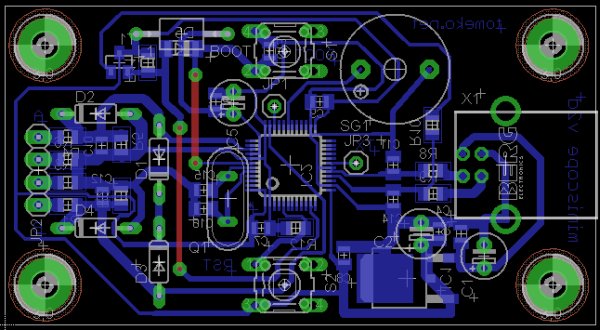
STM32F303CBT6 is pin compatible with STM32F103C8T6 used in miniscope v2c and previously designed PCB could be reused. Still few changes were made to make better use of STM32F303. USB pull-up resistor can now be controlled by software and is also disconnected when device is in reset state to allow re-enumeration without physical disconnecting and more convenient switching between bootloader and user firmware (DFU is intended to be used to upload firmware).
As a side note: it looks like DFU is not working on similar STM32F37x microcontrollers (ebrombaugh.studionebula.com).
STM32F30x ADCs are significantly faster than in STM32F1 (7.2 MSPS in 8-bit mode), but practical sampling speed is limited because of lack of input buffer. Of course PGA would help with getting optimal combination of speed/precision, sensitivity and acceptable input impedance.STM32F303CBT6 is pin compatible with STM32F103C8T6 used in miniscope v2c and previously designed PCB could be reused. Still few changes were made to make better use of STM32F303. USB pull-up resistor can now be controlled by software and is also disconnected when device is in reset state to allow re-enumeration without physical disconnecting and more convenient switching between bootloader and user firmware (DFU is intended to be used to upload firmware).
As a side note: it looks like DFU is not working on similar STM32F37x microcontrollers (ebrombaugh.studionebula.com).
STM32F30x ADCs are significantly faster than in STM32F1 (7.2 MSPS in 8-bit mode), but practical sampling speed is limited because of lack of input buffer. Of course PGA would help with getting optimal combination of speed/precision, sensitivity and acceptable input impedance.
For more detail: Miniscope v2d
- What microcontroller powers the Miniscope v2d?
The device is based on the STM32F303CBT6 microcontroller from the STM32F3 family. - How does the USB pull-up resistor function in this design?
The USB pull-up resistor can now be controlled by software and disconnects during reset to allow re-enumeration without physical disconnection. - What is the maximum sampling speed of the STM32F3x ADCs?
The practical sampling speed is limited to 7.2 MSPS in 8-bit mode due to the lack of an input buffer. - Can the PCB from Miniscope v2c be reused for v2d?
Yes, because the STM32F303CBT6 is pin compatible with the STM32F103C8T6 used in v2c, the previously designed PCB could be reused. - Does the DFU feature work on similar STM32F37x microcontrollers?
No, it appears that DFU is not working on similar STM32F37x microcontrollers. - What components help achieve an optimal combination of speed and precision?
The use of PGA (Programmable Gain Amplifier) mode with the opamps would help get the optimal combination of speed, precision, sensitivity, and acceptable input impedance. - How much FLASH memory does the STM32F303CBT6 contain?
The microcontroller features 128 kB of FLASH memory. - What is the primary purpose of the DFU option?
The DFU option is intended to be used to upload firmware to the device.
