
Summary of One wire brings power & data to LCD module
This article discusses using an 8-pin PICmicro as a dedicated controller for HD44780 LCD displays to solve I/O pin limitations in embedded systems. It compares 8-bit and 4-bit interface modes, noting that the 4-bit mode is suitable for 8-pin microcontrollers despite one input-only pin. The proposed solution involves treating the LCD module with its own PICmicro as an intelligent display to save costs and simplify development compared to upgrading the main microcontroller.
Parts used in Intelligent Display Project:
- HD44780-type LCD display
- 8-pin PICmicro
- Main embedded system microcontroller
- Data lines (D0..D7 or D4..D7)
- Control lines (EN, RS)
- Power supply pins (Vdd, Vss)
- Contrast pin (Vre)
Embedded systems frequently use HD44780-type LCD displays as it is considered the most popular alphanumeric display controller. The interface comprises at least 14 pins: eight for data, three for control (EN, WR, RS), two for power supply (Vdd, Vss), and one for contrast (Vre). Configured in 8-bit mode, it requires at least 10 I/O lines (D0..D7, EN, RS). Configured in 4-bit mode, it requires at least six I/O lines (D4..D7, EN, RS). This last case seems usable when using an 8-pin PICmicro. However, 8-pin PICmicros have one pin as an input-only pin.
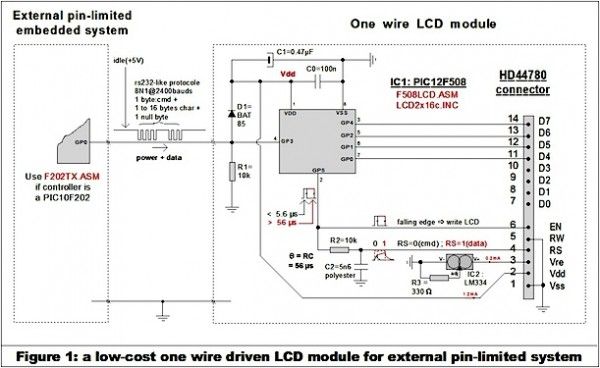
Many solutions for expanding I/O pins have been described in EDN Design Ideas (references 1 to 3). In a pin-limited external embedded system, if an additionnal LCD display becomes necessary, instead of changing the microcontroller with more I/O lines, it is often better (in terms of cost, and to make development easier and faster) to use this LCD module with a dedicated 8-pin PICmicro and consider it as an intelligent display.
For more detail: One wire brings power & data to LCD module
-
Why use an 8-pin PICmicro for an additional LCD?
It is often better for cost and faster development than changing the main microcontroller to one with more I/O lines. -
How many I/O lines does an HD44780 need in 8-bit mode?
It requires at least ten I/O lines including data lines D0 through D7, EN, and RS. -
How many I/O lines are required in 4-bit mode?
It requires at least six I/O lines consisting of D4 through D7, EN, and RS. -
What is the limitation of 8-pin PICmicros mentioned?
One pin on an 8-pin PICmicro functions as an input-only pin. -
What is the benefit of using the LCD module as an intelligent display?
This approach saves cost and makes development easier and faster when an additional display is needed. -
What components make up the HD44780 interface?
The interface includes eight data pins, three control pins, two power supply pins, and one contrast pin.
