
Summary of Quectel L16 – a more exact localization with a double amount of satellites
The Quectel L16 module enhances positioning accuracy by supporting both GPS and GLONASS, effectively doubling the available satellite count. This dual-system capability ensures superior performance in challenging urban environments. Built on STMicroelectronics' Teseo II engine, it represents an early adoption of multi-constellation technology for improved reliability and precision.
Parts used in the Quectel L16 Module:
- Quectel L16 module
- Teseo II engine from STMicroelectronics
- GPS system support
- Russian GLONASS system support
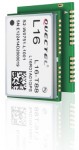
L16 module supports system GPS, but also the Russian GLONASS, thus enabling to use almost a double amount of satellites for a better accuracy and higher accuracy even in urban conditions. Quectel L16 based on Teseo II engine from STMicroelectronics, belongs to first modules supporting both navigation systems
Continued here:
Quectel L16 – a more exact localization with a double amount of satellites
- What navigation systems does the L16 module support?
The L16 module supports both the system GPS and the Russian GLONASS. - How many satellites can the L16 use compared to single-system modules?
It enables the use of almost a double amount of satellites for better accuracy. - Does the L16 perform well in urban conditions?
Yes, it provides higher accuracy even in urban conditions due to dual-system support. - What engine powers the Quectel L16 module?
The module is based on the Teseo II engine from STMicroelectronics. - Is the L16 one of the first modules to support both systems?
Yes, it belongs to the first modules supporting both GPS and GLONASS. - Can the L16 improve localization precision?
Yes, it offers more exact localization by utilizing a doubled satellite pool. - Why is using two satellite systems beneficial?
Using two systems allows for almost double the satellites, enhancing accuracy.
