
Summary of SMPS with Battery Backup and NiMH Charger
This article describes a high-efficiency SMPS circuit using the LM2595 buck regulator, accepting 8–45V AC input to deliver up to 1A at 5V. It highlights significant heat reduction compared to linear supplies and details components for rectification, filtering, delay-startup, and multiple output terminals including raw AC conversion.
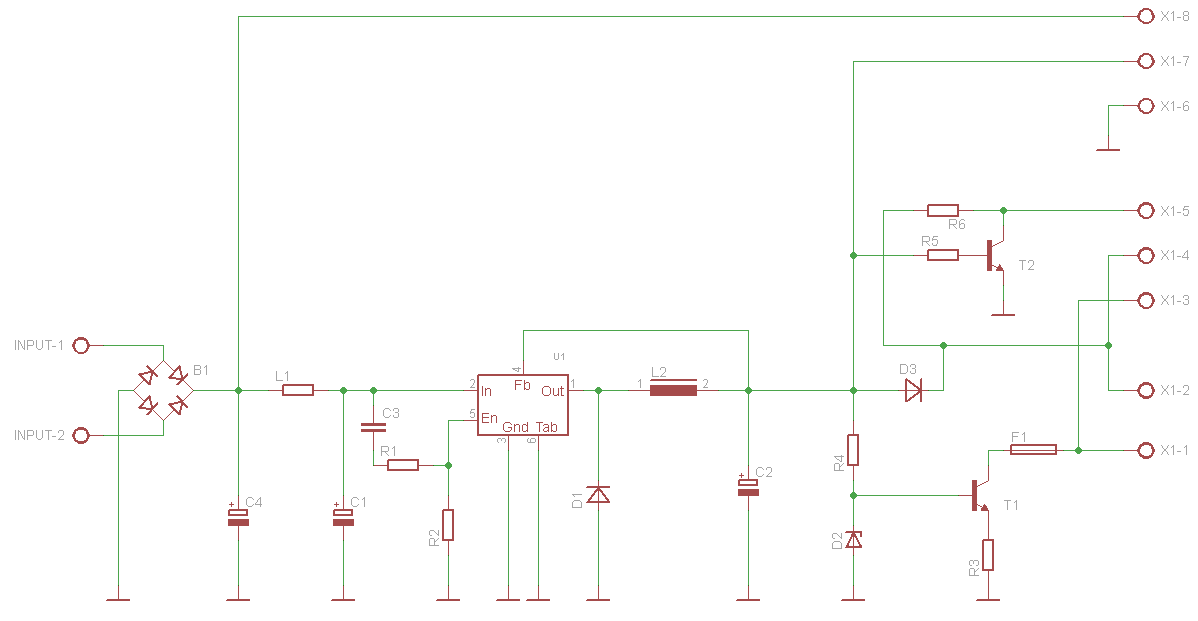
Parts used in the LM2595 SMPS Circuit:
- LM2595 buck regulator
- B1 bridge rectifier
- C4, L1, C1 (U LC filter)
- R1-R2 voltage divider
- C3 charge capacitor
- D1 catch diode
- L2 inductor
- C2 filtering capacitor
- X1-6 ground terminal
- X1-7 5V output terminal
- X1-8 raw AC output terminal
I designed this circuit for the same reason that i designed the SMPS Boost regulator with the MCP1640 – To gain experience in SMPS technology. This time i use the high power LM2595 buck regulator.The circuit accepts any AC voltage from 8 to 45 Volts.
This wide input voltage range is a remarkable feature! Plus, it can provide up to 1 ampere of current at 5 volts! Imagine what wold take to design a linear power supply to provide 5V 1A power from 45 volts! A huge power dissipation of 40 Watts! Your soldering iron provides probably less heat! The LM2595 has an efficiency which varies from 75% to 95%. Typically, the previously descried system has an efficiency of 80%, which means that the system will dissipate about 1 Watt of heat…
The AC input is rectified through the B1 bridge rectifier. A U LC filter decouples the circuit from the input (C4,L1,C1) and smooths the input voltage. The R1-R2 voltage divider along with the charge capacitor C3 perform a delay-startup. This part may be omitted if the delay-startup is not necessary. The heart of the circuit is the LM2595 with the catch diode D1, the inductor L2 and the filtering capacitor C2. This is where the step-down is done.
I’ve included several outputs. X1-6,7 and 8 are the PSU outputs. X1-6 is the ground terminal. X1-8 provides a rectified and filtered output of the raw AC input. Remember to calculate the RMS to peak conversion. If for example the AC input is 24VAC, the output at this terminal will be 34 Volts DC. The output X1-7 provides 5V to power any external circuit needed.
For more detail: SMPS with Battery Backup and NiMH Charger
- What is the primary purpose of this circuit design?
The designer created it to gain experience in SMPS technology. - Can this circuit accept a wide range of AC voltages?
Yes, it accepts any AC voltage from 8 to 45 Volts. - How much current can this power supply provide at 5 volts?
It can provide up to 1 ampere of current at 5 volts. - What is the typical efficiency of this system?
The system typically has an efficiency of 80%. - How does the heat dissipation compare to a linear power supply?
This system dissipates about 1 Watt of heat versus 40 Watts for a linear supply. - What component performs the step-down function in the circuit?
The heart of the circuit with the LM2595, D1, L2, and C2 performs the step-down. - What is the DC output voltage if the AC input is 24VAC?
The output at the X1-8 terminal will be 34 Volts DC. - Which terminal provides 5V to power external circuits?
The X1-7 output provides 5V to power any external circuit needed. - What happens if the delay-startup part is omitted?
The delay-startup feature may be omitted if it is not necessary.
