
Summary of Token number display system using microcontroller
This project implements a digital token display system for banks and public counters using an ATmega8 microcontroller and ULN2003 driver. It displays three-digit numbers to manage queues efficiently, allowing customers to wait until their number appears. The system is simple to install and operate, requiring only a push switch to advance the display when a counter is ready.
Parts used in the Token Number Display Project:
- Atmega 8 Microcontroller
- LM7805 Voltage Regulator
- 1000uf/16V Capacitor
- LEDs
- BC558 Transistor
- 100 Ohm Resistors
- 10K Ohm Resistors
- Tactile Switches
Bank token number display project is build using ATmega8 Microcontroller and ULN2003 for driving large LED display, PCB layout, Circuit diagram are self explanatory. It is capable to display three digits, its simple project using microcontroller.
Token issue systems are ideal for banks, airports, public dealing offices, hospitals,doctor’s clinics, restaurants and other such places where people have to wait in line for their turn. These systems allow customers to wait without having to stand in line, oncetheir number is displayed then only will they have to get in line for their turn. No need tomake your customers stand in long queues in sunlight or rain and wasting time. Justdistribute tokens on first come first serve basis and as soon as any counter is ready to provide services the person there just has to press one push switch to show the tokennumber in displays. All models are easy to install, operate & maintain. Any ordinaryelectrician can do the installation quickly.“A digital token is issued by cashier in bank to display the token number (etched on thetokens) which is issued to the customers against cheques for facilitating cash withdrawnfrom the bank. The cashier operates the display to show the token number against whichhe is ready to make the payment. The customer having the displayed token number canreport to the cashier’s counter to receive the payment. In this way payment is madesystematically to all desire customers without letting chaos to be created at the paymentwindow. In this way the device serve the purpose of improving the performance of the banking system.
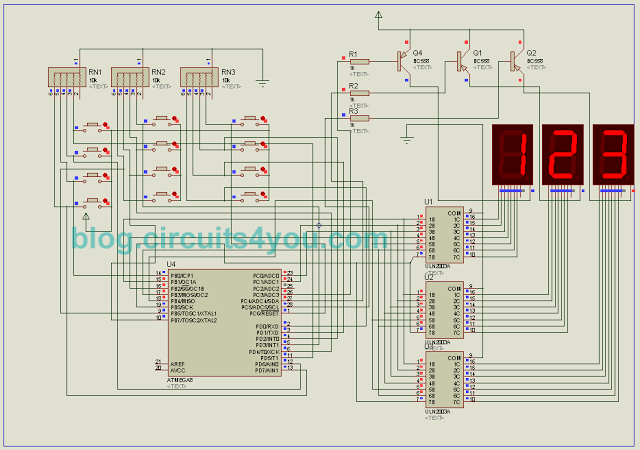
Step 1: Components Required
1. Atmega 8 Microcontroller
2. LM7805
3. 1000uf/16V Capacitor
4. LEDs
5. BC558
6. 100,10K Ohm Resistors
7. Tectile Switches
Step 2: Circuit Design and PCB Manufacturing
Download Requires Files
1. Try Simulation Click Here to Download Proteus Simulation File
2. Download pdf PCB Layout For more Detail: Token number display system using microcontroller
1. Atmega 8 Microcontroller
2. LM7805
3. 1000uf/16V Capacitor
4. LEDs
5. BC558
6. 100,10K Ohm Resistors
7. Tectile Switches
Step 2: Circuit Design and PCB Manufacturing
Download Requires Files
1. Try Simulation Click Here to Download Proteus Simulation File
2. Download pdf PCB Layout
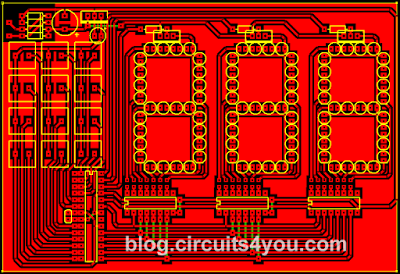 For more Detail: Token number display system using microcontroller
 - What components are required for this project?
The project requires an Atmega 8 Microcontroller, LM7805, 1000uf/16V Capacitor, LEDs, BC558, 100 and 10K Ohm Resistors, and Tactile Switches. - How many digits can the display show?
The system is capable of displaying three digits. - Which microcontroller is used in this design?
An ATmega8 Microcontroller is used to drive the large LED display. - Can an ordinary electrician install this device?
Yes, any ordinary electrician can do the installation quickly as all models are easy to install, operate, and maintain. - How does the cashier operate the display?
The cashier presses one push switch to show the token number in the displays when the counter is ready. - What is the primary purpose of this system?
The device serves to improve banking performance by systematically managing payments without creating chaos at the payment window. - Where else besides banks can this system be used?
It is ideal for airports, public dealing offices, hospitals, doctors clinics, restaurants, and other places with waiting lines. - What file formats are available for simulation and PCB layout?
A Proteus Simulation File and a PDF PCB Layout are available for download.
