
Summary of AM radio transmission using AVR using Atmega324 microcontroller
This article describes an AM radio transmitter project using an Atmega324 microcontroller running at 8 MHz. It generates a 540 KHz carrier signal via the TC1 timer and modulates it by varying the PWM duty cycle between 5% and 50% using TC0. An RLC resonant circuit converts the square waves into sine waves for transmission, utilizing a plant as the antenna.
Parts used in the AM radio transmission using AVR:
- Atmega324 microcontroller
- TC1 timer/counter
- TC0 timer/counter
- RLC resonant circuit
- Plant (used as antenna)
When you think about building a radio transmitter circuit, the first thing that comes in mind is it requires too many analog components. But wait a minute, this guy demonstrates an AM transmission using a microcontroller. The interesting part is it uses a plant as an antenna for transmission. This project is based on Atmega324 microcontroller, internally clocked at 8 MHz, and it generates a modulated AM signal using internal timers and counters. It uses TC1 timer/counter to generate a PWM signal of approximately 540 KHz. This is the carrier frequency. You know that before AM transmission, the high frequency carrier signal is modulated with a low frequency message signal. In this case, the carrier frequency is modulated by varying the duty cycle of the output PWM from 5% to 50% using TC0 timer/counter.
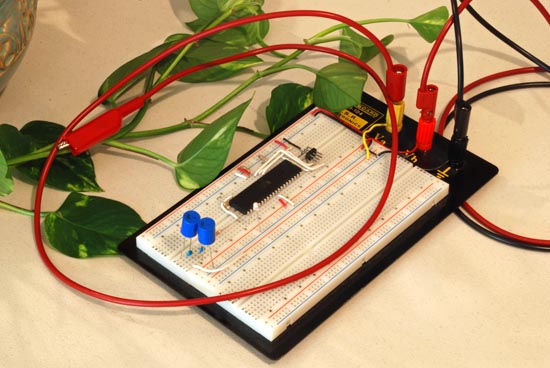
The modulated output from the microcontroller has square waves. A simple RLC resonant circuit can suppress the higher frequency components and change the square waves into sine waves. Now it is ready for transmission. The author tested it with a plant as an antenna, and worked well. Visit the link below to see more details about the project.
For more detail: AM radio transmission using AVR using Atmega324 microcontroller
- What microcontroller is used in this project?
The project is based on the Atmega324 microcontroller. - How is the carrier frequency generated?
It uses the TC1 timer/counter to generate a PWM signal of approximately 540 KHz. - Can a plant be used as an antenna?
Yes, the author tested the circuit with a plant as an antenna and it worked well. - How is the AM signal modulated?
The carrier is modulated by varying the duty cycle of the output PWM from 5% to 50% using the TC0 timer/counter. - Why is an RLC circuit needed?
A simple RLC resonant circuit suppresses higher frequency components to change square waves into sine waves. - What is the internal clock speed of the microcontroller?
The Atmega324 is internally clocked at 8 MHz. - Does this project require many analog components?
No, the demonstration shows that AM transmission can be achieved using a microcontroller instead of too many analog components. - What type of signal does the microcontroller initially produce?
The modulated output from the microcontroller consists of square waves.
