
Summary of Atmel ATmega Video generator with SDRAM
This project utilizes an ATmega8515 microcontroller to generate VGA video signals at 512x480 resolution with 256 colors. It employs an 8MB SDRAM from a 168-pin DIMM in burst mode, allowing the MCU to render graphics while the memory feeds data. The system supports text and BMP image display, offering high throughput with low CPU load compared to SRAM or DRAM solutions.
Parts used in the ATmega Video Generator:
- ATmega8515 microcontroller
- 8MB SDRAM (168-pin DIMM)
- RAM DAC
- 18.432MHz clock
- Delay line (or series of gates)
This projects uses 8MByte SDRAM from a 168 pin DIMM SDRAM and generates videosignal for a VGA monitor with a resolution of 512×480 pixels with 256 colors at 60Hz using mega8515.
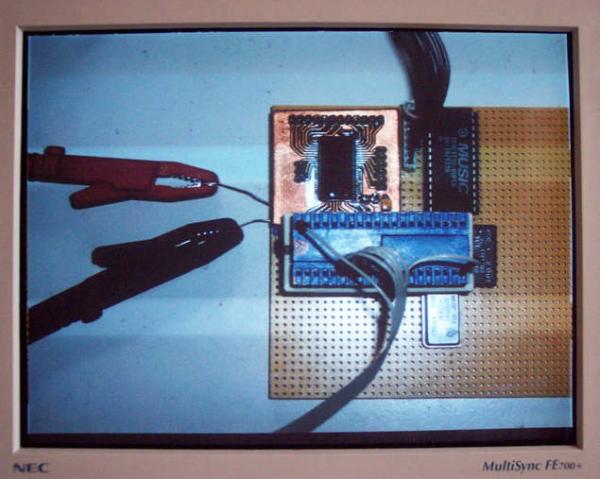
The project uses burst mode of SDRAM, which can feed up to 512 bytes without MCU help. This means that MCU can do anything (i.e. generate another graphics) during that time. 8MB SDRAM can be used to store up to 32 frames, so you can display one frames while generating another one.
So far this project works but is not yet complete.
The text demo application shows a text stored in flash memory. Graphics demo receives a BMP image large 512×512 pixels with 256 colors.
The data throughput of SDRAM is as fast as the AVR clock, and the CPU load is much lower than if DRAM or SRAM is used.
Here is a test image in the graphics mode. This picture shows the construction of the circuit: Besides the mega8515, SDRAM, the RAM DAC, a 18432MHz clock and a delay line (or just several gates in series) requires no additional components.
Text mode (rendered in graphics).
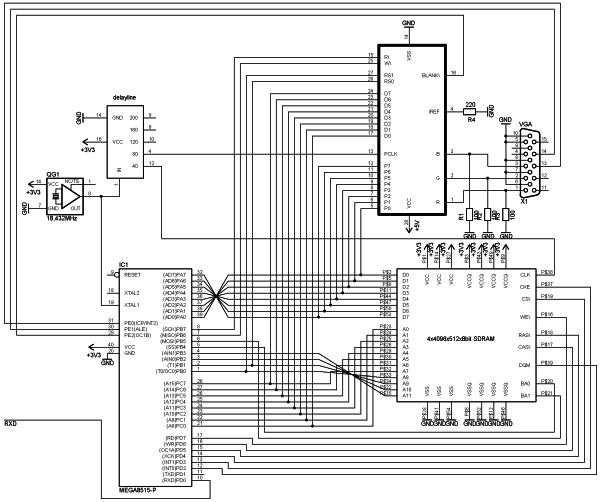
Read More: Atmel ATmega Video generator with SDRAM
- What resolution does the VGA monitor support?
The project generates a signal for a resolution of 512x480 pixels. - How many colors can be displayed on the screen?
The system displays up to 256 colors. - Can the MCU perform other tasks during video generation?
Yes, the burst mode allows the MCU to generate other graphics while the SDRAM feeds data without help. - How many frames can the 8MB SDRAM store?
The memory can store up to 32 frames simultaneously. - What is the clock frequency required for this circuit?
The circuit requires an 18.432MHz clock. - Does this project require additional components besides the listed parts?
No, it requires no additional components beyond the microcontroller, SDRAM, RAM DAC, clock, and delay line. - What types of images can the graphics demo receive?
The graphics demo receives a BMP image that is 512x512 pixels with 256 colors. - Is the data throughput of the SDRAM dependent on the AVR clock speed?
Yes, the data throughput is as fast as the AVR clock.
