
Summary of Controlling RGB LED colour using Atmega16
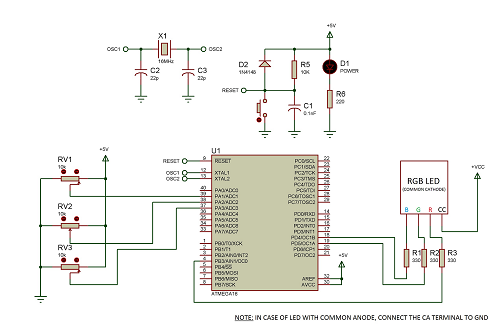
This article introduces RGB LED color theory, explaining that red, green, and blue are primary light colors mixed to create others. It details how objects reflect specific wavelengths while absorbing others and outlines the four-pin structure of RGB LEDs (three for colors, one common). The tutorial focuses on controlling these LEDs using an ATMega16 microcontroller to generate various hues through proportional mixing.
Parts used in the Controlling RGB LED colour using Atmega16:
- RGB LED
- ATMega16 microcontroller
This tutorial will give you a brief introduction to the concept of colors and how different colors can be produced using RGB LED. The color would be controlled using an ATMega16 microcontroller.
RGB LEDs are basically the combination of the 3 LEDs (Red, Green and Blue) fused into a single package. It consists of four pins totally out of which three of them for the three different colors. The 4th pin is common for all three colors and it’s either Cathode or Anode.

Concept of Color
Color is the visual perceptual property corresponding in humans to the categories called red, blue, yellow, green and others. (Wikipedia definition)
We know that white light (say coming from the Sun) consist of mixture of colors. Remember the prism experiment you head of when you were in school?
So the primary colors of light are Red, Blue and Green. All other colors we see are formed by mixing of these three colors in different proportions.
When we see an object, we are not seeing the object but actually we are seeing the light reflected by the object. Confusing isn’t it?
Let’s say that you are looking at a red car. Now the car appears red to you because it absorbs the green and blue part of the light incident on it and only allows the red part of the light to reflect.
So if you see a red colored car through a green filter (which allows only green light to pass through it), then it will appear in black color (since no light would reach your eyes)
And the conclusion is that
For more detail: Controlling RGB LED colour using Atmega16
- How is white light formed?
White light consists of a mixture of colors, specifically the primary colors of light which are Red, Blue, and Green. - What are the primary colors of light?
The primary colors of light are Red, Blue, and Green. - Why does a red car appear red?
A red car appears red because it absorbs green and blue light and reflects only the red part of the incident light. - How many pins does an RGB LED have?
An RGB LED consists of four pins totally. - What is the function of the fourth pin in an RGB LED?
The 4th pin is common for all three colors and is either Cathode or Anode. - What happens if you view a red car through a green filter?
If you see a red colored car through a green filter, it will appear black since no light reaches your eyes. - Which component controls the color of the RGB LED in this project?
The color is controlled using an ATMega16 microcontroller. - How are other colors produced using RGB LEDs?
All other colors are formed by mixing the three primary colors in different proportions.
