
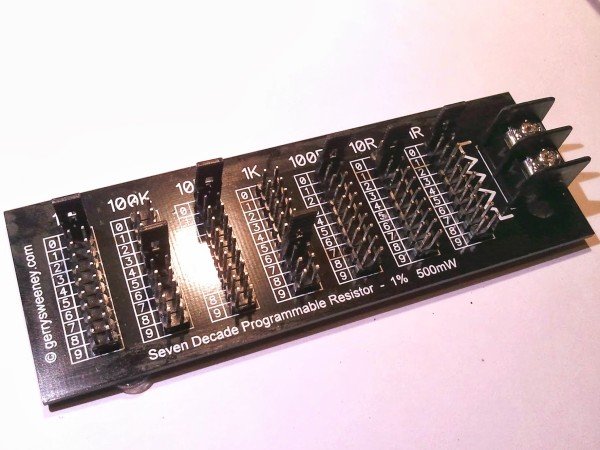
Summary of Decade resistor box with jumpers
### Summary The author, frustrated by the waste of cheap resistors during prototyping and the bulkiness of existing programmable boxes, designed a simple, cost-effective decade resistor box. Unlike high-precision manual units, this new design is optimized for breadboard use and machine manufacturing to ensure reasonable volume production and availability for others who need organized resistance values without high costs or size constraints.
Parts used in the Decade Resistor Box:
- Resistors
- Jumpers
- Circuit board (implied by "machine manufactured" project)
I have spent a lot of time over the years prototyping electronic circuits and the amount of resistors that have ended up in the trash because they are so cheap you don’t bother to keep them tidy or organised once you take them out of their organised storage – you know the story. One potential solution to this is a programmable resistance box but the problem with these things are they are bulky and expensive and do not lend themselves well to breadboard prototyping.
The cost of construction means they are typically the reserve of high-precision resistance boxes. I have a CROPICO RBB6E resistance box in my lab which I open up to have a look inside, its really well made, mostly by hand too, far too nice to abuse in prototyping….
I looked around at what is available but did not find a solution that met my own requirements so I decided to design something simple myself. I also wanted to make a simple project to get manufactured by machine which apart from other things requires reasonable volume, and I thought this project would be useful enough to others that I should get some made and make them available.
For more detail: Decade resistor box with jumpers
- Why did the author decide to design their own resistance box?
The author could not find an existing solution that met their requirements for simplicity, cost, and suitability for breadboard prototyping. - What problem does the author identify with traditional resistors?
Resistors are so cheap that users often do not bother to keep them tidy after removing them from storage, leading to significant waste. - Why are programmable resistance boxes generally unsuitable for this project?
They are typically bulky, expensive, and do not lend themselves well to breadboard prototyping. - What is the CROPICO RBB6E described as in the article?
It is described as a well-made, mostly hand-built high-precision resistance box that is too nice to abuse in prototyping. - What was the goal regarding the manufacturing of this project?
The goal was to make the project suitable for machine manufacturing which requires reasonable volume to be viable. - Who is the intended audience for this project?
The project is intended for others who need a useful tool for prototyping that is more accessible than high-precision boxes.
