
Summary of ENCLUSTRA UNVEILS MERCURY+ XU6 BASED ON XILINX’S ZYNQ ULTRASCALE+ MPSOC
Enclustra launched the Mercury+ XU6 System on Module, featuring an Xilinx Zynq UltraScale+ MPSoC for Linux execution. This compact 65x54mm module integrates ARM Cortex-A53 and R5 processors, a Mali-400MP2 GPU, up to 8GB DDR4 ECC SDRAM, and substantial flash storage. It supports diverse interfaces including PCIe Gen3/Gen2, USB 3.0, and Gigabit Ethernet, operating within a 5–15V power range. The module is designed to be paired with compatible carrier boards like the Mercury+ PE1 for custom hardware development.
Parts used in the Mercury+ XU6 Project:
- Xilinx Zynq UltraScale+ MPSoC
- ARM dual-/quad-core Cortex-A53 processor
- ARM dual-core Cortex-R5 processor
- Mali-400MP2 GPU
- 8 GB DDR4 ECC SDRAM
- 16 GB eMMC flash
- 64 MB QSPI flash
- PCIe Gen3 x4 interface
- PCIe Gen2 x4 interface
- USB 3.0 interfaces
- Gigabit Ethernet interface
- Mercury+ PE1 baseboard
Enclustra recently introduced two modules, Andromeda XZU90 SoM and Mercury+ XU6, capable of running Linux. Today’s focus will be on the Mercury+ XU6 that is built around the Xilinx Zynq UltraScale+ MPSoC that is an ultra-compact package with integrated H.264 / H.265 video codec. The hardware Mercury+ XU6 system on module comes into the light with only measuring 65 x 54mm supporting UltraScale+ models with up to 256K logic cells.
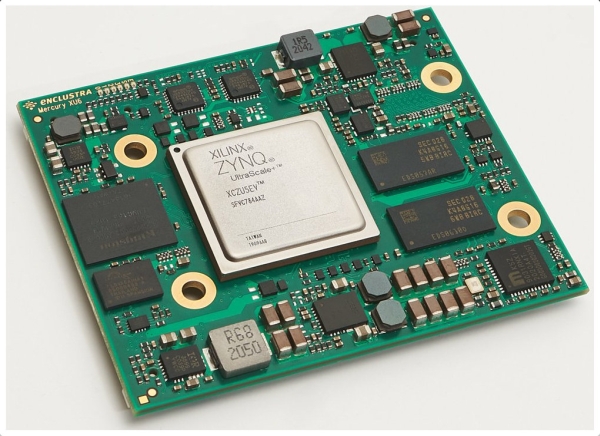
As mentioned earlier, the Mercury+ XU6 system on module is powered by the Xilinx Zynq Ultrascale+ MPSoC that features ARM dual-/quad-core Cortex-A53 clocked up to 1333 MHz and ARM dual-core Cortex-R5 running at a clock speed of 533 MHz. The system on module is integrated with up to 8GB DDR4 ECC SDRAM, 16GB eMMC flash, and 64MB QSPI flash storage.
Features Of Mercury+ XU6 System On Module:
- CPU: Xilinx’s Zynq Ultrascale+ MPSoC with ARM dual-/quad-core Cortex-A53 (64 bit, up to 1333 MHz) ARM dual-core Cortex-R5 (32 bit, up to 533 MHz)
- GPU: Mali-400MP2
- RAM: 8 GB DDR4 ECC SDRAM
- Flash memory: 16 GB eMMC flash, 64 MB QSPI flash
- Interfaces: PCIe Gen3 x4, PCIe Gen2 x4, 2x USB 3.0 and Gigabit Ethernet interfaces
- Dimension: 65 × 54 mm
- Power supply: 5–15 V supply
When we talk about any system on module, it requires a carrier board where it can be plugged or soldered. The manufacturer comes with two baseboards that support Mercury+ modules. The first Mercury+ PE1 has IO interfaces for almost every application and has three variants for building custom FPGA and SoC-based hardware.
Read more: ENCLUSTRA UNVEILS MERCURY+ XU6 BASED ON XILINX’S ZYNQ ULTRASCALE+ MPSOC
- What processor powers the Mercury+ XU6?
The module is powered by the Xilinx Zynq UltraScale+ MPSoC featuring ARM dual-/quad-core Cortex-A53 and ARM dual-core Cortex-R5 processors. - How much RAM does the Mercury+ XU6 support?
The system on module is integrated with up to 8GB DDR4 ECC SDRAM. - Can the Mercury+ XU6 run Linux?
Yes, the Mercury+ XU6 is capable of running Linux. - What are the dimensions of the Mercury+ XU6 module?
The hardware system on module measures 65 x 54 mm. - Does the Mercury+ XU6 include video codec capabilities?
Yes, it features an ultra-compact package with an integrated H.264 / H.265 video codec. - What interfaces are available on the Mercury+ XU6?
It includes PCIe Gen3 x4, PCIe Gen2 x4, 2x USB 3.0, and Gigabit Ethernet interfaces. - What is the required power supply voltage?
The module requires a 5–15 V supply. - Which baseboard supports the Mercury+ modules?
The manufacturer offers the Mercury+ PE1 baseboard which has IO interfaces for almost every application.
