
Summary of How Television Works
### Summary This article explains how human vision enables television technology through two brain functions: fusing small colored dots into images and integrating rapid still frames into motion. It details the role of pixels in creating clear visuals from a distance and the necessity of at least 15 frames per second for smooth movement. The text also describes the mechanics of cathode ray tubes (CRTs), where heated filaments emit electron beams that strike phosphor-coated screens to produce light, while briefly mentioning LCDs, plasma displays, and light bulb arrays as alternative display methods.
Parts used in Television Technology:
- Cathode Ray Tube (CRT)
- Anode
- Cathode
- Heated filament
- Vacuum
- Electrons
- Focusing anode
- Accelerating anode
- Phosphor coating
- LCDs
- Plasma displays
- 60-watt light bulbs
TV Pixels and Your Brain
Let’s start at the beginning with a quick note about your brain. There are two amazing things about your brain that make television possible. By understanding these two facts, you gain a good bit of insight into why televisions are designed the way they are.
The first principle is this: If you divide a still image into a collection of small colored dots, your brain will reassemble the dots into a meaningful image. This is no small feat, as any researcher who has tried to program a computer to understand images will tell you. The only way we can see that this is actually happening is to blow the dots up so big that our brains can no longer assemble them, like this:
Most people, sitting right up close to their computer screens, cannot tell what this is a picture of — the dots are too big for your brain to handle. If you stand 10 to 15 feet away from your monitor, however, your brain will be able to assemble the dots in the image and you will clearly see that it is the baby’s face. By standing at a distance, the dots become small enough for your brain to integrate them into a recognizable image.
Both televisions and computer screens (as well as newspaper and magazine photos) rely on this fusion-of-small-colored-dots capability in the human brain to chop pictures up into thousands of individual elements. On a TV or computer screen, the dots are called pixels. The resolution of your computer’s screen might be 800×600 pixels, or maybe 1024×768 pixels.
TV Motion and Your Brain
The human brain’s second amazing feature relating to television is this: If you divide a moving scene into a sequence of still pictures and show the still images in rapid succession, the brain will reassemble the still images into a single, moving scene. Take, for example, these four frames from the example video:
Each one of these images is slightly different from the next. If you look carefully at the baby’s left foot (the foot that is visible), you will see that it is rising in these four frames. The toy also moves forward very slightly. By putting together 15 or more subtly different frames per second, the brain integrates them into a moving scene. Fifteen per second is about the minimum possible — any fewer than that and it looks jerky.
When you download and watch the MPEG file offered at the beginning of this section, you see both of these processes at work simultaneously. Your brain is fusing the dots of each image together to form still images and then fusing the separate still images together into a moving scene. Without these two capabilities, TV as we know it would not be possible.
The Cathode Ray Tube
A few TVs in use today rely on a device known as the cathode ray tube, or CRT, to display their images. LCDs and plasma displays are other common technologies. It is even possible to make a television screen out of thousands of ordinary 60-watt light bulbs! You may have seen something like this at an outdoor event like a football game. Let’s start with the CRT, however.
The terms anode and cathode are used in electronics as synonyms for positive and negative terminals. For example, you could refer to the positive terminal of a battery as the anode and the negative terminal as the cathode.
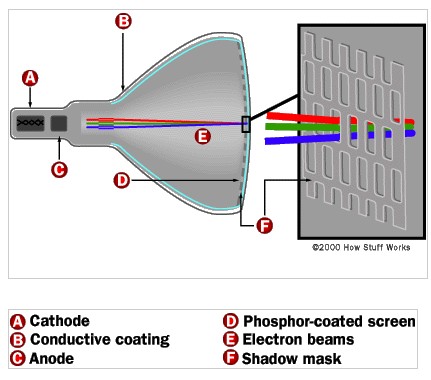
In a cathode ray tube, the “cathode” is a heated filament (not unlike the filament in a normal light bulb). The heated filament is in a vacuum created inside a glass “tube.” The “ray” is a stream of electrons that naturally pour off a heated cathode into the vacuum.
Electrons are negative. The anode is positive, so it attracts the electrons pouring off the cathode. In a TV’s cathode ray tube, the stream of electrons is focused by a focusing anode into a tight beam and then accelerated by an accelerating anode. This tight, high-speed beam of electrons flies through the vacuum in the tube and hits the flat screen at the other end of the tube. This screen is coated with phosphor, which glows when struck by the beam.
For more Detail: How Television Works
- How does the brain reassemble small colored dots?
The brain reassembles small colored dots into a meaningful image when they are small enough to be integrated, which typically happens when viewing from a distance of 10 to 15 feet. - What is the minimum number of frames per second needed for moving scenes?
Fifteen frames per second is about the minimum possible; fewer than that results in a jerky appearance. - What are the synonyms for positive and negative terminals in electronics?
In electronics, anode and cathode are used as synonyms for positive and negative terminals respectively. - What creates the vacuum inside a cathode ray tube?
The vacuum is created inside a glass tube that contains the heated filament acting as the cathode. - What causes the screen to glow in a CRT?
The screen glows because it is coated with phosphor which lights up when struck by a high-speed beam of electrons. - Can televisions be made using ordinary light bulbs?
Yes, it is possible to make a television screen out of thousands of ordinary 60-watt light bulbs. - What other technologies exist besides cathode ray tubes?
LCDs and plasma displays are other common technologies used to display images in modern televisions. - Why can't computers easily understand images like humans do?
Programming a computer to understand images is difficult because it requires replicating the brain's ability to fuse dots and frames, which researchers find challenging.
