
Summary of I2C EEPROM Programmer With AT2313 microcontroller
This project is an EEPROM programmer for I²C 24C series devices (tested with 24C32) that reads, writes, and erases via a PC serial (RS232) terminal. It uses an AT2313 microcontroller with a software I2C implementation and a MAX232 line driver. Powered by 5 VDC, it programs one 16-byte page at a time through a DIP8 socket without special PC software—just a terminal program like HyperTerminal. The 24C32 provides 4096 bytes (256 pages).
Parts used in the I2C EEPROM Programmer With AT2313 microcontroller:
- AT2313 microcontroller
- MAX232 RS232 line driver
- DIP8 socket for target EEPROM
- I2C EEPROM (24C32 tested)
- 5 VDC power supply
- RS232 serial port connector (DB9 or equivalent)
- Supporting passive components (resistors, capacitors) for microcontroller and MAX232
- PCB or protoboard and wiring
Description
This EEPROM programmer reads, writes and erases I²C 24C EEPROM devices. It has a PC serial port interface. The programmer needs 5VDC power supply. It can read or write one page (16 bytes) at a time by programming the page with a terminal program such as hyperterminal, no external software is needed to read or write to the EEPROM. At the moment only the 24C32 is tested with the programmer but it might work also with other I2C EEPROM devices. The 24C32 has 4096 bytes, that are 256 pages.
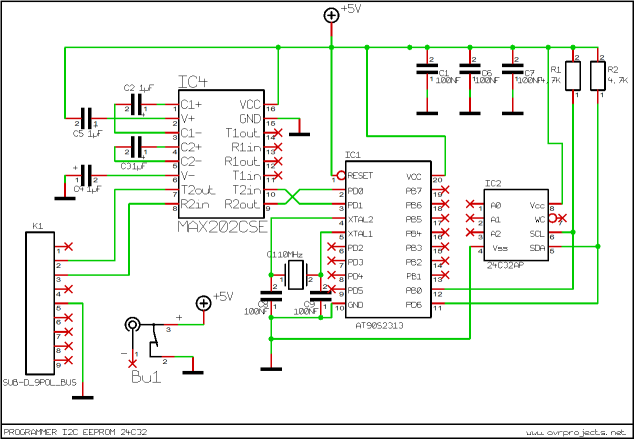
The programmer contains the AT2313 microcontroller which connects to the RS232 serial port of the PC through the MAX232 line driver. The microcontroller has software configured I2C bus which is connected to the I2C EEPROM device. The software inside the AT2313 receives commands and data from the terminal program through the RS232 port. The software translates the commands and data into serial datastreams for the I2C bus and sends it to the EEPROM. The commands contain read or write instruction for the I2C EEPROM. The target device is placed in a DIP8 socket.
The software for the microcontroller is made with the BASCOM AVR compiler. You can find more information how to interface a I2C EEPROM to a microcontroller at:
Interfacing I2C EEPROM
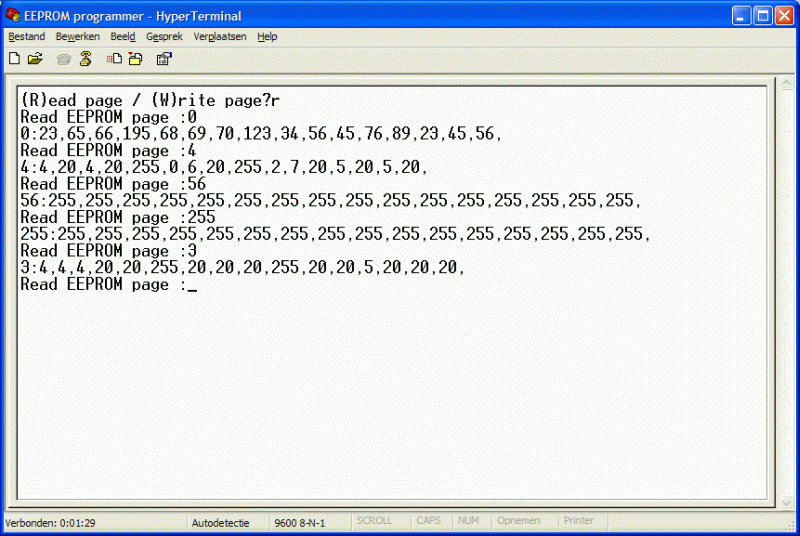
For more details, click: I2C EEPROM Programmer With AT2313 microcontroller
- What EEPROM devices does this programmer support?
The programmer is designed for I2C 24C EEPROM devices and has been tested with the 24C32; it may work with other I2C EEPROMs. - How is the programmer connected to the PC?
It connects to the PC via the RS232 serial port using a MAX232 line driver and communicates through a terminal program. - Does the programmer need special PC software?
No external software is needed; it uses a terminal program such as HyperTerminal to send commands and data. - How much power does the programmer require?
The programmer requires a 5 VDC power supply. - How many bytes can the 24C32 EEPROM store?
The 24C32 contains 4096 bytes, organized as 256 pages. - How many bytes are written or read at a time?
The programmer reads or writes one page (16 bytes) at a time. - Which microcontroller is used and how does it implement I2C?
The AT2313 microcontroller is used and implements the I2C bus in software. - Where is the target EEPROM placed on the programmer?
The target device is placed in a DIP8 socket. - How does the microcontroller communicate with the EEPROM?
The microcontroller receives commands from the terminal via RS232, translates them into I2C serial datastreams, and sends them to the EEPROM.
