
Summary of LEDger Led (polarity) tester
The LEDger is a compact PCB designed to test SMD and through-hole LEDs for polarity. It features a button cell battery and multiple footprints, allowing users to check anode/cathode orientation instantly while holding the component with tweezers. The board includes specific PLCC6 footprints to handle RGB LEDs purchased from eBay that may have incorrect wiring configurations.
Parts used in the LEDger:
- Small PCB
- Button cell battery
- SMD footprints
- Through-hole LED footprints
- PLCC6 footprint
This weeks PAW is something that I have wanted to have for a long time but never gotten around making – until now that is 🙂 Everytime I solder a SMD LED on a pcb I have to turn on one of my multimeters and flip it over to diode-test mode and then probe the SMD LED to see which connector is the anode and which is the cathode.
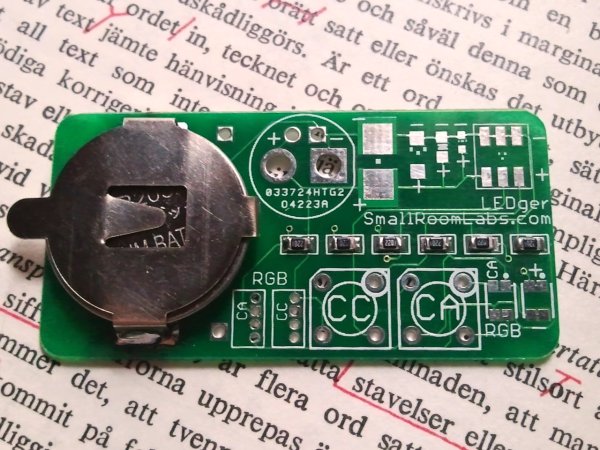
The LEDger is a small PCB with a button cell battery and smd footprints that allows me to, while still holding the LED in my tweezers. just hold it onto one of the footprints and see if it lights up or not.
While I was at it I added some other footprints both for SMD and thru-hole LEDs to make the board a bit more universal. The PLCC6 footprint might save me some trouble testing a roll of RGB leds that I bought from eBay where about 30% was BBB instead of RGB
For more detail: LEDger Led (polarity) tester
-
What problem does the LEDger solve?
It allows testing LED polarity without needing to flip a multimeter to diode-test mode. -
How do you use the device while holding an LED?
You hold the LED in tweezers and press it onto one of the footprints to see if it lights up. -
Does the board support different types of LEDs?
Yes, it includes footprints for both SMD and through-hole LEDs. -
Why was a PLCC6 footprint added?
To help test rolls of RGB LEDs that might have incorrect wiring like BBB instead of RGB. -
What powers the LEDger tester?
A button cell battery powers the small PCB. -
Can this tool replace a multimeter entirely?
No, it is specifically designed to check polarity quickly rather than perform full multimeter functions.
