
Summary of Open Source USB AVR Programmer for Students and Hobbyists using Atmega8 microcontroller
This project describes a DIY USB AVR programmer built around an Atmega8 microcontroller that implements USB in firmware, requiring only a few passive components. It works on Windows, Mac OS X, and Linux, can program up to 5 KB/s, and provides free firmware and drivers — though you need an AVR programmer once to flash the Atmega8 initially.
Parts used in the Open Source USB AVR Programmer:
- Atmega8 microcontroller
- Passive resistors (few)
- Bypass/decoupling capacitors (few)
- USB connector
- ISP header or programming connector
- PCB or protoboard
- Power supply (USB-powered)
- Optional housing/enclosure
If you cannot afford to buy a USB programmer for AVR, don’t worry, you can make one by yourself. This programmer uses a Atmega8 microcontroller with a few external passive components. The good thing is you don’t need any USB controller because it is implemented in the firmware inside Atmega8. Yes, you are right, you need an AVR programmer once to load the firmware inside Atmega8. You figure out how you gonna manage that.
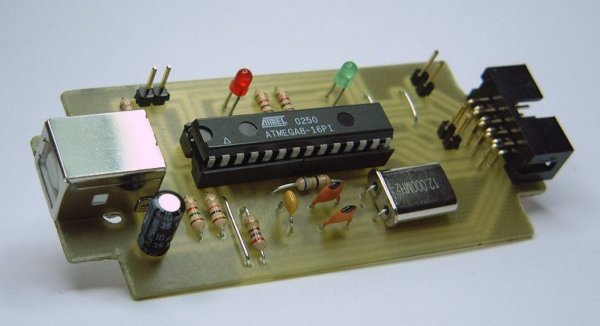
This programmer has been tested under Windows, Mac OS X, and Linux and worked well. It can program a chip at speed up to 5Kbytes/sec. The firmware for Atmega8 and necessary drivers for host computer are available for free.
For more detail: Open Source USB AVR Programmer for Students and Hobbyists using Atmega8 microcontroller
- Can I build a USB AVR programmer without a dedicated USB controller?
Yes. The Atmega8 runs firmware that implements USB, so no separate USB controller is needed. - Do I need an AVR programmer to build this project?
Yes. You need an AVR programmer at least once to load the USB firmware into the Atmega8. - Which operating systems is this programmer compatible with?
It has been tested and works on Windows, Mac OS X, and Linux. - What programming speed can I expect from this DIY programmer?
It can program a chip at speeds up to 5 Kbytes per second. - Is the firmware and driver software free?
Yes. The firmware for the Atmega8 and necessary host drivers are available for free. - Does the project require many external components?
No. It uses the Atmega8 and a few external passive components. - Can this programmer be used by students and hobbyists?
Yes. It is an open source solution intended for students and hobbyists.
