
Summary of Photocell Amplifier using microcontroller
This article describes a low-frequency amplifier designed for measuring relative photo currents ranging from 20 nanoamps to 200 microamps. It features adjustable transimpedance, low input resistance for zero-bias operation, and outputs 100mV to 3V for digital voltmeter reading. The design prioritizes quick assembly using ordinary components, except for an op-amp with low offset current and voltage.
Parts used in the Photocell Amplifier:
- Photo diodes
- Op amp (with low input offset current and decently low input offset voltage)
- 22 uf capacitor
- Digital voltmeter
- Isolated unregulated DC power supply
- Power input connector
- Voltage output connector
- Input connector
This is a low frequency amplifier with an adjustable transimpedance that is
intended to be used to take relative measurements of a wide range of photo currents.
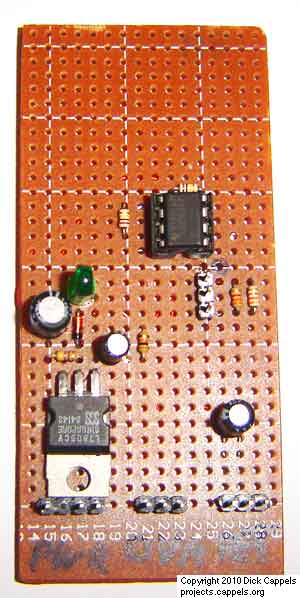
Find updates at www.projects.cappels.org
Introduction
I needed to make some relative optical measurements. I had some small but relatively large area photo diodes, that when operated as photovoltaic cells generated between 20 nanoamps and 200 microamps with the range of optical power available from a light source I needed to test. That is why this amplifier came into being.
The output of the amplifier is to be measured on a digital voltmeter. Besides being able to accept 20 na to 200 micro amps and output voltages that range form 100 mv to 2 or 3 volts, the amplifier needed to have a low input resistance so the diode could be run at or near zero bias so that its output would be a linear function of light on the photocell. It also has to have plenty of connectors. Along the bottom of the board in the image above, from left to right, are a power input connector because it would use an isolated unregulated DC power supply that is sometimes used for other things, a voltage output connector so that its output could be plugged into a digital voltmeter, and an input connector so that it can accept current from a variety of photodiodes.
The objective of the design was an amplifier that could be built quickly and use “ordinary” parts, except for the op amp, which needed to have low input offset current and a decently low input offset voltage. I also did not want to worry about low noise design, hence the 22 uf capacitor on the input and the use of a digital voltmeter to read the output.
For more detail: Photocell Amplifier using microcontroller
- What is the primary purpose of this amplifier?
To take relative measurements of a wide range of photo currents. - How much current can the amplifier accept?
The amplifier accepts currents ranging from 20 nanoamps to 200 microamps. - What is the expected output voltage range?
The output voltages range from 100 mv to 2 or 3 volts. - Why does the amplifier need low input resistance?
Low input resistance allows the diode to run at or near zero bias for linear output. - Can this amplifier be built quickly?
Yes, it uses few parts so it can be put together in a short amount of time. - Does the design focus on low noise?
No, the designer did not want to worry about low noise design. - What type of power supply does the board use?
It uses an isolated unregulated DC power supply. - Where should the output be measured?
The output is intended to be measured on a digital voltmeter.
