
Summary of SPARKFUN’S MICROMOD FAMILY ADDS THE TEENSY 4.0 BOARD WITH AN M.2 CONNECTOR
Sparkfun launched the MicroMod Interface Ecosystem in late 2020 for solder-free rapid prototyping. The latest addition, the Sparkfun MicroMod Teensy Processor, partners with PJRC to integrate the NXP iMXRT1062 chip. This board offers an ARM Cortex-M7 running at 600MHz with 16MB Flash and 1MB RAM. It features extensive connectivity including seven UARTs, four I2C buses, two SPI ports, CAN-Bus, digital audio, and USB Host/Device capabilities up to 480Mbit/s, enabling seamless transitions from prototype to product.
Parts used in the Sparkfun MicroMod Teensy Processor:
- NXP iMXRT1062 processor
- ARM Cortex-M7 processor core
- 16MB Flash Memory
- 1024K RAM Memory
- Seven serial UART ports
- Four I2C buses
- Two SPI ports
- CAN-Bus interface
- Digital audio (I2S) pins
- USB Host and Device capability
- SDIO for SD card support
Sparkfun launched the MicroMod Interface Ecosystem, a modular ecosystem of interchangeable processors and specialized carrier boards, in late 2020, to provide users with a solder-free rapid prototyping platform aimed at making the transition from prototypes to products easier and faster. The ecosystem has experienced tremendous success with new MicroMod Processor Boards, offering plug and play capability for different processors and MCUs released every now and then. The latest addition to the family is the Sparkfun MicroMod Teensy Processor.
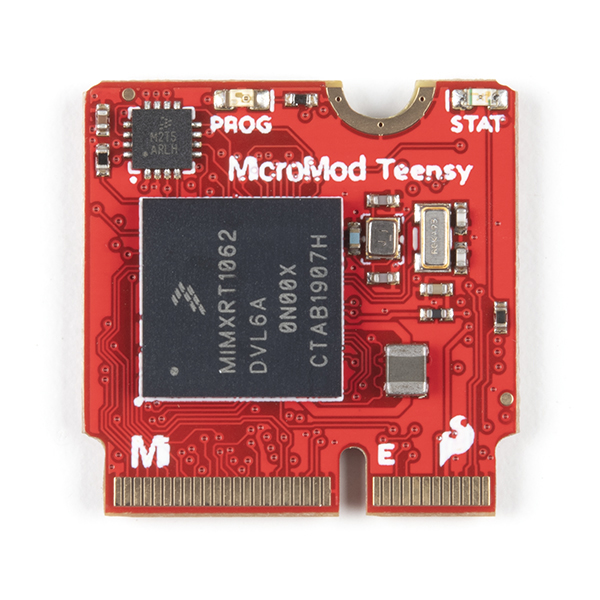
Developed in partnership with PJRC, which owns the Teensy Trademark, the Sparkfun MicroMod Teensy processor, brings the awesome computing power of the NXP iMXRT1062 processor, which we’ve all come to love from the experience with the Teensy 4.0, to the Sparkfun’s Micromod family.
Thanks to the NXP iMXRT1062, the Sparkfun MicroMod Teensy Processor features an ARM Cortex-M7 processor operating at clock speeds up to 600MHz, with 16MB Flash Memory, and 1024K of RAM Memory. To allow full utilization of the huge processing power, the MicroMod Teensy Processor board comes with a total of seven serial UART ports, four I2C buses, two SPI ports, CAN-Bus, 12 GPIO, dedicated digital, analog, and PWM pins, digital audio, and USB Host and Device capability at speeds of up to 480Mbit/s.
Feeling like you’d need more? well, one of the many great things about the iMXRT1062 is that many of its pins support multiple signal types, so you can customize them to meet the needs of your project.
The highlight features and specifications of the Sparkfun MicroMod Teensy Processor are provided below:
- USB Device up to 480Mbit/sec: Capable of enumerating as a USB keyboard, mouse, joystick, MIDI, audio, and more
- USB Host up to 480Mbit/sec: Capable of interfacing to USB flash drives, mice, keyboards, and more
- 7x Serial Ports
- 2x SPI
- 4x I2C Bus
- 1x CAN-Bus
- 1x I2S Digital Audio
- 1x SDIO for SD
- 2x Dedicated Analog Pins (Up to 14 available for use)
- 2x Dedicated PWM Pins (Up to 22 available for use)
Read more: SPARKFUN’S MICROMOD FAMILY ADDS THE TEENSY 4.0 BOARD WITH AN M.2 CONNECTOR
- What is the clock speed of the Sparkfun MicroMod Teensy Processor?
The processor operates at clock speeds up to 600MHz. - How much Flash Memory does the board have?
The board comes with 16MB of Flash Memory. - Does the Sparkfun MicroMod Teensy Processor support USB Host functionality?
Yes, it supports USB Host capability at speeds of up to 480Mbit/sec. - Can the pins on the iMXRT1062 be customized for different signal types?
Yes, many of its pins support multiple signal types to meet project needs. - What partnership developed this processor board?
It was developed in partnership with PJRC, which owns the Teensy Trademark. - How many I2C buses are included on the MicroMod Teensy Processor?
The board features four I2C buses. - Is there dedicated analog pin support on this board?
Yes, it has 2x Dedicated Analog Pins with up to 14 available for use. - What type of processor core is used in the Sparkfun MicroMod Teensy Processor?
It uses an ARM Cortex-M7 processor.
