
Summary of TINYHVSP – HIGH VOLTAGE SERIAL PROGRAMMER BASED ON ATTINY84
Stefan Wagner's TinyHVSP is a High Voltage Serial Programmer and Fuse Resetter designed for ATtiny 13, 25, 45, and 85 microcontrollers. Built around the ATtiny84 chip, it utilizes an HVSP interface with specific pins to program chips by applying 12 volts to the RESET pin. This tool also restores factory default fuse values, enabling programming when the RESET pin has been repurposed as a general I/O pin in previous firmware configurations.
Parts used in the TinyHVSP:
- ATtiny84 microcontroller
- ATtiny 13 microcontroller
- ATtiny 25 microcontroller
- ATtiny 45 microcontroller
- ATtiny 85 microcontroller
- SCI (serial clock input) pin
- SDI (data in) pin
- SII (instruction in) pin
- SDO (data out) pin
- RESET pin
- VCC pin
- GND pin
Stefan Wagner’s EasyEDA profile is definitely the go-to source for all things ATtiny. He’s built 10s of projects, some of which we have covered here, that are based on the tiny microcontrollers, and it only makes sense that one of his latest projects, called the TinyHVSP, is a tool to help with development using the Attiny series of microcontrollers.
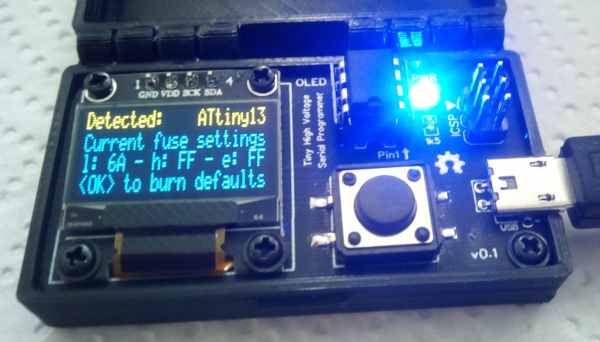
The device which is based on the ATtiny84 microcontroller is a High Voltage Serial Programmer (HVSP) and Fuse Resetter for ATtiny 13/25/45/85 microcontrollers.
HVSP is one of the numerous ways through which members of the AVR family of microcontrollers (especially the smaller chips like the ATtiny series) can be programmed. It involves the use of 4 pins consisting of the SCI (serial clock input), SDI (data in), SII (instruction in), and SDO (data out). Along with these four pins, the RESET, VCC, and GND pins are also used.
Programming a microcontroller using the HVSP approach involves the application of a “high voltage” (12 volts) to the RESET pin to put the microcontroller in the high-voltage serial programming mode. It is called “serial” because data is sent to the chip serially in a manner similar to what is experienced with SPI.
The fuse resetting feature of the device allows the developer to restore factory default values to the microcontroller. In situations where the RESET pin, for instance, has been configured as an I/O pin in the firmware, programming the board will be impossible unless the fuse reset is done.
Read more: TINYHVSP – HIGH VOLTAGE SERIAL PROGRAMMER BASED ON ATTINY84
- What is the primary function of the TinyHVSP device?
It acts as a High Voltage Serial Programmer and Fuse Resetter for specific ATtiny microcontrollers. - Which microcontroller serves as the basis for the TinyHVSP project?
The device is based on the ATtiny84 microcontroller. - How does the HVSP approach program a microcontroller?
It applies 12 volts to the RESET pin to enter high-voltage serial programming mode. - What happens if the RESET pin is configured as an I/O pin?
Programming becomes impossible unless the fuse reset feature is used to restore factory defaults. - Can this device be used for ATtiny 13 microcontrollers?
Yes, the device supports ATtiny 13, 25, 45, and 85 series microcontrollers. - Does the HVSP method use SPI-like data transmission?
Yes, data is sent serially in a manner similar to what is experienced with SPI. - What are the four main signal pins used in HVSP?
The four pins are SCI, SDI, SII, and SDO.
