
Summary of Sonicare toothbrush teardown: microcontroller, H bridge, and inductive charging
The author disassembled a non-functioning Sonicare Flexcare Platinum electric toothbrush, revealing high-quality internal complexity. The device features wireless inductive charging, a pressure sensor, multiple modes, and a vibration mechanism driving the head at 31,000 strokes per minute. Despite its gold-plated circuitry and robust design, moisture intrusion remains a potential reliability issue.
Parts used in the Sonicare Flexcare Platinum:
- Toothbrush base
- Brush head
- Charging coil
- Vibration mechanism
- Red coil
- Powerful magnet
- Battery
- Circuit board
- White spacer
- LEDs
- Buttons
My Sonicare electric toothbrush recently quit working, so I took it apart and examined the interesting circuitry inside. There’s much more complexity than I expected inside a toothbrush, especially in the mechanism that drives the brush head at 31,000 strokes per minute. Internally, the brush appears to be designed for quality rather than ease of manufacturing. Unfortunately, moisture can get in, causing reliability problems.
The toothbrush is a Sonicare Flexcare Platinum with more features than you’d expect in a toothbrush: three brushing modes, three intensities and a couple timers, along with 10 LEDs to indicate its status. A pressure sensor in the toothbrush changes the vibration if you apply too much pressure while brushing. The toothbrush uses wireless inductive charging so it charges when set on the base. (This toothbrush may seem overly complicated, but it’s nothing compared to the new model that includes Bluetooth.)
The toothbrush is a Sonicare Flexcare Platinum with more features than you’d expect in a toothbrush: three brushing modes, three intensities and a couple timers, along with 10 LEDs to indicate its status. A pressure sensor in the toothbrush changes the vibration if you apply too much pressure while brushing. The toothbrush uses wireless inductive charging so it charges when set on the base. (This toothbrush may seem overly complicated, but it’s nothing compared to the new model that includes Bluetooth.)
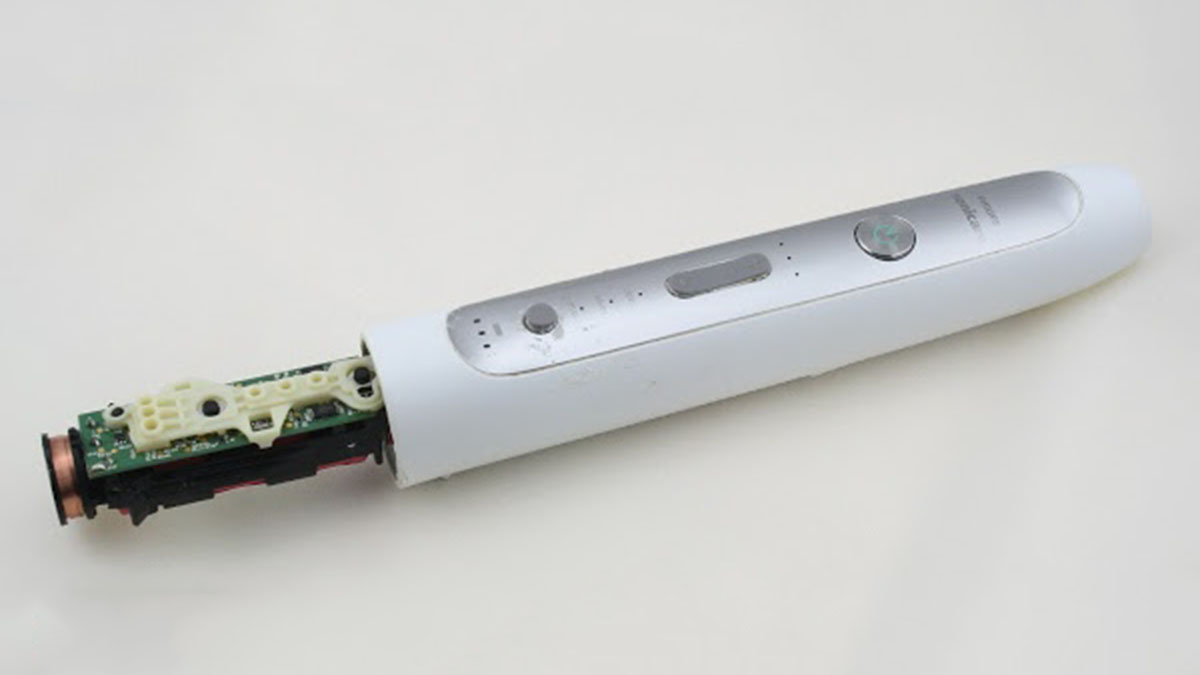
The first step was to remove the toothbrush base, allowing the toothbrush mechanism to be removed from the case. The toothbrush head mounts on the right; it needed to be removed to disassemble the toothbrush. At the left is the charging coil used to wirelessly charge the toothbrush.
The photos below show the top and bottom of the toothbrush internals. I expected to find a simple, low-cost mechanism, so I was surprised at how much complexity there was inside. The vibration mechanism (right) is built from multiple metal and plastic parts screwed together, requiring more expensive assembly than I expected. The circuit board is literally gold-plated and has a lot of components, even if it doesn’t quite reach Apple’s level of complexity. Overall, the toothbrush’s internal design is high quality (except, of course, for the fact that it quit working, as did an earlier one).
The brush contains several key components, as can be seen above. In the center is the large red coil that causes the toothbrush to vibrate. On the right is the vibration mechanism, which has a powerful magnet that is moved by the coil. The brush head snaps on at the right. The battery (red, left) takes up about a third of the toothbrush. The long, thin circuit board (green) has the circuitry to operate the toothbrush. A white spacer sits on top of the circuit board, with holes for the LEDs and buttons.
For more detail: Sonicare toothbrush teardown: microcontroller, H bridge, and inductive charging
The photos below show the top and bottom of the toothbrush internals. I expected to find a simple, low-cost mechanism, so I was surprised at how much complexity there was inside. The vibration mechanism (right) is built from multiple metal and plastic parts screwed together, requiring more expensive assembly than I expected. The circuit board is literally gold-plated and has a lot of components, even if it doesn’t quite reach Apple’s level of complexity. Overall, the toothbrush’s internal design is high quality (except, of course, for the fact that it quit working, as did an earlier one).
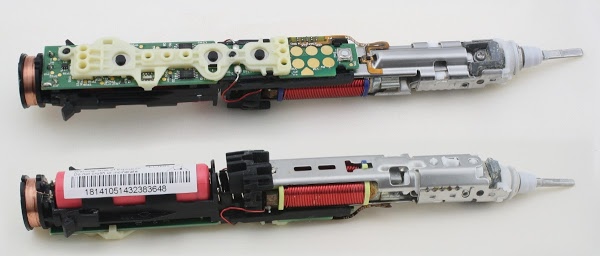
The brush contains several key components, as can be seen above. In the center is the large red coil that causes the toothbrush to vibrate. On the right is the vibration mechanism, which has a powerful magnet that is moved by the coil. The brush head snaps on at the right. The battery (red, left) takes up about a third of the toothbrush. The long, thin circuit board (green) has the circuitry to operate the toothbrush. A white spacer sits on top of the circuit board, with holes for the LEDs and buttons.
For more detail: Sonicare toothbrush teardown: microcontroller, H bridge, and inductive charging
- How fast does the brush head vibrate?
The brush head drives at 31,000 strokes per minute. - Can I charge this toothbrush wirelessly?
Yes, the toothbrush uses wireless inductive charging when set on the base. - What happens if I apply too much pressure while brushing?
A pressure sensor changes the vibration if you apply too much pressure. - How many LEDs are inside the toothbrush?
There are 10 LEDs to indicate the status of the toothbrush. - Does the circuit board have special plating?
The circuit board is literally gold-plated. - What occupies about a third of the toothbrush internally?
The battery takes up about a third of the toothbrush. - Where is the white spacer located?
A white spacer sits on top of the circuit board with holes for the LEDs and buttons. - Is there a newer model available than the one described?
Yes, a new model includes Bluetooth functionality.
