
Summary of AC Current Probe for Oscilloscopes
This article describes a DIY AC current probe designed for monitoring deflection circuits in computer monitors where budget constraints limited access to test equipment. The probe functions as a current transformer, measuring AC currents ranging from tens of milliamps to 10 amps peak-to-peak across frequencies from several tens of Hz to a couple MHz. It connects in series with a load wire passing through a toroid core, utilizing a termination resistor and a potentiometer for calibration, allowing users to view current waveforms on an oscilloscope.
Parts used in the AC Current Probe:
- Toroid core
- Wire (for primary loop)
- Secondary sensing winding
- 2.7 Ohm termination resistor
- 1K potentiometer
- Oscilloscope
Overview
I needed several current probes when designing the deflection circuits and high voltage supply for a computer display monitor, and the lab in which I was consulting only had one current probe, which I shared with the other four engineers on the project. We did not really have a budget for test equipment on that project. Designing the deflection circuit included designing several inductors, a current transformer among them. It was merely a small diversion to design and put together a couple of simple current probes so I could, for example. simultaneously watch the base current and the collector current of switching transistors.
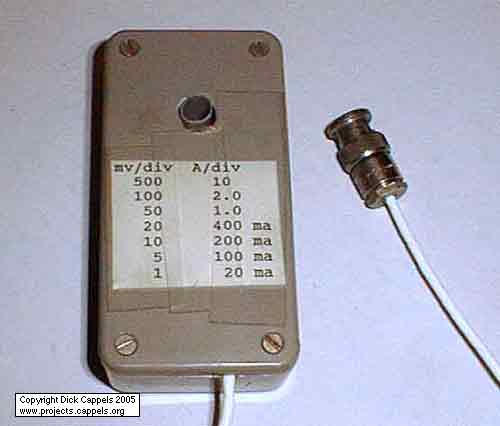
The probe described here was designed to be used over the range of several tens of Hz to a couple MHz with currents from a few tens of milliamps to about 10 amps peak-to-peak. Formulae are give which will allow you to create a design suitable for your own applications.
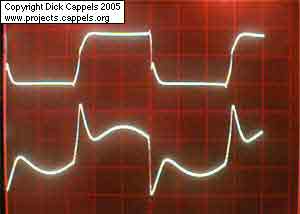
To use this probe, a wire is connected in series with the load that you want to see the current through, and that wire is passed through the hole in the probe. An oscilloscope is used to view and measure the current waveform, which is calibrated in terms of volts output per amp of input current. The sensitivty of the circuit can be multipled by using multiple turns in the sensing winding. For example, to get 5 times the sensitivity, pass the input wire through the hole in the toroid five times. Of cousre, it would be much better to design the probe to have the sensitivity required for your application, but this trick is ok if you don’t have to do it too often.
This probe only measures AC current.
The current probe is a current transformer. A single loop of wire passes through the center of the toroid core, inducing current in the secondary. A 2.7 Ohm resistor is the termination resistor and a 1K pot is used to calibrate the output voltage as a function of input current.
For more detail: AC Current Probe for Oscilloscopes using microcontroller
-
What is the primary purpose of this project?
The project was designed to create simple current probes for monitoring deflection circuits and high voltage supplies when lab budgets were insufficient. -
Can this probe measure DC current?
No, the article explicitly states that this probe only measures AC current. -
How does one increase the sensitivity of the circuit?
Sensitivity can be multiplied by using multiple turns in the sensing winding, such as passing the input wire through the toroid hole five times for five times the sensitivity. -
What frequency range does this probe support?
The probe is designed to operate over a range of several tens of Hz to a couple MHz. -
What components are used to calibrate the output voltage?
A 1K pot is used to calibrate the output voltage as a function of input current. -
How is the probe connected to the circuit under test?
A wire is connected in series with the load, and that wire is passed through the hole in the probe. -
What device is required to view the current waveform?
An oscilloscope is used to view and measure the current waveform.
