
Summary of ATTiny2313 Board RS232
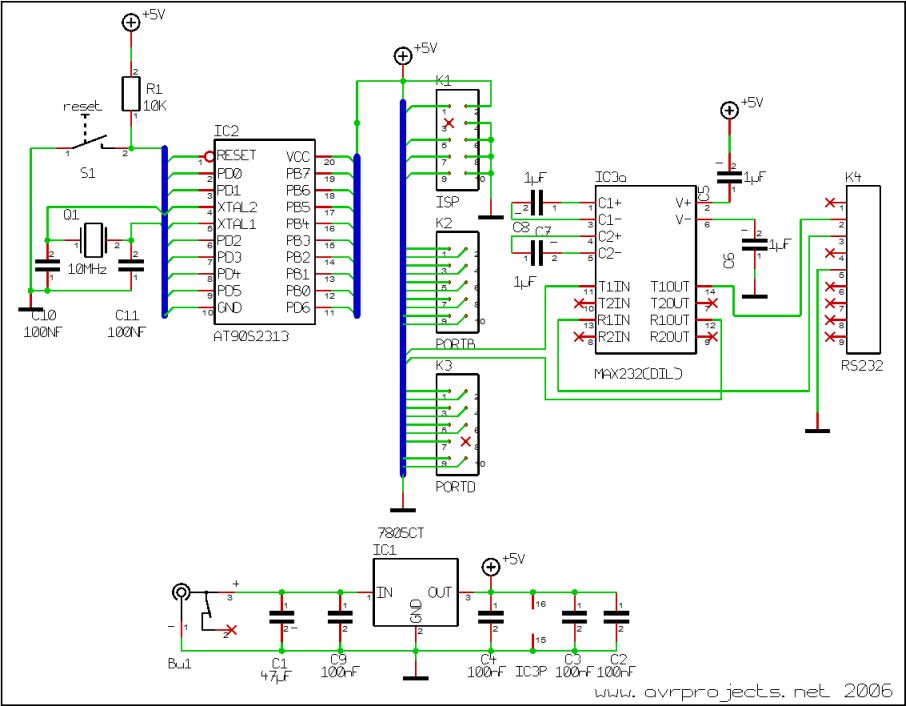
This small educational ISP controller board uses an AT2313 microcontroller with a 10 MHz crystal, ISP 10-pin programming connector, reset button, ML10 I/O headers, DB9 serial port with MAX232 level shifter, 5V regulator powered via 1.1 mm DC jack, and is suited for experiments, prototyping, and simple projects like LED blink and LCD interfaces.
Parts used in the ISP-board:
- DC Conn 1,1mm pin (Bu1)
- 47µF 16V (C1)
- 100nF (C2)
- 100nF (C3)
- 100nF (C4)
- 1µF 63V (C5)
- 1µF 63V (C6)
- 1µF 63V (C7)
- 1µF 63V (C8)
- 100nF (C9)
- 100nF (C10)
- 100nF (C11)
- 7805 (IC1)
- AT90S2313 (IC2)
- MAX232 (IC3)
- ML10 (K1)
- ML10 (K2)
- ML10 (K3)
- DB9 female (K4)
- 10MHz crystal (Q1)
- 10k resistor (R1)
- Switch (S1)
- PCB
Description
This board is a small controller board on which you can build your projects. It is suited for educational use, experiments or prototyping. The board uses the AT2313 microcontroller with a 10Mhz crystal. The board contains the ISP 10-pin connector for in circuit serial programming. It has also a push button reset switch for resetting the microcontroller. The I/O pins of the microcontroller are also available on two ML10 connectors for connecting for example the LCD-Interface board. The power can be connected via the DC connector which has a pin of 1.1mm. The power regulator supplies the microcontroller with the 5V DC power it needs. The DB9 bus connector can be hooked to the serial port of your PC for communication between the microcontroller and the PC. The MAX232 IC takes care of the voltage conversion of the RS232 voltage levels and the micrcontroller voltage levels.
Programming
The microcontroller on the board can be programmed via the 10-pin ISP connector. The following AT microcontrollers can be programmed with this board:
- ATTiny2313
- AT90S2313 (obsolete)
- AT90S1200 (obsolete)
Connector pinout
In the table below you see the pins of the connectors.
|
|
|
Software
There are several projects on this site that you can try and use with the ISP-board:
Partlist
| 1 | Bu1 | DC Conn 1,1mm pin |
| 2 | C1 | 47µF 16V |
| 3 | C2 | 100nF |
| 4 | C3 | 100nF |
| 5 | C4 | 100nF |
| 6 | C5 | 1µF 63V |
| 7 | C6 | 1µF 63V |
| 8 | C7 | 1µF 63V |
| 9 | C8 | 1µF 63V |
| 10 | C9 | 100nF |
| 11 | C10 | 100nF |
| 12 | C11 | 100nF |
| 13 | IC1 | 7805 |
| 14 | IC2 | AT90S2313 |
| 15 | IC3 | MAX232 |
| 16 | K1 | ML10 |
| 17 | K2 | ML10 |
| 18 | K3 | ML10 |
| 19 | K4 | DB9 female |
| 20 | Q1 | 10MHz |
| 21 | R1 | 10k |
| 22 | S1 | Switch |
| 23 | PCB |
- What microcontroller does the board use?
The board uses the AT2313 microcontroller with a 10MHz crystal. - How is the microcontroller programmed?
The microcontroller is programmed via the 10-pin ISP connector. - Which AT microcontrollers are supported for programming?
ATTiny2313, AT90S2313 (obsolete), and AT90S1200 (obsolete) can be programmed with this board. - How is power connected to the board?
Power is connected via the DC connector which has a 1.1mm pin. - What provides the 5V supply to the microcontroller?
The 7805 power regulator supplies the microcontroller with 5V DC. - How can the board communicate with a PC?
The DB9 bus connector can be hooked to the PC serial port, with the MAX232 IC handling voltage conversion. - Are the I/O pins accessible for peripherals like an LCD?
Yes, the I/O pins are available on two ML10 connectors for connecting peripherals such as an LCD-Interface board. - Does the board include a reset option?
Yes, the board contains a push button reset switch for resetting the microcontroller. - What projects are suggested for use with the ISP-board?
Suggested projects include Blink a LED, LCD@AVR, LCD Thermometer DS1621, LCD Thermometer LM35, and Real Time Clock.
