
Summary of AVR GPS Locator using avr microcontroller
This project interfaces an SR87 GPS module with an ATtiny2313 microcontroller to display real-time latitude and longitude on an LCD. Users can mark a specific location by entering a 16-character name via a PC-AT keyboard, which the system stores in on-chip EEPROM alongside coordinates. Upon returning to the marked spot, the device displays the saved name and triggers a buzzer. While currently limited to one location due to BASCOM demo constraints, the architecture supports multiple entries if memory permits.
Parts used in the AVR GPS Locator:
- ATtiny2313 Microcontroller
- SR87 GPS Module
- LCD Display
- PC-AT Keyboard
- Button SW1
- Buzzer
- On-chip EEPROM
In this project i have interfaced an GPS with AVR microcontroller, the ATtiny2313 gets the location from the GPS and display it over the LCD display. This project also have the feature of marking a place with its name. For entering the Name of the place i have used the PC-AT Keyboard.
At starting the microcontroller will display the latitude and longitude on the LCD display and if you need to mark the place, then press the Button SW1. Now the microcontroller will ask you to enter the name through the PC keyboard. Type the Name of the place of maximum 16 characters and press Enter key to store it.
The ATtiny2313 will store the name and the current location on the Onchip EEPROM. So when you come to the same location next time the microcontroller will display the name of the place on the LCD and it will also produce an buzzer sound.
In this project you can add only 1 location, Since i am using the demo version of BASCOM, it can compile a maximum of 2KB. If you can compile more then you can add as much locations you want.
The locations takes 12bytes, for ex. Latitude : 08.10.17N & longitude: 77.25.36E
The Name of the place takes 16bytes. so you need a maximum of 28bytes per location.
I have used SR87 GPS module from Progin, it have the following features
- High sensitivity SiRF Star chipsets.
- High performance receiver tracks up to 20 satellites.
- TTL output for GPS command interface. (Since it is TTL output i directly connect it to the microcontroller)
- Low power consumption.
- Average Cold Start time under 42 seconds.
- On-chip 1Mb SRAM.
- Reacquisition time 0.1 second.
- Support accurate 1PPS output signal aligned with GPS timing.
- Support Standard NMEA-0183 and SiRF Binary protocol.
- Multi-path mitigation hardware.
- Built-in a lithium battery enables fast positioning.
- Compact size (25.4×25.4×7 mm3) for easy integration into hand-held devices.
Circuit Diagram
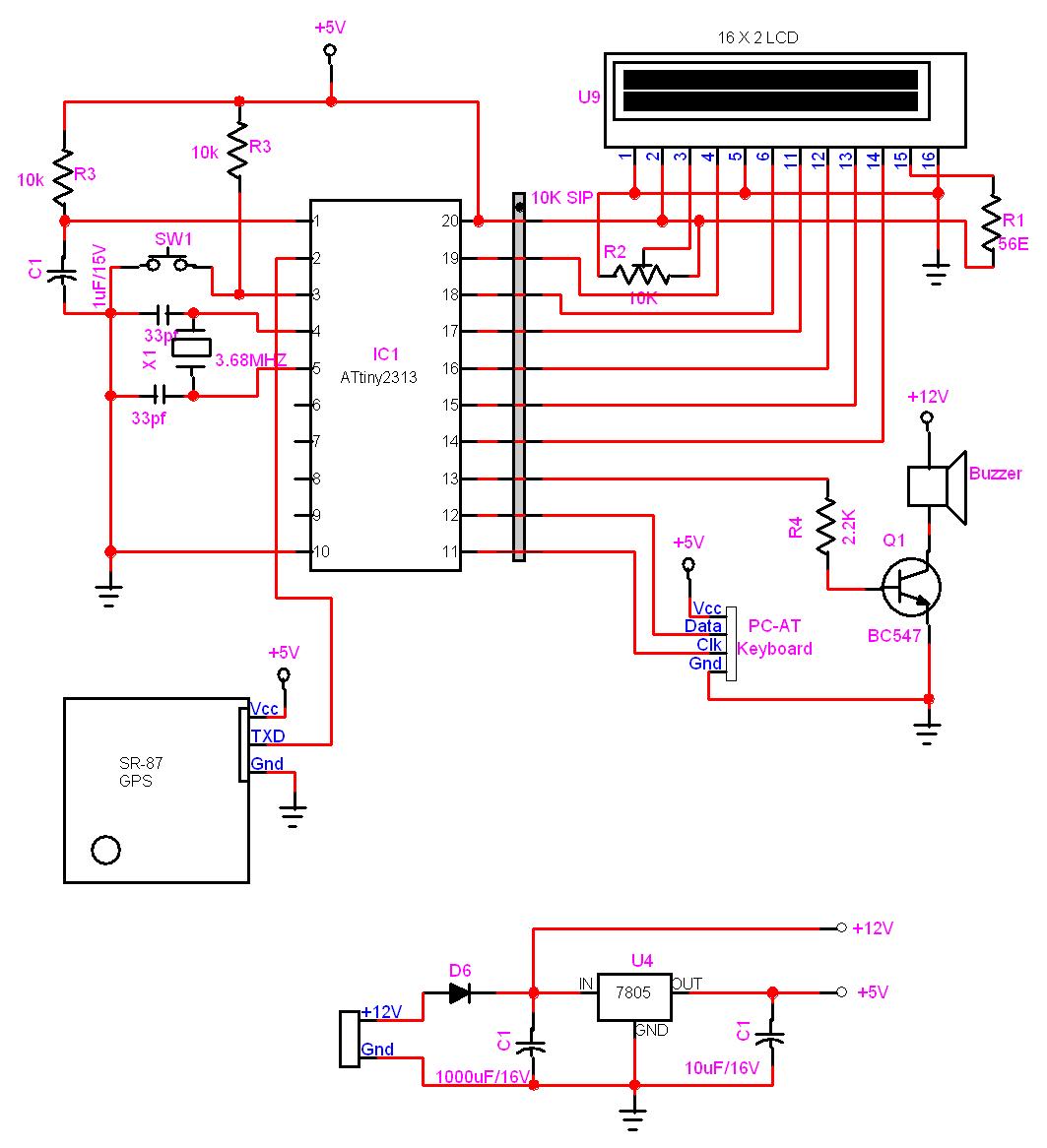
For more Detail: AVR GPS Locator using avr microcontroller
- How does the system store location data?
The ATtiny2313 stores the name and current location directly on its Onchip EEPROM. - What is the maximum character limit for a place name?
You can enter a name of maximum 16 characters using the PC keyboard. - Can this project save multiple locations?
Currently, it adds only one location because the demo version of BASCOM compiles a maximum of 2KB. - Does the device alert you when returning to a saved spot?
Yes, the microcontroller displays the place name and produces a buzzer sound upon return. - How many bytes are required per location entry?
Each location requires a maximum of 28 bytes, consisting of 12 bytes for coordinates and 16 bytes for the name. - What type of output does the SR87 GPS module provide?
The module provides a TTL output for the GPS command interface, allowing direct connection to the microcontroller. - How many satellites can the receiver track?
The high performance receiver tracks up to 20 satellites. - What happens if you press Button SW1?
Pressing Button SW1 prompts the microcontroller to ask for a place name via the PC keyboard.
