
Summary of Barker Code-Locked Loop Synchronous Demodulator using ATtiny2313 microcontroller
This article describes a low-component phase-locked loop (PLL) that locks onto and detects the amplitude of an incoming 7-bit Barker code. The system utilizes a switched resistor demodulator driven directly by microcontroller output pins, eliminating the need for analog switches or multipliers. It employs balanced modulators, integrates a voltage-controlled crystal oscillator within the PLL, and extends op-amp output range near ground. The design uses ATtiny12 and ATtiny2313 microcontrollers alongside a quad op-amp to achieve robust noise rejection and processing gain in RF communications.
Parts used in the Barker Code-Locked Loop:
- ATtiny12 microcontroller
- ATtiny2313 microcontroller
- Quad op-amp (LM324)
- Resistors
- Two 2N4401 transistors
- Infrared LED
- Photo diode
- Surface mount components
A simple, low component count phase locked loop that locks onto and detects the amplitude of an incoming baseband 7 bit Barker code using a switched resistor demodulator that is driven directly by a microcontroller’s output pins.
- Balanced modulators using resistors and a microcontroller’s output pins.
- Locking into oncoming Pseudo-noise (PN) stream.
- Microcontroller modulates its own crystal oscillator frequenc inside a Phase-Locked Loop (PLL).
- Extending the output range of a bipolar op-amp to opearte near ground.
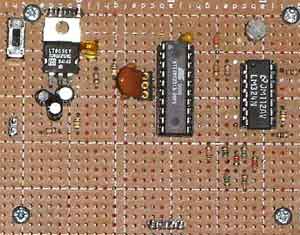
Photo 1. The only semiconductors in the circuit are the microcontroller
and a quad opamp. This picture was taken before the offset adjustment
for the signal level measurement circuit was installed. Some surface
mount components are on the other side of the board.
Click on the image above for a larger version.
Downloads
Download the AVR Studio assembly source for the ATtiny12 7 bit Barker beacon: Brkshf061015B.asm
The AVR Studio assembly source for the ATtiny2313 demodulator / 7 bit Barker source: bark3p061015A.asm
Download the AVR Studio assembly source for the ATtiny2313 181.818 kHz Barker code transmitter: rf7bark061015B.asm
Find updates at www.projects.cappels.org
Related web pages:
Digital Lock-in Milliohmmeter http://cappels.org/dproj/dlmom/dlmom.html
Experimental 1 kHz Synchronous Demodulator http://cappels.org/dproj/syncdet/syncdet.html
This simple circuit includes three synchronous demodulators and two
integrators that process the demodulation signal. The modulation is achieved by switching
the microncroller’s I/O pins between high impedance and current sinking states, so no additional
analog switches or multipliers are needed. The first op-amp stage (pins 8,9, and 10) is used
to provide a uniformly low output impedance to the demodulators. It can be converted to a gain
stage or a filter, provided there is sufficient loop gain to maintain a sufficiently low output impedance.
Introduction
The circuit in figure 1 is that of a synchronous demodulator that meets these requirements, and additionally, it operates from a single positive power supply. The circuit will be described in detail later in this page. The ATtiny2313 microcontroller is used as a voltage controlled crystal oscillator and Barker code generator, and could be replaced with small scale logic devices. The code generation is initiated by interrupts from the microcontroller’s internal 8 bit timer, and there is plenty of time available for control and computational tasks that could used to modulate the Barker code stream with data or to decode an incoming stream.
This implementation, using a 7 bit Barker code with a 148 microsecond chip rate, was intended as a means of proving a concept. The low chip rate was selected because it is easy to deal with using the inexpensive equipment available to me. A longer Barker code and a faster chip rate would increase performance, and merely scaling the design will provide those improvements.
stream of the 7 bit Barker code. The Barker code gates a 50 milliamp
constant current source made of the two 2N4401 transistors.
As with the ATtiny2313, this function could be easily replaced with discrete logic. In addition to the code output, the ATtiny12 also has a sync output that occurs one time with each repetition of the Barker code.In an experiment to visually illustrate operation of the demodulator, I connected a photo diode between the signal input and “ground” on the demodulator circuit in Figure 1 and used the 7 bit Barker code beacon shown in Figure 2. There was no electrical connection between the beacon and the demodulator, except that their power supplies were plugged into the same electrical outlet. During some experiments, the beacon was battery operated, and I did not notice any difference in performance between those experiments in which the beacon was battery operated and those experiments in which the beacon was powered from a power supply.
Before testing, the free run frequency of the demodulator had to be set. Channel one of a Tektronix TDS-2002 oscilloscope was connected to the punctual Barker code output pin on the ATtiny2313 (ATtiny2313 pin 18), and scoope was sync’d to the sync output of the ATtiny2313 (ATtiny2313 pin 16). Channel two of the scope was connected to the Barker output of the ATtiny12 on the beacon assembly (ATtiny12 pin 7) and the infrared LED on the beacon was covered so demodulator would not detect the beacon’s signal. While simultaneously viewing the prompt Barker code generated on the demodulator and the Barker code generated by the beacon, the free run frequency of the demodulator was adjusted so that rate of local prompt Barker code generation was fraction of a word per second slower than that of the beacon.
Channel two of a Tektronix TDS-2002 oscilloscope was then moved to the output of the voltage follower stage in the demodulator (LM324 pin 8) and the IR LED on the beacon was uncovered. letting some of the light from the LED fall on the photo diode connected to the demodulator. Photo 1 and Photo 2 show what the signals looked like.
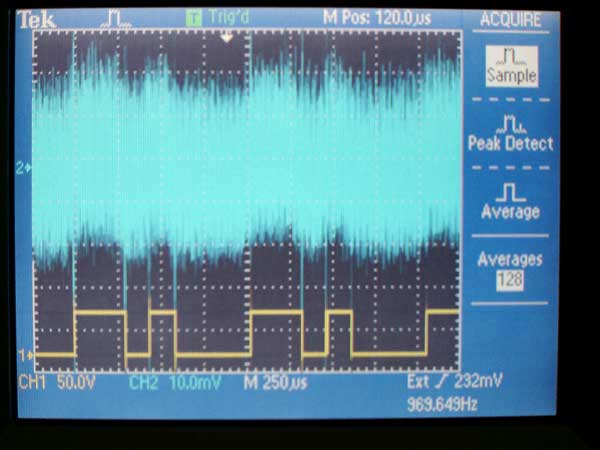
Photo 2. This is a screen shot while the scope (Tektronix TDS-2002)is in the sampling mode. The blue trace shows the incoming signal from a photo diode, with the noise provided by fluorescent lights and a dangling 1 meter clip lead. The yellow trace is the prompt Barker code generated by the ATtiny2313 on the demodulator. The scope was synchronized to the sync output on the ATtiny2313.
Signals
Experimental 1 kHz Synchronous Demodulator, examines the sensitivity of the demodulator and its ability to measure very small signals in spite of the circuit relying on a quad op-amp that is not known for its low noise performance or exceptional DC stability.
The main problem with using a simple square wave for low level measurements is that they are susceptible to noise, especially at the signal frequency and its odd harmonics. One solution to this susceptibility is to transmit and demodulate with a signal that is made of many different frequencies, one that effectively looks like random noise, but isn’t really random. This signal is referred to as pseudo noise, or PN, in many signal processing articles. Figure 3 and Figure 4 show the 7 bit pseudo random sequence used in this series of experiments. This 7 bit sequence is the 7 bit Barker code. All versions of a particular Barker codes that are inverted and/or shifted in time are the same Barker code.
- How does the circuit achieve modulation without additional analog switches?
The modulation is achieved by switching the microcontroller's I/O pins between high impedance and current sinking states. - What type of signal sequence does the demodulator lock onto?
The circuit locks onto and detects the amplitude of an incoming 7 bit Barker code. - Can the microcontroller be replaced with other logic devices?
Yes, the ATtiny2313 could be replaced with small scale logic devices. - Does the power source affect the performance of the beacon?
No, there was no difference in performance noticed between battery-operated experiments and those powered from a power supply. - How is the free run frequency of the demodulator set before testing?
The free run frequency is adjusted so that the rate of local prompt Barker code generation is fraction of a word per second slower than that of the beacon. - What happens to random noise during the integration process?
The average value of random noise is zero, and the integrator averages input signals over time to reduce noise to a very low level. - What is the purpose of the sync output on the microcontroller?
The sync signal occurs one time with each repetition of the Barker code to facilitate testing of the circuit. - How can the first op-amp stage be utilized in this circuit?
The first op-amp stage provides a uniformly low output impedance and can be converted to a gain stage or a filter if sufficient loop gain exists.
