
Summary of LCD Thermometer TCN75 Using ATTiny2313
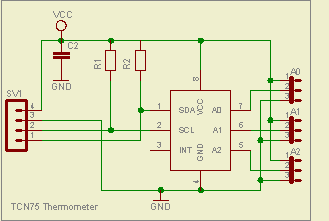
This project implements a small LCD thermometer using the Microchip TCN75 I2C temperature sensor and an ATtiny2313 microcontroller. The TCN75 provides programmable trip point, hysteresis, and interrupt/comparator output; the ATtiny2313 reads TCN75 registers over I2C and drives an LCD. Software is written in BASCOM AVR (BASIC) and compiled to a hex file for the microcontroller. The PCB contains the TCN75 and two resistors and connects to PORT B (I2C) and PORT D (LCD) of the ATtiny2313.
Parts used in the LCD Thermometer TCN75 Using ATTiny2313:
- Microchip TCN75 temperature sensor (SO8)
- ATTiny2313 microcontroller
- LCD display
- Two resistors (for I2C pull-ups)
- Small PCB
- Power supply (2.7V to 5.5V compatible)
- Programmer to flash hex file into ATTiny2313
Description
This small thermometer board uses the Microchip TCN75 device. It is a cheaper clone of the LM75, it costs about 2,50 Euro. The TCN75 comes in a SO8 packaging. The TCN75 is a serially programmable temperature sensor. It has an output that is programmable as either a simple comparator for thermostat operation or as a temperature event interrupt. Hysteresis is also programmable. Communication with the TCN75 goes via the serial I2C two-wire bus. The serial bus permits reading the current temperature, programming the set point and hysteresis, and configuring the device. Address selection inputs allow up to eight TCN75’s to share the same 2-wire bus. The output’s polarity is user programmable.
Features of the TCN75 sensor
- Solid State Temperature Sensing; 0.5C Accuracy (Typ.)
- Operates from – 55C to +125C
- Operating Range …………………………… 2.7V – 5.5V
- Programmable Trip Point and Hysteresis
- Standard 2-Wire Serial Interface
- Thermal Event Alarm Output Functions as Interrupt or Comparator / Thermostat Output
- Up to 8 TCN75’s May Share the Same Bus
- Shutdown Mode for Low Standby Power Consumption
- 5V Tolerant I/O at VDD = 3V
- Low Power….. 250µA (Typ.) Operating 1µA (Typ.) Shutdown Mode
Hardware
The hardware consists of the TCN75 and two resistors that are placed on a small PCB. The board is connected to the PORT B of the ATTiny2313 microcontroller. The registers of the TCN75 are read by the microcontroller and the temperature is shown on a LCD display which is connected to PORT D.
Software
The software is made with the AVR BASCOM compiler, which translates the BASIC software code into a hex file that needs to be programmed in to the microcontroller.
For more details: LCD Thermometer TCN75 Using ATTiny2313
- What sensor is used in the project?
The Microchip TCN75 temperature sensor in SO8 packaging is used. - How does the microcontroller communicate with the TCN75?
Communication is via the serial I2C two-wire bus connected to PORT B of the ATTiny2313. - What microcontroller is used to read the TCN75?
The ATTiny2313 microcontroller is used to read the TCN75 registers. - What software/tool is used to create the firmware?
The AVR BASCOM compiler is used to write BASIC code and generate the hex file. - Where is the temperature displayed?
The temperature is shown on an LCD display connected to PORT D of the ATTiny2313. - What components are on the PCB besides the TCN75?
The PCB contains the TCN75 and two resistors. - Can multiple TCN75 sensors share the same bus?
Yes, up to eight TCN75 devices may share the same two-wire bus using address selection inputs. - What power voltage range does the TCN75 support?
The TCN75 operates from 2.7V to 5.5V.
