
Summary of SATRAN: A WIFI-CONTROLLED SATELLITE ANTENNA TRACKING SYSTEM
This article describes SATRAN, a compact, 3D-printable satellite antenna tracking system. It uses an azimuth/elevation rotator controlled via an Android app to follow satellites by comparing signal strength and adjusting the antenna's position accordingly. The system defines orientation using two degrees of freedom: azimuth (0-360 degrees) and elevation (0-180 degrees). Designed as an affordable kit, it replaces earlier prototypes built from spare parts with a refined, user-friendly design that calculates satellite positions using Kepler elements.
Parts used in the SATRAN Project:
- Android app
- 3D printed mount
- Azimuth/elevation rotator
- Satellite antenna
- Kepler elements data
An antenna tracking system adjusts the axis of an antenna to follow a moving signal source like a communication satellite. The working of an antenna tracking system is quite simple; the antenna is, first of all, commanded to move in any direction. Then, the level of the received signal is compared with the previous signal intensity. If the strength of the received signal has increased, the antenna is commanded to move in that direction. If the signal level of the received signal has gone down, the antenna moves in the opposite direction, and in this way, an antenna tracking system follows a communication satellite.
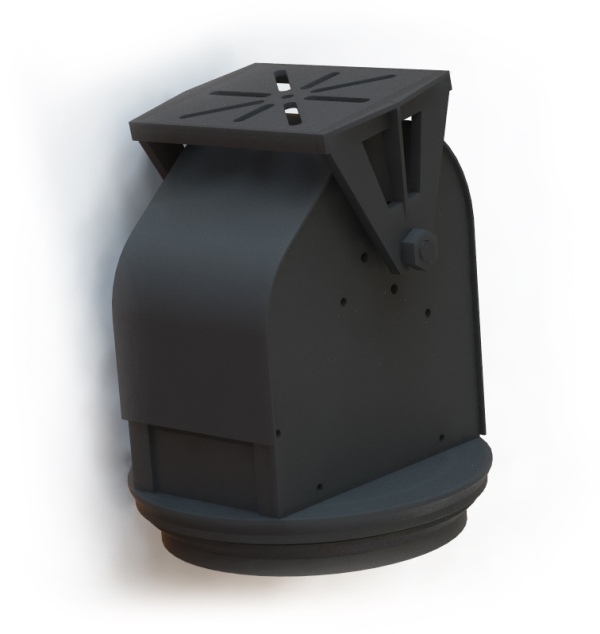
The tracking system consists of two main parts: a control part and the physical structure of the antenna. The control part is responsible for making the two-axis positions of the antenna follow a predefined trajectory during satellite tracking. There are two degrees of freedom for an antenna, namely azimuth, and the elevation angle. The elevation angle is used to define how up in the sky the antenna must face. The azimuth angle, on the other hand, tells us in which direction the antenna should face. An azimuth value ranges from 0 to 360 degrees. Here, north is 0 degrees, and when you change the antenna face to the east, it will be 90 degrees and so on. When you return to facing north, completing the rotation, it will read 360 degrees.
The elevation value ranges from 0 to 180 degrees. When the satellite is overhead, the value will be 90 degrees, and when at the horizon, the value will be 0 degrees. So, it is easy to point at the sky with the help of azimuth and elevation values.
Daniel Nikolajsen from Sweden shared his compact satellite antenna tracking device SATRAN. SATRAN is an azimuth/elevation rotator that can be controlled via an android app and can be 3D printed at home. The rotator of the project has a 3D printed mount that is compatible with many different kinds of antennas.
Daniel says about his project;
This is a continuation of an old project of mine when I built a simple satellite antenna tracker with an android app that calculates the position of any satellite using its “Kepler elements”, and controlling the Az-El antenna rotator to track it across the sky. During a few late nights together with two other ham operators, we built a crappy but functional prototype from spare parts. Now some years later, I decided to redesign it from the ground up as an affordable and easy to use kit.
Read more: SATRAN: A WIFI-CONTROLLED SATELLITE ANTENNA TRACKING SYSTEM
- How does the antenna tracking system adjust its axis?
The system compares received signal levels; if strength increases, it moves in that direction, otherwise it moves opposite. - What are the two main parts of the tracking system?
The control part and the physical structure of the antenna. - Which angles define the antenna's two degrees of freedom?
Azimuth and elevation angle. - What is the range of values for the azimuth angle?
It ranges from 0 to 360 degrees. - How is the elevation angle defined?
It defines how high up in the sky the antenna must face, ranging from 0 to 180 degrees. - Can the SATRAN rotator be built at home?
Yes, the project can be 3D printed at home. - What software controls the SATRAN device?
An Android app controls the device. - What method does the app use to calculate satellite position?
The app calculates position using Kepler elements.
