
Summary of Speaking Calculator using AVR ATmega88 microcontroller
This project is a low-power Speaking Calculator designed for visually impaired users, utilizing only three chips to perform basic math and voice feedback. It features operations like addition and division, memory functions, and voice mode toggling on a 3V battery. The core system relies on an AVR ATmega88 microcontroller for processing, an EEPROM for sound storage, and specific audio components for speech decoding and amplification, all displayed on a small LCD screen.
Parts used in the Speaking Calculator:
- AVR ATmega88 microcontroller
- AT24C1024 two-wire serial EEPROM
- RC-2 speech waveform encoder
- LM4861 Audio Power Amplifier
- MDLS16166 alphanumeric LCD (16 characters x 1 line)
- Keypad
- 3V Battery
- Resistors (two required for RC-2)
- Capacitor (one required for RC-2)
This Speaking Calculator project is an interesting device built just by three chips that can be very useful to blind people. The system has four basic operations (addition, subtraction, multiplication and division), and the functions: clear all, change of sign (+/-), inverse (1/x), square root (v), pi number (p), add with memory (M+) and read from memory (MR). It also has the keys POWER_ON, POWER_OFF and VOICE to change between the Voice and No-voice modes. It works with a battery of 3 volts.
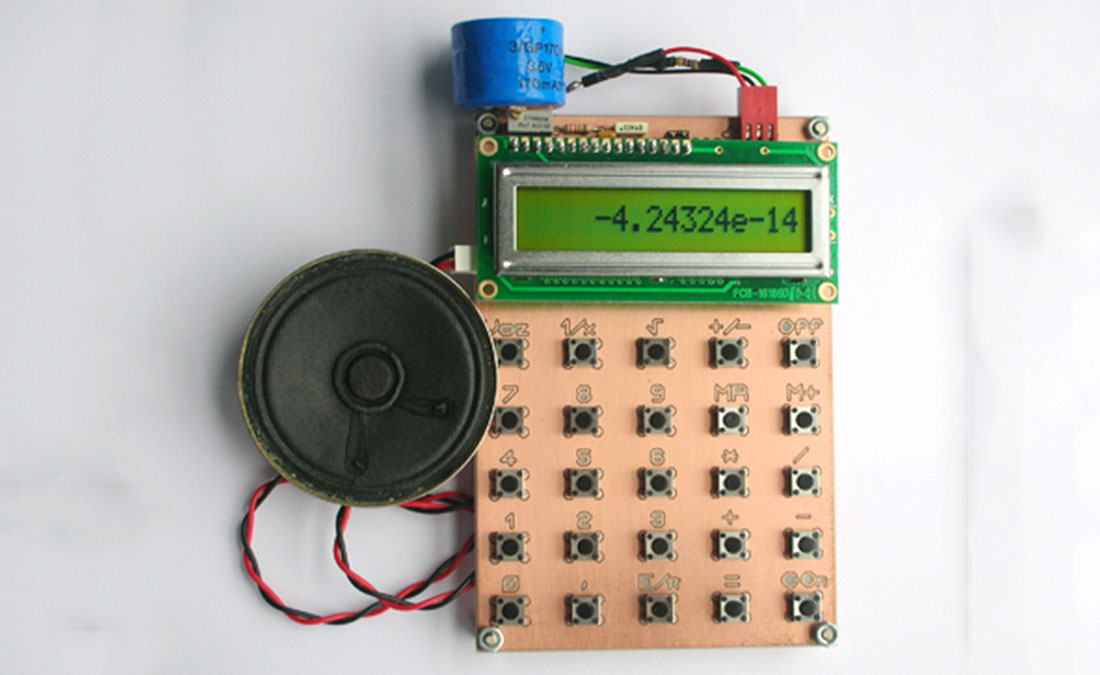
Main component of the system is the AVR ATmega88 microcontroller which has role reading the keypad, doing mathematical calculations, showing the results, voice generating and the handling of the batteryenergy in order to increase its lifetime. The system uses a two-wire serial EEPROM, AT24C1024, that contains the codified sound that the computer uses to communicate the results and to inform on the keys pressed by the human operator.
The Talking Calculator uses the speech waveform encoder RC-2 that needs only two resistors and one capacitor to do voice decoding. The LM4861, an Audio Power Amplifier with Shutdown Mode, is used to amplify the sound. To show the results we use a 3V alphanumeric LCD MDLS16166 of 16 characters x 1 line. The talking calculator is designed by Mariano Barron Ruiz from Spain.
For more detail: Speaking Calculator using AVR ATmega88 microcontroller
- What are the basic mathematical operations supported?
The system supports addition, subtraction, multiplication, and division. - How does the device communicate results to the user?
It uses a codified sound stored in an EEPROM to speak the results and key presses. - Can the calculator change between voice and silent modes?
Yes, it has a VOICE key to toggle between Voice and No-voice modes. - What power source does the calculator use?
The system works with a 3-volt battery. - Which component handles the mathematical calculations?
The AVR ATmega88 microcontroller performs the mathematical calculations. - What audio component is used to amplify the sound?
An LM4861 Audio Power Amplifier with Shutdown Mode is used for amplification. - How many resistors and capacitors are needed for the RC-2 encoder?
The RC-2 speech waveform encoder needs only two resistors and one capacitor. - Does the calculator have memory functions?
Yes, it includes add with memory and read from memory functions.
