
Summary of Volt-Amp meter using AVR microcontroller
This article details a DIY project to build a volt-amp meter using an AVR microcontroller. The device measures voltage from 0 to 30V and current up to 5A. It utilizes a potential divider for voltage sensing and an ACS712 Hall effect sensor for current measurement. The system relies on the microcontroller's 10-bit ADC to convert analog signals into digital values, which are then processed using specific formulas to calculate real-world readings before displaying them on an LCD screen.
Parts used in the Volt-Amp Meter:
- AVR Microcontroller
- Potential Divider (Resistors R1=50k and R2=10k)
- Hall Effect Current Sensor (ACS712 5A chip)
- LCD Display
- Voltage Reference (5V)
Voltage and current are two most important parameters of electricity. This project teaches you to build a simple volt-amp meter using avr microcontroller. This project may not enable you to build a high end measurement tool but will be a good diy project which gives a better understanding on A/D converter in microcontrollers. This meter is capable of measuring voltage ranging from 0 to 30V and current ranging from 0 to 5A. Care must be taken while using so that the input should not exceed the specifications.
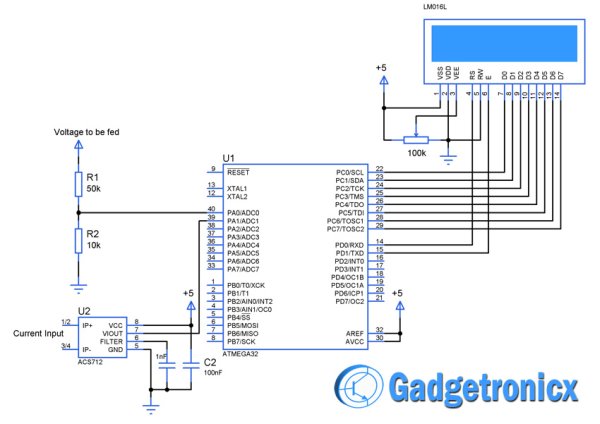
SETTING UP THE SENSORS:
VOLTAGE MEASUREMENT:
A simple potential divider is employed to measure the voltage. The above potential divider was set up in such a way it gives 5v as output when 30v input is applied to it since the input voltage given to AVR should be less than or equal to 5V.
The formula for setting the potential divider resistor is
Vout = Vin x R2 / (R1 + R2)
We knew our Vout should be <= 5V. So applying this and fixing a resistor R2 as 10k will give
5v = 30 x 10k /(R1 + 10k)
R1 = 50k.
CURRENT MEASUREMENT:

We are using a pretty straight forward approach to measure current. Here we are using a Hall effect current sensor to measure current. This sensor can measure current up to 5A. 1A of current is equivalent to 185mv of change in output voltage. There are also 20A and 30A version of this chip available. Read more about this sensor here.
CALIBRATION:
The next task is to perform the calibration to display the real values using our Microcontroller. So in order to do that we need to know the Step Size of our A/D converter in AVR microcontroller. It was given by the formula
Step size = Vref / 2^10 (Since it is a 10 bit ADC) .
= 5/1024 = 4.88mv
This is the step size of our A/D converter in AVR microcontroller that is for every 4.88mv change in input there will be a change in ADC value in the register.
TO CALCULATE VOLTAGE:
As i have previously mentioned the voltage sensing is done by using a Voltage divider which bears the formula
Vout = Vin x R2 / (R1 + R2)
Am going to use this formula to derive the real voltage from the sensed voltage. Since we obtain the sensed voltage in the form of digital numbers we need to make a conversion to obtain Vout value from it. So
Vout = Digital Value read from A/D register * Vref / 2^10
Vout = Digital Value read from A/D register * 5 / 1024 , Simplifying this we get
Vout = Digital Value * 0.00488
This will give us exact Vout voltage from the voltage divider, now applying this Vout in the divider equation will give the real voltage given as input to the voltage divider.
Vin= Vout * (R1+R2) /R2
Vin = Vout * 60k / 10K
Vin = Vout * 6
The above final equation i have added in the 41 line of the code, This will give the real voltage that needs to be measured and displayed.
TO CALCULATE CURRENT:
The IC ACS712 5A chip gives out 185mA of voltage change in the output when there is a 1A change in the current flow. And the nominal voltage will be of 2.5 Volts so the ADC always reads 2.5 V even if there is no current through it.
Vout = Digital value read from the A/D register * 5 /1024 , simplifying we get
Vout = Digital value * 0.00488
So the real value of current can be given as
Amp = (Vout – Nominal Voltage) / 185mA (Change in output voltage of sensor)
Amp = (Vout – 2.5) / 0.185
This equation was added in the line 54 of the code. I have replaced Amp with available float variable Vin in the code to cut down the code size.
CODE:
#include<avr/io.h>
#define F_CPU 8000000UL
#include<util/delay.h>
#include<stdio.h>
double vin;
double vout;
unsigned int value;
char output[6];

void lcd_cmd(char cmd)              //Command sub routine LCD
{
   PORTC=cmd;
   PORTD&=~(1<<0);
   PORTD|=(1<<1);
   _delay_ms(5);
   PORTD&=~(1<<1);
   _delay_ms(5);
}

void lcd_data(char *txt)         //Data sub routine LCD
{
   while(*txt!='\0')
   {
   PORTC=*txt;
   PORTD|=(1<<0);
   PORTD|=(1<<1);
   _delay_ms(5);
   PORTD&=~(1<<1);
   _delay_ms(5);
   txt++;
    }
}

void voltage(void)             //Sub routine to read voltage
{
  ADMUX|=(1<<0);
  ADCSRA|=(1<<6);
  while(ADIF==0);
  value=ADCL|ADCH<<8;
  vout=value*0.00488;             //To determine output Voltage from sensor
  vin=6*vout;                    //To determine real voltage
  sprintf(output,"%.2f",vin);
  lcd_cmd(0x86);
  lcd_data(output);
}

void current(void)
{
  ADMUX&=~(1<<0);
  ADCSRA|=(1<<6);
  while(ADIF==0);
  value=ADCL|ADCH<<8;
  vout=value*0.00488;            //To determine output voltage from sensor
  vin=(vout-2.5)/0.185;          //To determine real current
  sprintf(output,"%.2f",vin);    //Float to char conversion for printing
  lcd_cmd(0xc6);
  lcd_data(output);
}

int main(void)
{
  DDRC=0xff;
  DDRD=0x03;
  PORTC=0x00;
  PORTD=0x00;
  lcd_cmd(0x38);
  lcd_cmd(0x01);
  lcd_cmd(0x0c);
  lcd_cmd(0x80);
  lcd_data("VOLTS:");
  lcd_cmd(0xc0);
  lcd_data("CURNT:");
  ADMUX=0x00;
  ADCSRA=0x87;                     //Initializing A/D converter
  while(1)
   {
    voltage();            //Voltage display
    _delay_ms(10);
    current();           //Current Display
   }
  return 0;
}
NOTE:
- Care must be taken so that the input parameters (voltage & current) should not exceed the limitations.
- You can change the limitations by replacing the sensors and must be calibrated accordingly.
Related content
Read More: Volt-Amp meter using AVR microcontroller
- What range of voltage can this meter measure?
The meter is capable of measuring voltage ranging from 0 to 30V. - How does the project measure current?
It uses a Hall effect current sensor, specifically the ACS712 5A chip. - What is the step size of the A/D converter in this project?
The step size is calculated as 4.88mV based on a 10-bit ADC with a 5V reference. - Does the current sensor output a voltage when there is no current flow?
Yes, the nominal voltage is 2.5 Volts even if there is no current through it. - How is the real voltage calculated from the digital value?
The formula used is Vin equals Vout multiplied by 6, derived from the resistor ratio. - Can the measurement limitations be changed?
Yes, you can change limitations by replacing the sensors and calibrating accordingly. - What happens if the input exceeds the specifications?
Care must be taken so that the input should not exceed the specifications. - What is the voltage change equivalent for 1 Ampere of current?
1A of current is equivalent to 185mV of change in output voltage.
