
Summary of Multi-channel temperature logger using Atmega48 microcontroller
This article details a project using an Atmega48 microcontroller to monitor temperature via its 8 ADC channels. It employs LM335 sensors and the chip's built-in USART for serial communication at 19200 baud, driven by a 9.21 MHz clock. A Python script on the PC logs the incoming data.
Parts used in the Multi-channel Temperature Logger:
- Atmega48 microcontroller
- LM335 temperature sensor
- PC running Python software
This project describes how to use all the 8 ADC channels of an Atmega48 microcontroller to read temperature sensors and the measured data to a PC for logging by using the built-in USART capabilities of the chip.
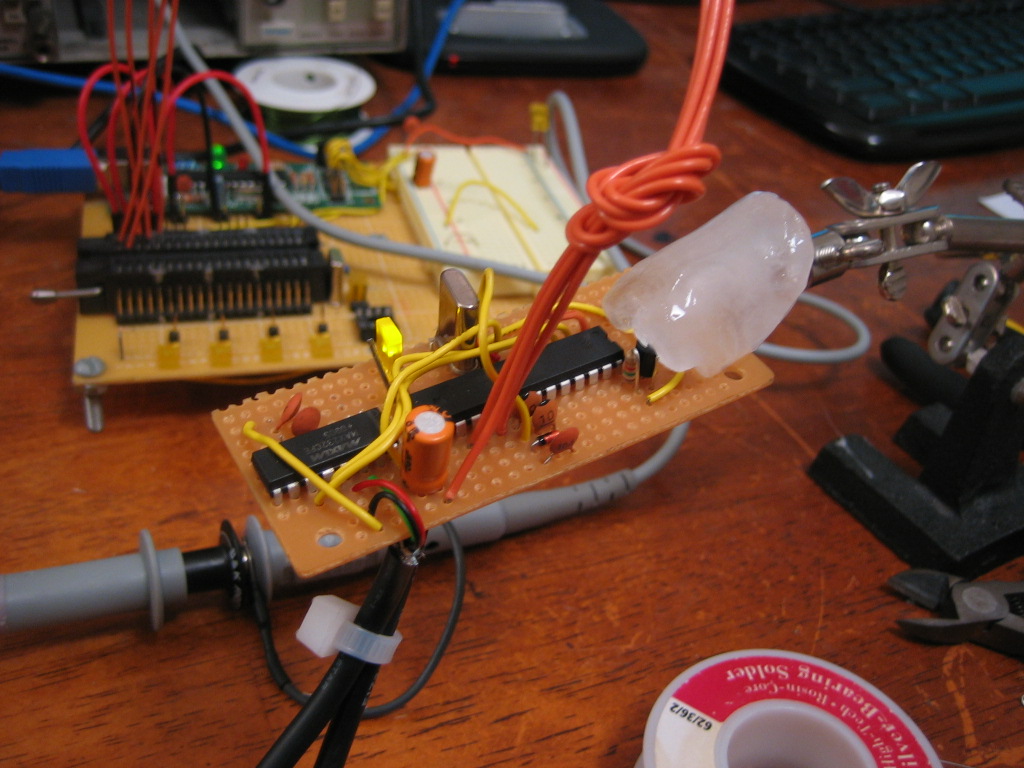
For demonstration, the temperature sensor used is LM335 that gives an output voltage proportional to the Kelvin temperature. The microcontroller is operated with a 9.21 MHz clock that works well for serial communication at 19200 baud. The software running on the PC is written in Python that keeps looking at the serial port and receives the incoming data.
For more detail: Multi-channel temperature logger using Atmega48 microcontroller
-
How many ADC channels does the Atmega48 use in this project?
The project utilizes all 8 ADC channels of the Atmega48 microcontroller. -
What type of temperature sensor is used for demonstration?
An LM335 sensor is used, which outputs a voltage proportional to Kelvin temperature. -
What clock speed operates the microcontroller?
The microcontroller is operated with a 9.21 MHz clock. -
At what baud rate is serial communication configured?
The system works well for serial communication at 19200 baud. -
Which programming language is used for the PC software?
The software running on the PC is written in Python. -
How does the PC receive the measured data?
The Python software keeps looking at the serial port to receive incoming data. -
What capability of the chip allows data transmission to the PC?
The built-in USART capabilities of the chip are used for logging data.
