
Summary of 125 kHz RFID reader based on ATtiny13
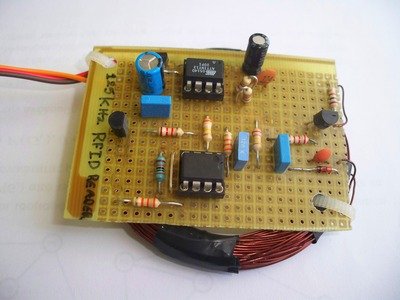
This project is a 125 kHz RFID reader using an ATtiny13 that reads EM4100-format 10-digit tag IDs (cards or key fobs) and outputs them as ASCII at 2400 bps, with a buzzer indicating successful reads. The ATtiny13 generates a 125 kHz drive on PB0 to energize coil L1, creating an electromagnetic field that powers tags; received signals are demodulated and decoded. The circuit includes a transistor switching network, resonant LC, demodulator, and serial output.
Parts used in the 125 kHz RFID reader based on ATtiny13:
- ATtiny13 microcontroller
- L1 coil (reader coil)
- C2 (resonant capacitor with L1)
- T1 transistor (switching transistor)
- R1 100 ohm resistor
- D1 diode (part of demodulator)
- C3 capacitor (part of demodulator)
- R5 resistor (part of demodulator)
- Buzzer
- Power supply +5V and ground connections
- Serial output interface for 2400 bps ASCII transmission
Introduction
This RFID reader works with 125 kHz tags in credit card size shape cards and with 125 kHz key fobs (picture 1). The EM4100 protocol is used. When you approach an RFID Tag close enough (4-5 cm) to the reader’s coil (L1) the reader will read the 10-digit unique ID of the Tag and transmit it as ASCII characters trough the serial output with 2400 bits per second.
The circuit includes a buzzer that beeps when a Tag is read successfully.
Description
I will try to explain with simple words how the RFID works. The ATtiny13 uses the PWM function to produce an 125 kHz square wave signal. This signal comes out from PB0 pin. On the falling edge of the PB0 (Logic ‘0’), the T1 does not conduct.So the L1 is energized from R1 (100 ohm) with +5V. When PB0 pin is rising (Logic ‘1’) the T1 is conducting and one side of L1 goes to GND. The L1 goes in parallel with C2 creating an LC oscillator. These transitions of L1 to logic ‘1’ and logic ‘0’ are made 125000 times in one second (125 kHz).
Picture 3: The 125 kHz waveform that is transmitted from L1 and C2 components.
The RFID reader provides energy to the transponder (Tag) by creating an electromagnetic field. The energy transmission between the RFID reader and the Tag is the same as transformers convert the voltage from the 220V AC power network to 12V AC, based on the magnetic field that creates the primary coil. In our case the primary coil is the RFID reader and the secondary coil is the RFID tag. The only difference is that on RFID circuits there is no iron core between the two coils (one coil is on the reader side and the other coil is in to the RFID tag). The D1 ,C3 and R5 components constitute an AM signal demodulator (AM = Amplitude Modulation) .
For more detail: 125 kHz RFID reader based on ATtiny13
- What tag types does this RFID reader work with?
It works with 125 kHz tags in credit card size and 125 kHz key fobs using the EM4100 protocol. - What data does the reader output when a tag is read?
The reader outputs the tag's 10-digit unique ID as ASCII characters. - At what serial speed does the reader transmit tag IDs?
Tag IDs are transmitted through the serial output at 2400 bits per second. - What generates the 125 kHz signal in the circuit?
The ATtiny13 uses its PWM function on PB0 to produce the 125 kHz square wave. - How far must a tag be from the coil to be read?
A tag must be approximately 4–5 cm from the reader coil (L1) to be read. - Which components form the LC resonant circuit?
The L1 coil and capacitor C2 form the LC resonant circuit transmitting the 125 kHz field. - How does the reader provide energy to the tag?
The reader creates an electromagnetic field with the primary coil (L1) which inductively transfers energy to the tag's coil similar to a transformer without an iron core. - What components form the AM demodulator?
The D1 diode, C3 capacitor, and R5 resistor constitute the AM demodulator. - What indicates a successful tag read?
The circuit includes a buzzer that beeps when a tag is read successfully.
