
Summary of 24VAC to 5VDC Conversion
This article explains converting 24VAC to 5VDC for home automation devices using a half-wave rectifier. It details the necessity of selecting diodes based on peak reverse voltage (68V) derived from RMS values and smoothing output with a capacitor.
Parts used in the 24VAC to 5VDC Conversion Project:
- Half-wave rectifier
- Diode
- Capacitor
- Single power supply
- Control circuit
Voltage conversion from 24VAC to 5VDC is quite useful, because a lot of home automation devices use 24VAC, including sprinkler solenoids, home surveillance systems etc. Having a conversion module makes it easy to use a single power supply, without a separate 5V adapter for your control circuit. There are plenty of resources you can find online about it. But these resources are rather scattered. So in this blog post I will summarize and discuss the common choices.
AC to DC Rectification
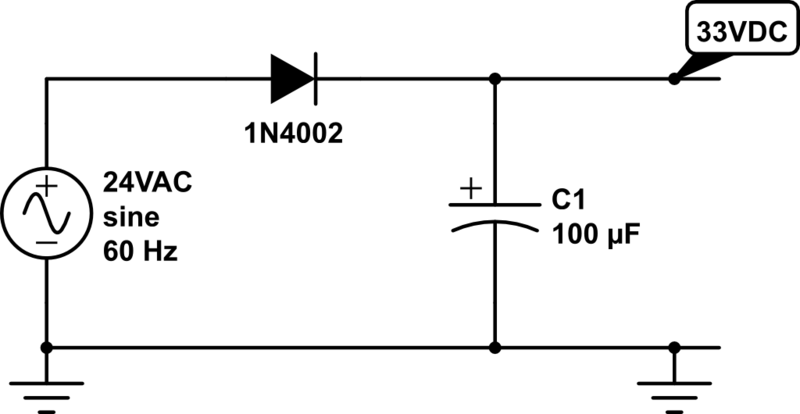
Before we begin, the first step is to have a rectifier that converts voltage from AC to DC. The common choices are half-wave rectifier (which requires just one diode) or full-wave rectifier (which requires four diodes). For simplicity, I will use half-wave rectifier as an example. The typical schematic of a half-wave rectifier is as follows:
It’s simply a diode followed by a capacitor to smooth out the rectified AC waves. As we know, diode only allows current to flow in one direction, so after the AC voltage passes through the diode, only positive voltage remains. The diode must be selected based on the maximum reverse voltage and the maximum current. One thing easy to forget is that when we talk about 24VAC, we mean the RMS (root-mean squared) magnitude of the voltage is 24V. Since AC voltage is a sine wave, the peak voltage is actually 24 * sqrt(2) = 34V, which is quite a bit higher. The maximum reverse voltage applied on the diode is therefore 34 – (-34) = 68V, which is when the AC voltage runs to the negative peak. So a diode with 70V peak reverse voltage is sufficient.
For more detail: 24VAC to 5VDC Conversion
-
Why is converting 24VAC to 5VDC useful?
It allows home automation devices like sprinkler solenoids and surveillance systems to use a single power supply without separate 5V adapters. -
What are the common choices for AC to DC rectification?
The common choices are a half-wave rectifier requiring one diode or a full-wave rectifier requiring four diodes. -
How does a half-wave rectifier work?
It uses a diode followed by a capacitor to allow current to flow in one direction, leaving only positive voltage, while the capacitor smooths the waves. -
How do you calculate the peak voltage from 24VAC?
The peak voltage is calculated by multiplying the RMS value by the square root of two, resulting in approximately 34V. -
What is the maximum reverse voltage applied to the diode?
The maximum reverse voltage is 68V, occurring when the AC voltage reaches its negative peak. -
Which diode specification is sufficient for this project?
A diode with a 70V peak reverse voltage rating is sufficient to handle the 68V maximum reverse voltage.
