
Summary of 27 MHZ WIRELESS KEYBOARD SPY CIRCUIT ATMEL ATMEGA64
The article describes a 27 MHz wireless keyboard spy circuit using an Atmel ATmega64 microcontroller that captures keystrokes from a Microsoft wireless multimedia keyboard and stores them to an SD card or forwards via USB/Wi‑Fi with a stronger antenna. It links to schematics, PCB files, source code, and sample code for building and adapting the project.
Parts used in the 27 MHz Wireless Keyboard SPY Circuit:
- Atmel ATmega64 microcontroller
- 27 MHz wireless keyboard (Microsoft wireless multimedia keyboard used for tests)
- RF receiver module tuned to 27 MHz
- SD card and SD card socket
- USB interface circuitry for PC connection
- Wi‑Fi antenna or external RF antenna for improved signal reception
- Power supply components (regulators, capacitors)
- PCB (EAGLE schematic and PCB layout provided)
- Miscellaneous passive components (resistors, capacitors)
- Connectors and wiring
In an article “Symantec warns: each word or phrase that you enter on the wireless keyboard, can be tracked!” Was called I knew it was true, but such a project would never have thought… Electronics Projects, 27 MHz Wireless Keyboard SPY Circuit Atmel ATmega64 “avr project, microcontroller projects, “
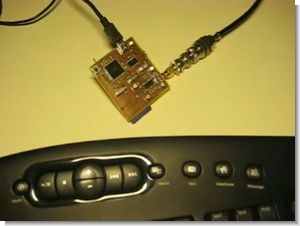
In an article “Symantec warns: each word or phrase that you enter on the wireless keyboard, can be tracked!” Was called I knew it was true, but such a project would never have thought I’d reached on the web
Circuit else is going on what is written in the wireless keyboard can be sent to computers for most of our tests uses a “microsoft wireless multi media” is done on the keyboard
WIRELESS KEYBOARD SPY
Wireless keyboard spy circuit ATmega-64 based on the usb link with the can be made sd card division, guess computer connection when it is not on the card data is written wi-fi antenna input, though there was a, we use the keyboard, the signal is very weak, but the circuit with a powerful antenna is connected happens wonder
All details have been shared source code files, etc. şema.pcb eagle. uygulamasa who work on the project with ATmega64 usb for communication, literacy issues sd card can sample codes feyza ready to PCBs may be edited for different projects drawing
WIRELESS KEYBOARD SPY TEST
source: https://320volt.com/en/atmega64-27mhz-kablosuz-klavye-casus-devresi/ Wireless Keyboard SPY schematic source code files alternative link 27mhz-wireless-keyboard-spy-circuit-atmel-atmega64.rar alternative link2 alternative link3
- What microcontroller is used in the project?
The project uses an Atmel ATmega64 microcontroller. - Can captured keystrokes be stored locally?
Yes, the circuit can write captured data to an SD card. - Does the project support USB communication to a PC?
Yes, the project uses USB for communication with a computer. - What keyboard was used in most tests?
Tests mainly used a Microsoft wireless multimedia keyboard. - Is an external antenna necessary?
The keyboard signal is weak, and connecting a more powerful antenna improves reception. - Are schematics and source code available?
Yes, schematics, PCB files, and source code files are provided via linked downloads. - Can the provided PCBs be edited for other projects?
Yes, the PCBs may be edited for different projects. - Does the project offer sample code for SD card use?
Yes, sample codes for SD card use are included.
