
Summary of Top 10 Rogers PCB Manufacturers in China
### Summary This article guides buyers in identifying reliable Rogers PCB manufacturers in China by distinguishing between suppliers with genuine RF expertise and those merely using "Rogers" as a keyword. It details the critical technical requirements for high-frequency boards, such as PTFE handling, plasma treatment, and material traceability. The text evaluates ten specific manufacturers—Bicheng, Riching, RayPCB, Kejie, PCBCool, HXP Circuit, PCBTok, iPCB, Haoda Electronic, and Meidear—highlighting their stated capabilities, Rogers material lists (e.g., RO4350B, RT/duroid), layer counts, and necessary verification steps for quality assurance.
Parts used in the Rogers PCB Manufacturing Projects:
- Rogers hydrocarbon-ceramic laminates
- Rogers PTFE materials
- Taconic laminates
- Wangling laminates
- F4B materials
- Bondply layers (including RO4450F)
- Copper foil profiles
- Mixed-dielectric stackups (Rogers plus FR-4)
- Plasma treatment equipment
- Test coupons for Dk/Df verification
Searching for a Rogers PCB manufacturer in China is not as straightforward as it may seem. Many suppliers use “Rogers PCB” as a search term, but that does not necessarily mean they have meaningful experience with RF stackups, PTFE or hydrocarbon-ceramic laminates, bondply selection, controlled impedance, plasma treatment, or material traceability.
These details matter because a high-frequency board can look perfectly acceptable and still miss its electrical targets. Rogers laminates are commonly used in antennas, radar systems, satellite communications, microwave instruments, RF power circuits, filters, and high-speed digital hardware, where small changes in dielectric thickness, copper profile, or etching can affect performance. For a side-by-side comparison of Dk, Df, thermal performance, thickness options, and typical applications, see this Rogers PCB material specifications table.
The manufacturers below were selected because their official websites publish information related to Rogers materials, RF and microwave boards, high-frequency laminates, or mixed-dielectric construction. This is not a revenue ranking, and inclusion does not mean that every supplier is suitable for every RF design. Some companies focus heavily on high-frequency PCBs, while others offer Rogers materials as part of a broader PCB or EMS portfolio.
Bicheng PCB
Introduction
Bicheng PCB is one of the more clearly RF-focused manufacturers in this group. According to its company profile, Shenzhen Bicheng Electronics Technology was founded in 2003 and operates as a high-frequency PCB supplier and exporter.
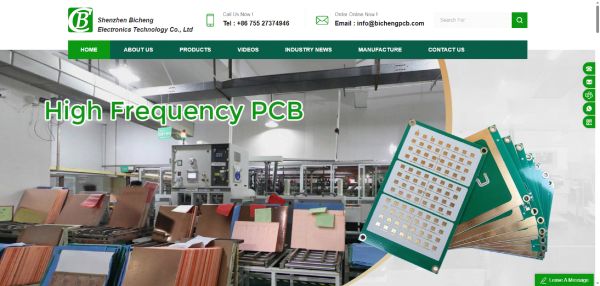
Its published application areas include cellular base-station antennas, satellite systems, high-frequency passive components, microstrip and stripline circuits, millimeter-wave equipment, radar, and digital RF antennas.
Bicheng says its high-frequency boards are primarily manufactured with materials from Rogers, Taconic, and Wangling, covering dielectric constants from 2.2 to 10.2. The company also publishes product examples and technical content related to RO4350B and other Rogers constructions.
That RF-specific positioning makes Bicheng a reasonable starting point for microwave and antenna projects. Material certificates, copper type, impedance data, and actual manufacturing location should still be confirmed during qualification.
Capabilities
Capability item Published information What to verify
Founded and base Founded in 2003 and based in Shenzhen, China. Confirm the current legal entity, factory address, and export account details.
Manufacturing footprint The official site presents Bicheng as a Shenzhen high-frequency PCB supplier and exporter. Ask which processes are completed in-house and whether any RF production steps are subcontracted.
International service The company says it serves high-frequency applications worldwide. Request references or examples involving similar RF board structures when project risk is high.
Core scope High-frequency, FR-4, flexible, metal-core, HDI, quick-turn, controlled-impedance, heavy-copper, and backplane PCBs. Make sure the quoted process route is intended for RF materials rather than standard FR-4 production.
Rogers capability Rogers, Taconic, and Wangling materials; dielectric constants from 2.2 to 10.2; several RO4350B examples. Confirm the exact laminate, bondply, copper foil, stackup, and impedance test method.
Quality signals Company pages refer to ISO 9001, ISO 14001, IATF 16949, UL, and RF manufacturing experience. Request current certificates and lot-level laminate documentation.
RFQ checks The site provides useful RF application and material information. Ask for TDR or RF coupon results, Dk assumptions, etch compensation, and surface-finish recommendations.
Official sources Bicheng company profile and RO4350B product pages. Use current supplier documents for final approval.
Riching PCB
Introduction
Riching PCB describes itself as a direct high-frequency PCB manufacturer in Shenzhen rather than a trading company. Its public RF capability information goes beyond the usual material list and addresses several process issues that matter in production.
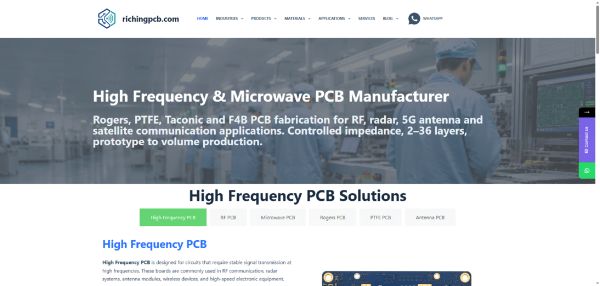
The company discusses Rogers hydrocarbon-ceramic laminates, Rogers PTFE materials, Taconic, F4B, mixed FR-4 and high-frequency stackups, plasma activation for PTFE, TDR testing, and metallographic microsection inspection.
Riching lists standard production from 2 to 32 layers, with advanced builds reaching 50 layers. Its site also provides prototype and production lead-time ranges and refers to impedance verification through test coupons.
The company’s founding year is less clearly presented, but for an RF project the more important question is whether its published processes can be tied to the specified material lot, stackup, and inspection plan.
Capabilities
Capability item Published information What to verify
Founded and base Based in Shenzhen; the founding year is not clearly stated on the page reviewed. Request the legal company profile and establishment date if required for onboarding.
Manufacturing footprint Riching states that it operates as a direct factory with its own equipment and engineering team. Confirm the factory address and whether plasma treatment, TDR, electrical testing, and microsection analysis are performed in-house.
International service The site is written for overseas RF PCB customers and provides engineering-oriented order guidance. Confirm export procedures, document availability, and direct access to engineering staff.
Core scope Rogers, PTFE, Taconic, F4B, hybrid FR-4, controlled-impedance, prototype, and volume PCB production. Establish whether the project requires PTFE, hydrocarbon ceramic, Taconic, F4B, or a hybrid stackup.
Rogers capability RO4350B, RO4003C, RO3003, RO3006, RO3010, RT/duroid 5880, and RT/duroid 5870; 2–32 layers standard and up to 50 layers for advanced work. Require laminate certificates, a lamination plan, copper foil details, coupon data, and evidence of PTFE hole-wall preparation.
Quality signals The site mentions TDR, flying-probe testing, microsection inspection, and IPC Class 2 and Class 3 options. Ask which inspections are standard, which are optional, and whether reports are supplied with the order.
RFQ checks Riching publishes more RF process information than many general PCB suppliers. Confirm which advanced limits can be combined, particularly on high-layer PTFE boards with fine features.
Official sources Riching high-frequency factory and company pages. Reconfirm all limits during stackup review.
RayPCB
Introduction
RayPCB is the public-facing brand of RayMing Technology. The company says it was established in 2005 and provides PCB fabrication, PCB assembly, and component sourcing to customers worldwide.
Its broader product range includes Rogers PCB, Teflon PCB, high-frequency boards, HDI, aluminum PCB, flexible circuits, and rigid-flex boards.
RayMing also operates an RF-focused company website that describes double-sided and multilayer Rogers PCB manufacturing. That site lists materials or constructions associated with RO4003C, RO3003, RO4350B, RT/duroid 5880, RT/duroid 5870, and RO4450F bondply.
Some of the material names on the page use unusual prefixes, so buyers should confirm the exact Rogers product designation rather than copying the wording directly into a purchase specification.
Capabilities
Capability item Published information What to verify
Founded and base RayPCB and RayMing state that the company was established in 2005; the RF-focused site lists a Shenzhen headquarters. Confirm the legal entity, factory address, and ownership of the RF-focused domain.
Manufacturing footprint Company pages describe PCB production and assembly, with older pages referring to manufacturing resources in Shenzhen and Jiangxi. Ask which plant manufactures Rogers boards and where assembly is completed.
International service RayPCB says it works with companies of different sizes worldwide. Confirm communication coverage, shipping terms, and the standard documentation package.
Core scope PCB manufacturing, PCB assembly, component sourcing, prototype assembly, turnkey, partial-turnkey, and final assembly. Keep RF bare-board requirements separate from assembly and component-sourcing responsibilities.
Rogers capability Rogers and Teflon PCBs, including material references associated with RO4003C, RO3003, RO4350B, RT5880, RT5870, and RO4450F. Request original laminate certificates and confirm exact product names and thicknesses.
Quality signals The company refers to IPC Class 3 capability, cleanliness controls, heavy copper, and tight tolerances. Confirm which IPC class applies to the quoted order and what inspection records are included.
RFQ checks RayPCB combines RF board production with broader turnkey EMS services. Define who owns stackup review and electrical validation before assembly begins.
Official sources RayPCB company profile and RayMing RF-focused pages. Verify the company relationship and material data before approval.
Kejie PCB
Introduction
Kejie PCB is a China-based Rogers PCB manufacturer offering rigid, flexible, rigid-flex, HDI, high-frequency, and assembled PCBs. The company is based in Meizhou, Guangdong, with assembly operations later expanded to Shenzhen and Dongguan, and serves customers across the United States, Europe, Asia, and other international markets.

Its high-frequency capability page lists Rogers and TMM laminates for RF, microwave, and millimeter-wave applications, including RO4003C, RO4350B, RO3006, RO3010, RO4360G2, and several TMM grades. Published limits include 2 to 20 layers, frequencies up to 40 GHz, 0.1/0.1 mm trace and spacing, and controlled impedance within ±5%.
These figures are useful for initial screening, but buyers should still confirm how the impedance tolerance applies to the required stackup, copper profile, and production volume.
Capabilities
Capability item Published information What to verify
Founded and base The company says it was established in the late 1990s and is based in Meizhou, Guangdong. Confirm the legal founding date and the plant responsible for RF board production.
Manufacturing footprint Group contacts are listed in Meizhou, Shenzhen, and Hong Kong, with assembly expansion also referenced in Dongguan. Confirm which entity handles the quote, fabrication, assembly, and export paperwork.
International service Kejie says it serves customers in the United States, Europe, Asia, and more than 100 countries overall. Review engineering response times, logistics, and regional support.
Core scope Rigid, flex, rigid-flex, HDI, high-frequency PCB, and PCB assembly. Treat RF material review and PCBA review as separate engineering steps.
Rogers capability RO3000, RO4000, and TMM series; up to 40 GHz; 2–20 layers; 0.254–3.2 mm thickness; 0.1/0.1 mm trace and spacing; ±5% controlled impedance. Confirm laminate availability, traceability, and the conditions under which the impedance tolerance applies.
Quality signals The company emphasizes DFM review, engineering support, and project-specific material sourcing. Request RF coupon results, measurement reports, and acceptance criteria.
RFQ checks The website provides useful material and process details. Supply frequency, loss budget, copper profile, laminate grade, and stackup constraints at the beginning of the RFQ.
Official sources Kejie company, contact, and high-frequency PCB pages. Use project-specific engineering confirmation for final limits.
PCBCool
Introduction
PCBCool is the digital PCB and electronics manufacturing brand of PS Electronics. Its Rogers capability is part of a broader PCB, PCBA, testing, and box-build service rather than a narrowly focused RF-only business.
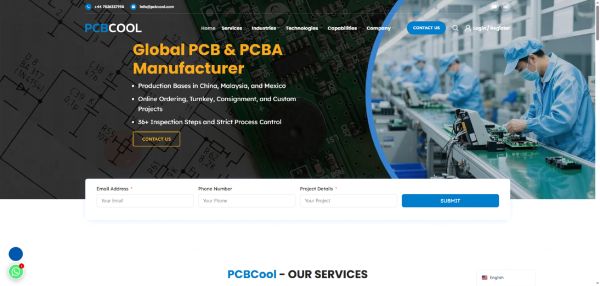
The company lists manufacturing resources in China, Malaysia, and Mexico. Its published material range includes Rogers 4350B, RO3003, RO4003C, RT/duroid 5880, Taconic, Teflon, and mixed-lamination structures.
Additional capability information refers to Rogers, Taconic, Arlon, Isola, F4B, Panasonic, and Nelco materials, as well as Rogers-plus-FR-4 and PTFE-plus-FR-4 stackups.
This broader production model may suit customers that need both an RF bare board and downstream assembly. In that case, responsibility for RF validation should be defined separately from assembly inspection and functional testing.
Capabilities
Capability item Published information What to verify
Founded and base PCBCool is backed by PS Electronics, which reports nearly 20 years of PCB and PCBA experience. Confirm the legal contracting entity and the facility that will fabricate the RF bare board.
Manufacturing footprint The company lists production resources in China, Malaysia, and Mexico, along with regional support in the United States. Confirm separate routes for bare PCB fabrication, assembly, and testing.
International service PCBCool says it supports global customers through multiple manufacturing and service locations. Review export documents, account coverage, logistics, and after-sales responsibility.
Core scope PCB fabrication, Rogers and other high-performance materials, component sourcing, PCB assembly, testing, box build, and delivery. Define whether the order covers only the bare RF board or a complete assembled product.
Rogers capability Rogers 4350B, RO3003, RO4003C, RT5880, Taconic, Teflon, mixed lamination, and broader RF/high-speed material options including Arlon, Isola, F4B, Panasonic, and Nelco. Confirm laminate lot, Dk and Df assumptions, copper foil, frequency range, impedance tolerance, and coupon design.
Quality signals Published inspection options include AOI, bare-board electrical testing, SPI, X-ray, ICT, and FCT. Separate bare-board RF verification from PCBA inspection and final functional testing.
RFQ checks The company’s main advantage is integration from PCB production through assembly and box build. Request a dedicated RF DFM review and an assembly/test plan as separate deliverables.
Official sources PCBCool company profile, factory network, and manufacturing capability pages. Treat published values as screening information until the stackup is reviewed.
HXP Circuit
Introduction
Guangdong HuiXinPu Circuit, also known as HXP Circuit, says it began as Dongguan HuiXinPu Circuit in 2011. The company reports opening a new factory in Guangdong in 2021, serving overseas customers since 2013, and operating an international sales office in Shenzhen.
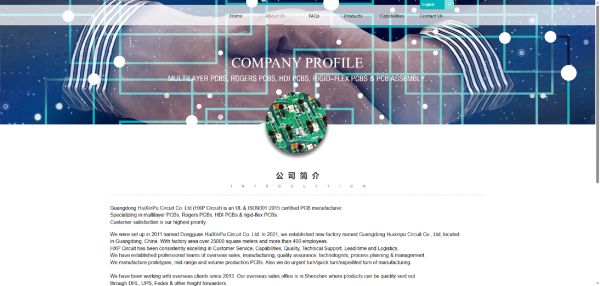
Its RF capability is stated directly. HXP lists Rogers PCB, Rogers-on-copper-base construction, Rogers and FR-4 TG170 hybrid boards, high-frequency laminates, controlled impedance, blind and buried vias, back drilling, and edge plating.
That range makes HXP particularly relevant to projects involving mixed-material or thermally demanding RF boards rather than only simple two-layer antenna circuits.
Capabilities
Capability item Published information What to verify
Founded and base Established in 2011 as Dongguan HuiXinPu Circuit; a new Guangdong factory was opened in 2021; overseas sales are supported from Shenzhen. Confirm the current factory address and whether all entities operate under the same quality system.
Manufacturing footprint The company lists a factory area of more than 25,000 square meters and over 400 employees. Ask which site performs RF lamination, drilling, plating, imaging, and testing.
International service HXP says it has served overseas customers since 2013 and ships through major couriers and freight forwarders. Confirm export paperwork, response time, and technical communication procedures.
Core scope Multilayer, Rogers, HDI, rigid-flex, components, stencils, and PCB assembly. Define responsibility for the bare board, components, stencils, and assembly.
Rogers capability Rogers PCB, Rogers on copper base, Rogers plus FR-4 TG170 hybrids, 4–20-layer HDI, controlled impedance, blind and buried vias. Confirm the exact laminate, bondply, coupon design, and thermal-mechanical limits.
Quality signals UL, ISO 9001:2015, and RoHS compliance are listed. Request current certificates and sample inspection reports.
RFQ checks HXP publishes a broad selection of special PCB processes. Ask which processes can be combined reliably in the same Rogers hybrid build.
Official sources HXP company profile and capability pages. Confirm the final process window at the project level.
PCBTok
Introduction
PCBTok is a trademark of MV Circuit Technology. According to its company profile, the business was founded in 2008, maintains an office in Shenzhen, and operates a PCB factory in Jiangxi Province.
The company covers both bare-board production and PCB assembly and says it has worked with more than 3,000 customers worldwide.
Its product range includes Rogers, high-frequency, multilayer, HDI, flexible, rigid-flex, aluminum, ceramic, and metal-core PCBs. The same profile refers to AOI, flying-probe testing, ICT, X-ray, fixture testing, microsection analysis, certificates of conformity, and IPC Class 2 and Class 3 inspection.
These are useful qualification signals, but buyers should determine whether Rogers material handling and RF coupon measurement are routine processes at the Jiangxi factory or arranged only for selected projects.
Capabilities
Capability item Published information What to verify
Founded and base Founded in 2008; office in Shenzhen and factory in Jiangxi Province. Confirm the MV Circuit Technology legal entity and current plant address.
Manufacturing footprint The company lists more than 13,000 square meters of factory space and equipment for PCB fabrication and assembly. Confirm which equipment and production area are used for high-frequency materials.
International service PCBTok says it supports more than 3,000 customers worldwide. Ask about export documentation, engineering communication, and similar RF customer programs.
Core scope PCB fabrication, SMT, BGA assembly, through-hole assembly, and turnkey PCBA. Clarify whether the project will be supplied as a bare RF PCB or an assembled board.
Rogers capability Rogers, high-frequency, HDI, multilayer, ceramic, aluminum, flex, and rigid-flex boards are listed. Request the available laminate grades, stackup review, impedance tolerance, and material certificates.
Quality signals ISO 9001:2015, ISO 14001:2015, UL, RoHS, AOI, flying probe, ICT, X-ray, microsection, and IPC Class 2/Class 3 are listed. Confirm which reports are included as standard and which require an additional charge.
RFQ checks PCBTok is a broad PCB and PCBA supplier rather than an RF-only manufacturer. State the RF constraints clearly so the order is not handled as a standard FR-4 build.
Official sources PCBTok company profile. Confirm current RF capability with the engineering team.
iPCB
Introduction
iPCB presents itself as a China-based PCB and PCBA EMS provider offering design, layout, fabrication, component sourcing, assembly, and testing.
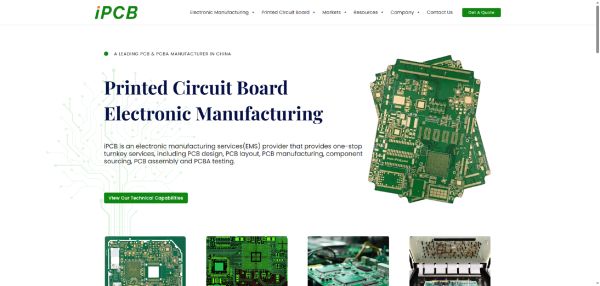
The company says it serves customers in more than 80 countries and focuses on microwave and high-frequency PCBs, mixed-dielectric boards, ultra-high-layer IC test boards, HDI, any-layer HDI, IC substrates, rigid-flex, and conventional multilayer FR-4.
Its Rogers capability page lists a dielectric constant range from 2.2 to 16, finished thickness from 0.1 to 12 mm, copper weights from 0.5 to 3 oz, and finishes including silver, gold, and OSP. Materials listed include RO4350B, RO4003C, RO4835, RT/duroid 5880, RO3003, and RO4725.
Because this information appears across several company-controlled domains, buyers should confirm the legal entity, factory location, and applicability of each published limit.
Capabilities
Capability item Published information What to verify
Founded and base A company-controlled article says iPCB was founded in 2002 and is headquartered in Shenzhen; the main site identifies iPCB Circuits Limited. Confirm the legal company name, domain ownership, and actual factory address.
Manufacturing footprint iPCB presents itself as a China PCB and EMS manufacturer serving customers in more than 80 countries. Ask which facility manufactures Rogers boards and which handles PCBA.
International service The company reports customers in more than 80 countries. Confirm language support, export procedures, and logistics.
Core scope PCB design, layout, manufacturing, sourcing, assembly, PCBA testing, microwave PCB, HDI, IC substrate, rigid-flex, and multilayer FR-4. Establish whether the RF bare board and assembly are controlled under the same production route.
Rogers capability Dk from 2.2 to 16; single-layer through multilayer hybrids; 0.1–12 mm thickness; 0.5–3 oz copper; RO4350B, RO4003C, RO4835, RT5880, RO3003, and RO4725. Confirm current material availability, certificates, and which values apply to multilayer hybrid construction.
Quality signals Company pages refer to ISO 9001, UL, RoHS, and IPC standards. Request current certificates and project-specific acceptance criteria.
RFQ checks iPCB combines broad EMS capability with published RF process information. Require RF DFM, stackup approval, and measurement data before authorizing assembly.
Official sources iPCB company, Rogers PCB, and technical article pages. Resolve entity and domain details before final qualification.
Haoda Electronic
Introduction
Shenzhen Haoda Electronic Technology appears through more than one company-controlled website. One profile says Shenzhen Haoda Technology was established in 2000 and is headquartered in Shenzhen. Another says Haoda Electronic was established in 2005.
That difference should be clarified during supplier onboarding.
The company’s broader manufacturing profile covers PCB design and layout, bare-board production, assembly, rigid and flexible circuits, and high-density multilayer boards. It also refers to exports to the United States, Europe, Africa, and other markets.
Haoda’s public information is less detailed on Rogers processing than that of the RF-focused suppliers above. A buyer considering Haoda should therefore request a written response covering laminate options, copper foil, PTFE or hydrocarbon-ceramic processing, impedance measurement, and material traceability.
Capabilities
Capability item Published information What to verify
Founded and base One company page says 2000; another says 2005. Both identify Shenzhen as the company base. Confirm the legal entity, founding date, and relationship between the websites.
Manufacturing footprint Shenzhen headquarters and manufacturing language are published. Confirm the factory address and whether PCB production is completed in-house.
International service The company says it exports to the United States, Europe, Africa, and other regions. Review export documents, communication procedures, and customer support.
Core scope PCB design and layout, bare boards, assembly, rigid and flexible boards, and high-density multilayer PCB. Define whether the quote includes fabrication, assembly, or engineering support.
Rogers capability The company shows high-density and RF-related manufacturing signals, but detailed Rogers information is limited. Request the Rogers laminate list, Dk and Df data source, stackup review, and coupon measurement method.
Quality signals Company pages emphasize engineering and quality control but publish limited certificate detail. Request current certificates and representative inspection reports.
RFQ checks Haoda’s public profile is broader than that of a dedicated RF PCB supplier. Do not qualify the supplier on keyword use alone; require a written RF process plan.
Official sources Haoda company and PCBComing company profiles. Confirm the entity and Rogers capability before approval.
Meidear PCB
Introduction
Shenzhen Meidear is smaller than several of the large PCB and EMS groups in this list, but its company profile is direct about its Rogers capability.
The company says it was founded in 2014 and is based in Shenzhen. It describes itself as a manufacturer and exporter serving North America, South America, Europe, the Middle East, and other international markets.
Its published product range includes multilayer boards up to 40 layers, HDI, high-frequency PCB, metal-core PCB, rigid-flex, FPC, CEM-3, Rogers PCB, heavy copper, and thin-board construction. The company also lists monthly PCB capacity of 10,000 square meters and more than 2,000 PCBA models per month.
Meidear may be worth considering for smaller or mid-sized projects, but demanding microwave designs still require evidence of material control, RF measurement, and repeatable high-frequency processing.
Capabilities
Capability item Published information What to verify
Founded and base Founded in 2014 and based in Shenzhen. Confirm the current legal entity and manufacturing address.
Manufacturing footprint Shenzhen manufacturing is listed, along with monthly PCB capacity of 10,000 square meters and more than 2,000 PCBA models. Ask whether Rogers boards are produced at the same facility and which equipment is used.
International service The company lists North America, South America, Europe, the Middle East, and worldwide markets, with a high reported export percentage. Confirm export history, comparable customer programs, and shipping support.
Core scope PCB and PCBA production, quick-turn prototypes, small and medium quantities, and mass production. Clarify responsibility for the bare board and assembly.
Rogers capability Rogers, high-frequency, multilayer up to 40 layers, HDI, rigid-flex, FPC, metal-core, heavy-copper, and thin boards. Request laminate certificates, stackup approval, impedance data, and an RF coupon plan.
Quality signals The company refers to its engineering team, manufacturing equipment, and testing instruments. Request current ISO, UL, IATF, or other required certificates.
RFQ checks Meidear publishes a broad range of special PCB technologies. Confirm whether the requested construction is a routine production process or a case-by-case build.
Official sources Meidear company profile. Require RF-specific process evidence before production release.
Final Assessment
A useful China PCB manufacturer list should do more than collect company names. It should help buyers understand where each supplier fits and where closer verification is still needed.
In the end, Rogers PCB sourcing is built on confidence—not only in published capabilities, but in the consistency, discipline, and accountability behind every production run.
-
Why is searching for a Rogers PCB manufacturer in China difficult?
Many suppliers use the term Rogers without having meaningful experience with RF stackups, PTFE, or material traceability. -
What specific processes matter for high-frequency board production?
Key processes include bondply selection, controlled impedance, plasma treatment, and ensuring material traceability. -
Which companies are identified as RF-focused manufacturers in the article?
Bicheng PCB, Riching PCB, RayPCB, Kejie PCB, HXP Circuit, and Meidear PCB are highlighted as having strong RF focus. -
What Rogers materials are commonly listed by these manufacturers?
Commonly listed materials include RO4350B, RO4003C, RO3003, RT/duroid 5880, and TMM series laminates. -
How can a buyer verify if a supplier handles RF materials correctly?
Buyers should request laminate certificates, copper type data, impedance test methods, and proof of in-house plasma treatment. -
Does PCBCool offer assembly services alongside Rogers PCB fabrication?
Yes, PCBCool offers integrated services including component sourcing, PCB assembly, testing, and box build. -
What is the recommended approach for selecting a manufacturer based on this text?
Sourcing should be built on confidence in consistency and accountability rather than just published capability lists.
