
Summary of 2A, 70V SEPIC/Boost DC/DC converter with 7µA Iq – Electronics-Lab
The LT8494 is a monolithic switching regulator supporting SEPIC, boost, and flyback topologies. It features low ripple Burst Mode operation with 7μA quiescent current and dual supply pins to extend battery life. The device offers a wide input voltage range up to 60V, programmable frequency from 250kHz to 1.5MHz, and an internal NPN power switch rated at 2A/70V. It includes UVLO programming via the SWEN pin and a soft-start function controlled by a single capacitor.
Parts used in the LT8494 Project:
- LT8494 Monolithic Switching Regulator
- NPN Power Switch (2A/70V)
- Resistor Divider for SWEN Pin
- Single Capacitor for Soft-Start
- Capacitor for Output Ripple Reduction
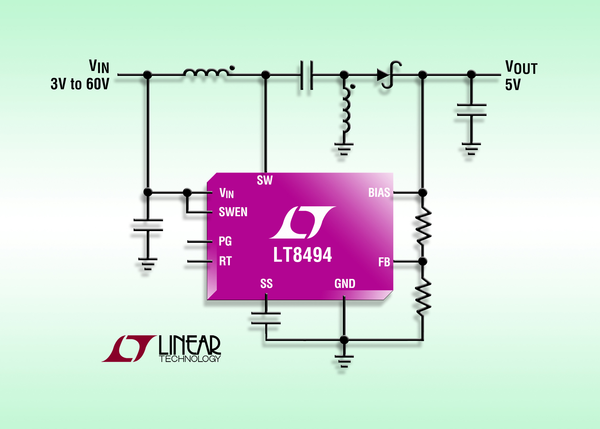
Features
- Low Ripple Burst Mode® Operation:
7μA IQ at 12VIN to 5VOUT
Output Ripple (<10mV Typ.) - Dual Supply Pins:
Improves Efficiency
Reduces Minimum Supply Voltage to ~1V after
Start-Up to Extend Battery Life - Wide Input Voltage Range of ~1V to 60V (2.5V to 32V for Start-Up)
- PG Functional for Input Supply Down to 1.3V
- FMEA Fault Tolerant in TSSOP Package
- Fixed Frequency PWM, SEPIC/BOOST/FLYBACK Topologies
- NPN Power Switch: 2A/70V
- Programmable Switching Frequency: 250kHz to 1.5MHz
- UVLO Programmable on SWEN Pin
- Soft-Start Programmable with One Capacitor
- Small 20-Lead QFN or 20-Lead TSSOP Packages
Description
The LT®8494 is an adjustable frequency (250kHz to 1.5MHz) monolithic switching regulator. Quiescent current can be less than 7μA when operating and is ~0.3μA when SWEN is low. The LT8494 can be configured as either a SEPIC, boost or flyback converter.
The low ripple Burst Mode operation maintains high efficiency at low output current while keeping output ripple below 10mV. Dual supply pins (VIN and BIAS) allow the part to automatically operate from the most efficient supply. Input supply voltage can be up to 60V for SEPIC topologies and up to 32V (with ride-through up to 60V) for boost and flyback topologies. After start-up, battery life is extended since the part can draw current from its output (BIAS) even when VIN voltage drops below 2.5V.
Using a resistor divider on the SWEN pin provides a programmable undervoltage lockout (UVLO) for the converter. A power good flag signals when VOUT reaches 92% of the programmed output voltage.
For more detail: 2A, 70V SEPIC/Boost DC/DC converter with 7µA Iq – Electronics-Lab
- What topology options does the LT8494 support?
The LT8494 can be configured as either a SEPIC, boost, or flyback converter. - How low can the quiescent current go when SWEN is low?
The quiescent current drops to approximately 0.3μA when SWEN is low. - Can the input supply voltage reach up to 60V?
Yes, the input supply voltage can be up to 60V for SEPIC topologies. - Does the device maintain high efficiency at low output currents?
Yes, low ripple Burst Mode operation maintains high efficiency at low output current. - How is the undervoltage lockout programmed?
A resistor divider on the SWEN pin provides a programmable undervoltage lockout. - What signals when the output voltage reaches 92% of the target?
A power good flag signals when VOUT reaches 92% of the programmed output voltage. - Is the switching frequency adjustable?
Yes, the switching frequency is programmable from 250kHz to 1.5MHz. - How many capacitors are needed for the soft-start function?
Only one capacitor is required to program the soft-start.
