
Summary of 3D Printed Stepper Motor
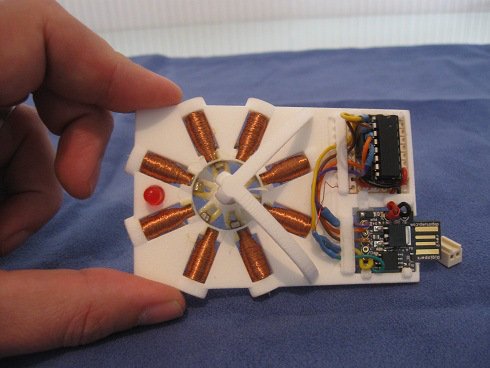
Christopher Hawkins created a compact, programmable 3D printed stepper motor designed to demonstrate motor mechanics. Using nails, magnet wire, neodymium magnets, a Digispark microcontroller, and custom 3D printed parts, he achieved a business card-sized device capable of rapid movement without losing steps. Although labeled a first draft with room for improvement, it successfully demonstrates a 15-degree step angle (functioning as 7.5 degrees in this configuration).
Parts used in the 3D Printed Stepper Motor:
- Nails
- Magnet wire
- Neodymium magnets
- Digispark microcontroller
- Custom 3D printed piece
Check out this cool 3D Printed Stepper Motor that Christopher Hawkins made. You can see in the video that it can move quite quickly and not loose any steps. This design would be idea to teach how stepper motors work.
Via: Hack a Day
“This is a programmable stepper motor and driver that I made out of some nails, magnet wire, neodymium magnets, a digispark microcontroller, and a 3D printed piece that I designed around these things. My goal was to make something about the size of a business card that moved. You can’t exactly fit it in your wallet but it does indeed move. It just a first draft- there’s lots of room for improvement. It has a step angle of 15 degrees (although the way I’m driving it, it is 7.5 degrees.)”
For more detail: 3D Printed Stepper Motor
- Who made this 3D printed stepper motor?
Christopher Hawkins created the device. - What components were used to build the motor?
The project uses nails, magnet wire, neodymium magnets, a Digispark microcontroller, and a custom 3D printed piece. - Can this motor move quickly without losing steps?
Yes, the video shows it moves quite quickly and does not lose any steps. - Is this design suitable for teaching how stepper motors work?
Yes, the design is ideal for teaching the principles of stepper motors. - What is the intended size of this motor?
The goal was to make something about the size of a business card. - Does this motor fit inside a standard wallet?
No, you cannot exactly fit it in your wallet. - What is the step angle of this specific design?
The step angle is 15 degrees, though it operates at 7.5 degrees in this configuration. - Is this considered a finished product or a prototype?
This is described as a first draft with lots of room for improvement.
