
Summary of 555 timer triggers phase-control circuit
### Summary This article describes a control circuit using a 555 timer IC to manually adjust power delivered to a load. By varying potentiometer R3, the firing phase angle of thyristor Q3 is adjusted between 0 and 180 degrees, altering the load current's duty cycle. A full-wave diode bridge provides pulsed DC for applications like dimming, though a triac can be used for AC power. The timer acts as a monostable multivibrator triggered by transistor Q1, creating an off-time interval determined by 1.1R3C2.
Parts used in the Phase-Control Circuit:
- Potentiometer R3
- Thyristor Q3
- Full-wave diode bridge
- IC1 (555 timer)
- Zener diode D1
- Filter capacitor C1
- Resistors R1 and R2
- Transistor Q1
- Transistor Q2
- Capacitor C2
The control circuit in Figure 1a allows you to manually adjust the power delivered to a load. By changing the setting of potentiometer R3, you change the phase angle at which the thyristor (Q3) fires (Figure 1b), thereby altering the load current’s duty cycle. The adjustment range is about 0 to 180°. Q3’s off time is linear with R3, but of course the resulting load power is not linear with R3.
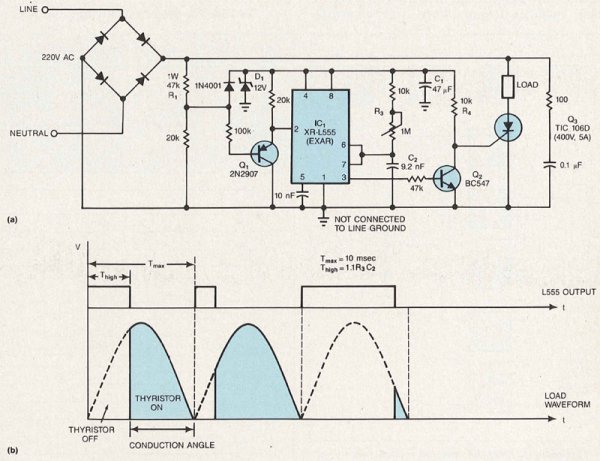
The full-wave diode bridge delivers pulsed-dc voltage to the load, making the circuit suitable for dc-control applications such as dimming. (The circuit can handle ac power if you substitute a triac for Q3 and make slight modifications.)
IC1 is a low-power—1 mW—timer configured as a monostable monovibrator. Zener diode D1 and filter capacitor C1, activated by pulses from the voltage divider R1/R2, form a dc supply for the timer. Q1 turns on and applies a negative-going trigger to the timer (pin 2) each time Q1’s base voltage approaches 0V. In response, the timer issues a positive pulse that turns on Q2 and turns off Q1, removing load power for an interval equal to 1.1R3C2. To increase the control resolution, you can lower the value of R3, substitute a potentiometer with more turns, or add a fixed resistor in series with the potentiometer.
For more detail: 555 timer triggers phase-control circuit
- How does changing potentiometer R3 affect the circuit?
Changing R3 alters the phase angle at which thyristor Q3 fires, thereby adjusting the load current's duty cycle. - What is the adjustment range for the phase angle?
The adjustment range is approximately 0 to 180 degrees. - Can this circuit handle AC power?
Yes, if you substitute a triac for Q3 and make slight modifications. - How is the 555 timer configured in this design?
IC1 is configured as a low-power monostable monovibrator. - What determines the duration of the load power off interval?
The interval equals 1.1 times the product of R3 and C2. - How can you increase the control resolution of the circuit?
You can lower the value of R3, use a multi-turn potentiometer, or add a fixed resistor in series with the potentiometer. - What voltage supply is provided for the timer?
A dc supply is formed by Zener diode D1 and filter capacitor C1 activated by pulses from voltage divider R1/R2. - What component triggers the timer on pin 2?
Transistor Q1 applies a negative-going trigger to the timer each time its base voltage approaches 0V.
