
Summary of How the Clover Coffee Maker Works
The Clover coffee maker, developed by the Seattle-based Coffee Equipment Company in 2005, revives premium drip coffee by brewing one cup at a time. Unlike batch brewers, it allows precise customization of water temperature and brewing time using PID controllers, enhancing flavor extraction for high-end beans. Acquired by Starbucks in 2008, it combines French press and vacuum pot technologies through patented VacuumPress Technology to maximize taste potential.
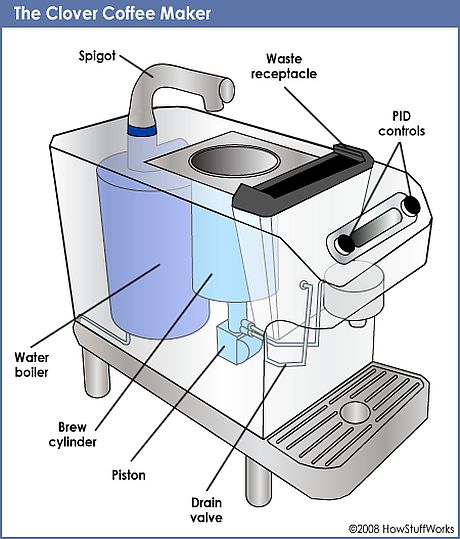
Parts used in the Clover Coffee Maker:
- Proportional integral derivative (PID) controller
- Steel brew cylinder
- Piston
- Drain valve
- Actuator
- Perforated mesh screen
One machine aims to bring the glamour back to drip coffee: the Clover coffee maker. It was developed in 2005 by the Seattle-based Coffee Equipment Company. As opposed to a batch brew that yields enough cups to get a business through the morning rush, the Clover brews one cup of coffee at a time. With a Clover, the barista and the customer can customize the way the coffee tastes by tinkering with the water temperature and the brewing time.
The result is not the kind of coffee you add milk or sugar to, and it sure doesn’t begin with anything instant. This coffee maker has become a way to highlight coffee beans from around the world, beans that may cost almost a hundred dollars a pound. The Clover has coffee drinkers reaching into a wine lover’s vocabulary for words like earthy, citrusy and spicy. Connoisseurs praise the floral undertones or deride a grassy flavor, and café owners have found customers willing to pay latte prices for drip coffees.
In 2006, the first year Clover was on the market, about 100 machines were sold to independent coffee shops, and sales tripled the following year [source: The Economist]. Depending on where you live, finding a Clover coffee maker might have been as difficult as finding its four-leafed namesake. But you might be seeing a lot more of them. In March 2008, Starbucks announced its purchase of the Coffee Equipment Company. All future Clovers will appear exclusively in Starbucks.
What does this mean for the coffee industry? Does the Clover really produce better-tasting coffee, and even if it did, would you pay five bucks for it? What can this machine do that your coffee maker at home can’t? On the next page, we’ll take a look inside the Clover.
Clover Coffee: Building on French Presses and Vacuum Pots
The flavor of your coffee depends on two things — how the beans are roasted and how the drink is prepared. Roasting packs the flavor potential into a coffee bean, while grinding and brewing prepare the beans in a way that maximizes the flavor. The Clover gives you control over the two brewing factors that affect the flavor, which are the temperature of the water and the dwell time, or the time in which the grounds are in contact with the water.
The Clover uses a proportional integral derivative (PID) controller to create the exact right temperature of water every time. Even a change of a few degrees in water temperature can make the difference between a cup of sludge and a cup that highlights the flavor of the bean. If the water is too hot, it will overextract the flavor of the beans, resulting in a bitter taste, but if the water is not hot enough, then you have underextraction and a weak cup of coffee.
This coffee maker also lets you dial in the exact number of seconds that the grounds are in contact with the water, and the Clover’s brewing process is designed to bring out the best in the grounds. Let’s look at how it compares with other coffee-making methods.
Most people have an automatic drip coffee maker on their kitchen counter — it’s fast, easy and gets them going in the morning. Unfortunately, the drip coffee maker is not going to win any awards for how the coffee tastes. These makers don’t heat the water enough or allow the grounds to interact with the water for long enough to make the perfect cup of coffee.
To get the best-tasting coffee, coffee experts have long agreed that you have to use a French press or a vacuum brewer. Both of these methods allow for more control of the water temperature and the brewing method than an automatic. To make coffee in a French press, the grounds and almost-boiling water steep for several minutes. The top of the French press has a plunger that’s attached to a mesh filter. When you push down on the plunger, the screen separates the brewed coffee from the grounds. The grounds are pushed to the bottom, and coffee is poured out the top.
Vacuum pots are named for the air vacuum that’s created between its two connected globes to draw down the brewed coffee. The bottom globe is placed on heat, which warms the water within it. As the water heats and expands, the resulting water vapor creates pressure that forces the rest of the water into the top globe, where the ground coffee awaits. The vapor also moves up, which heats the water and the coffee and agitates it for a good brew. When the bottom globe is taken off the heat, everything that rose up must now come down, so the brewed coffee, minus the used grounds that are caught by a filter, fills the bottom globe.
What does this have to do with how the Clover works? Well, the Clover uses the best of both methods with its patented VacuumPress Technology. The brewing happens in a steel brew cylinder that sits atop a piston. When the brewing process starts, the piston moves to its lowest position and a drain valve at the bottom of the machine closes. After the coffee steeps, an actuator forces the piston to rise with the used grounds held by a perforated mesh screen, almost like a French press in reverse. When it does this while the drain valve is closed, a vacuum is created that draws down the brewed coffee. The piston descends again, the drain valve opens and the coffee enters the waiting cup.
For more Detail: How the Clover Coffee Maker Works
-
When was the Clover coffee maker developed?
It was developed in 2005 by the Seattle-based Coffee Equipment Company. -
How does the Clover control water temperature?
The machine uses a proportional integral derivative (PID) controller to create the exact right temperature every time. -
What technology does the Clover use to brew coffee?
It uses patented VacuumPress Technology that combines elements of French presses and vacuum pots. -
Who purchased the Coffee Equipment Company in March 2008?
Starbucks announced its purchase of the company in March 2008. -
What happens if the water is too hot during brewing?
If the water is too hot, it will overextract the flavor of the beans, resulting in a bitter taste. -
Why are automatic drip coffee makers often criticized for taste?
They do not heat the water enough or allow the grounds to interact with the water long enough for a perfect cup. -
How does the piston function in the Clover brewing process?
An actuator forces the piston to rise holding the used grounds while creating a vacuum to draw down the brewed coffee. -
What factors affect the flavor of coffee according to the article?
The flavor depends on how the beans are roasted and how the drink is prepared, specifically water temperature and dwell time.
