
Summary of How to Driving and Measure a Thermocouple
This article explains that thermocouples provide accurate temperature readings in difficult or rugged environments. It describes a two-part circuit where a driving device powers the thermocouple, followed by an amplifier that boosts and offsets the voltage. The specific circuit achieves an output of 10mV per degree Celsius when using a K-Type thermocouple.
Parts used in Thermocouple Measurement Circuit:
- Thermocouple
- Driving Device
- Amplifier
- K-Type Thermocouple
Thermocouples are a great way to take accurate temperature measurements in hard to reach places or in very rugged environments. Using one can be tricky if your new to the device.
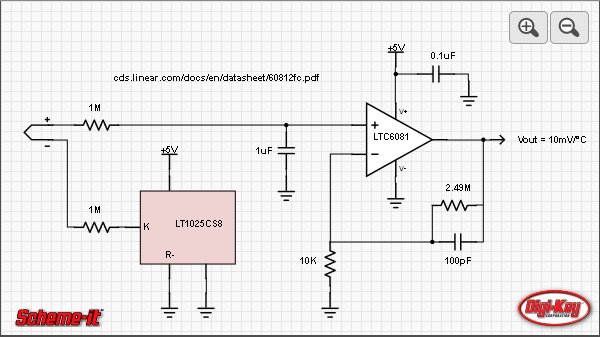
This circuit has two parts the thermocouple needs to be driven by a device and then an amplifier can be used to amplify and offset the voltage into a signal that can be useful. In this circuit the output of the amplifier Vout = 10mv/°C when using a K-Type thermocouple.
For more detail: How to Driving and Measure a Thermocouple
-
What are thermocouples best used for?
They are great for taking accurate temperature measurements in hard-to-reach places or very rugged environments. -
How many parts does this circuit have?
This circuit has two parts consisting of a driving device and an amplifier. -
Can a new user find it tricky to use one?
Yes, using one can be tricky if you are new to the device. -
Does the amplifier offset the voltage?
Yes, the amplifier is used to amplify and offset the voltage into a useful signal. -
What is the output formula for this circuit?
The output of the amplifier is Vout = 10mv/°C. -
Which type of thermocouple is specified for this output?
A K-Type thermocouple is used to achieve the stated output.
