
Summary of Practical Guide to Implementing Solar Panel MPPT Algorithms
This article explains that solar panels without MPPT controllers suffer from wasted power, higher installation costs, and premature battery failure. While standard MPPT algorithms find maximum power output, they struggle with partial shading due to multiple peaks in the power graph. Advanced solutions for shading often require extra equipment or complex models suitable only for large installations, not this specific application.
Parts used in Solar Panel MPPT Project:
- Solar panel
- Battery
- MPPT controller
- Monitoring cells
- Extra switches
- Current sensors
INTRODUCTION
Using a solar panel or an array of panels without a controller that can perform Maximum Power Point
Tracking (MPPT) will often result in wasted power,which ultimately results in the need to install more
panels for the same power requirement. For smaller/cheaper devices that have the battery
connected directly to the panel, this will also result in premature battery failure or capacity loss, due to the
lack of a proper end-of-charge procedure and higher voltage. In the short term, not using an MPPT controller
will result in a higher installation cost and, in time, the costs will escalate due to eventual equipment failure.
Even with a proper charge controller, the prospect of having to pay 30-50% more up front for additional solarpanels makes the MPPT controller very attractive
SOLAR PANEL MPPT
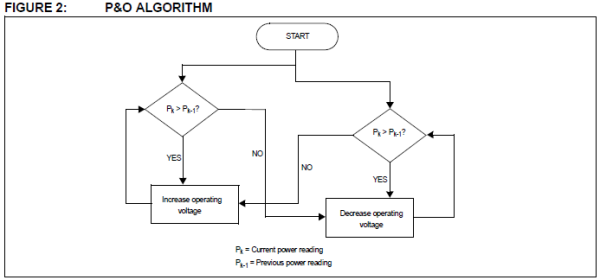
The main problem solved by the MPPT algorithms is to automatically find the panel operating voltage that
allows maximum power output. In a larger system, connecting a single MPPT controller to multiple panels
will yield good results, but, in the case of partial
shading, the combined power output graph will have multiple peaks and valleys (local maxima). This will
confuse most MPPT algorithms and make them track incorrectly. Some techniques to solve problems related
to partial shading have been proposed, but they either need to use additional equipment (like extra monitoring
cells, extra switches and current sensors for sweeping panel current), or complicated models based on the
panel characteristics (panel array dependent). These techniques only make sense in large solar panel
installations, and are not within the scope of this application note
For more detail: Practical Guide to Implementing Solar Panel MPPT Algorithms
- What happens if a solar panel lacks an MPPT controller?
It results in wasted power, higher installation costs, and potential premature battery failure. - Why do smaller devices fail prematurely without an MPPT controller?
Lack of proper end-of-charge procedures and higher voltage cause capacity loss. - How does partial shading affect MPPT algorithms?
It creates multiple peaks and valleys in the power graph, confusing most algorithms. - Can standard MPPT algorithms handle partial shading effectively?
No, they tend to track incorrectly when local maxima appear due to shading. - What is required to solve partial shading issues in large systems?
Additional equipment like monitoring cells, extra switches, and current sensors are needed. - Are complex models based on panel characteristics recommended here?
No, these techniques are not within the scope of this application note.
