
Summary of The Rise of Digital Control for DC/DC Regulation
### Summary This article discusses the shift from analog to digital control in DC/DC converters, driven by advances in high-speed, low-power silicon. Digital power management offers dynamic optimization of closed-loop responses, allowing real-time adjustments for environmental changes, capacitive loading, and component aging. The text compares analog and digital voltage regulators, highlighting efficiency benefits, and cites the Linear Technology LTC3549 as an example of a modern buck regulator achieving over 90% efficiency in portable applications.
Parts used in the Digital Power Management Project:
- High-speed silicon chips
- Low power consumption components
- Inexpensive silicon
- Analog power supply
- Digital equivalent power supply
- Switching step-down (buck) converter
- Battery
- Sensitive silicon
- Closed-loop response system
- Linear Technology LTC3549
Traditionally, switching DC/DC converters (voltage regulators) were controlled using analog techniques because these were simple to implement and helped to maximize the power supply’s efficiency. Digital components were too slow and power greedy to challenge analog dominance.
However, over the past several years the introduction of high-speed, low power consumption and inexpensive silicon has rekindled interest in “digital power management.”
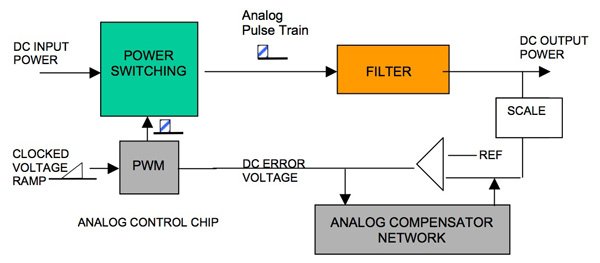
Armed with these new chips, designers are keen to take advantage of features such as the ease with which digital control enables optimization of the power supply by adaptation of a closed-loop response – even allowing adjustment “on the fly” to suit changes in the operating environment or to compensate for factors such as capacitive loading and component aging.
This article considers the benefits that digital power brings to voltage regulators by comparing an analog power supply with its digital equivalent. The article then continues by describing some of the latest digital regulators released by major vendors that take advantage of the control techniques discussed.
Control vs. efficiency
Efficiency is a critical design parameter of power supply engineering. In a simple switching step-down (“buck”) converter for a portable device, for example, the designer wants to lower the battery voltage to a level suitable for sensitive silicon but not waste any valuable millivolts in the process. Lossless conversion is impossible, but careful design can see modern switching buck regulators with better than 90 percent efficiency.
Linear Technology, for example, offers the LTC3549, a 2.25 MHz buck regulator for portable applications. The device provides 250 mA output current (with an input voltage of 1.8 V and an output voltage of 1.2 V) and claims an efficiency of up to 93 percent.
For more detail: The Rise of Digital Control for DC/DC Regulation
- Why are designers interested in digital power management?
New high-speed, low power consumption, and inexpensive silicon have rekindled interest in this technology. - What advantages does digital control offer over analog techniques?
Digital control enables optimization of the power supply through adaptation of a closed-loop response. - Can digital regulators adjust settings while operating?
Yes, they allow adjustment on the fly to suit changes in the operating environment. - How do digital regulators handle component aging?
Digital control can compensate for factors such as capacitive loading and component aging. - Is lossless conversion possible in switching buck regulators?
No, lossless conversion is impossible, but careful design can achieve better than 90 percent efficiency. - What is the efficiency claim of the Linear Technology LTC3549?
The device claims an efficiency of up to 93 percent. - What type of converter is mentioned for portable devices?
A simple switching step-down or buck converter is used for portable devices. - Why were digital components previously not dominant?
Digital components were too slow and power greedy to challenge analog dominance traditionally.
