
Summary of 400kHz function generator with ICL8038
This article describes a high-performance function generator based on the ICL8038 integrated circuit, capable of producing sine, square, and triangle waves from 0 Hz to over 400 kHz. The design features adjustable frequency, amplitude, DC offset, duty cycle, and waveform selection. Unlike standard configurations, this circuit removes a 10M potentiometer that caused distortion and replaces the slow internal pull-up resistor with an external LM293 comparator to ensure steep square wave edges at high frequencies.
Parts used in the 400kHz Function Generator:
- ICL8038 integrated chip
- LM293 comparator
- Pull-up resistor for square wave output
- Switch for waveform selection
Function generator with adjustable frequency from 0 Hz to over 400 kHz, adjustable amplitude, DC offset, duty, and of course the function selection – square, triangle, and sine. Generator based on good old ICL8038 integrated chip generator that gives pretty good shaped signals as for amateur purposes.
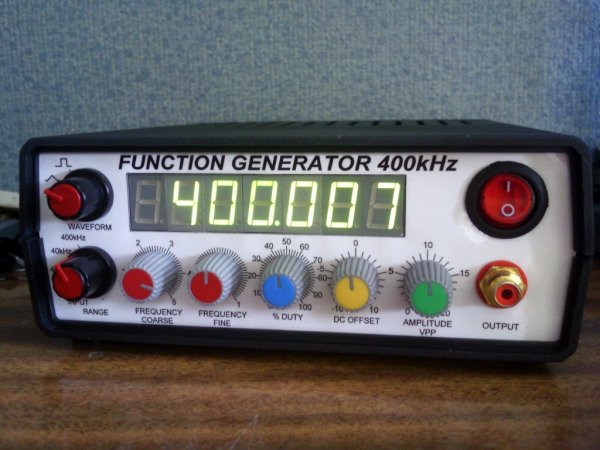
This circuit has been designed a little differently than ICL’s note or other similar circuits are suggesting. I tested a bunch of different configurations with different peripherals and chosen the best – so to get good waveshape at 400kHz. I got rid of some of the elements, I added my own solutions. The two ICL chips that i have can oscillate around up to 420-430kHz, and practically we can get good waveforms up to that frequency.
The biggest problem of these circuits generators is strong distortion on sine wave output pin 2 at frequencies above 100kHz – so most of the solutions based on this chip has a limited frequency. I found a workaround by not putting the load on the square wave output from pin 9 (open collector that needs to be pulled up to the power supply). In some way the quality of other waveforms is dependent on the load on this pin. Pull-up resistor is activated only when switching output to the square waveform – with the same switch. I got rid of the recommended in the note 10M pot to “improve” the vaweforms. As it turned out its only making them worse, and add a characteristic spout on the top of the upper half of the sine.
Square output pin 9 with open collector, normally would never be able to give a good square wave at these frequencies. Rising edge depends only on the pull-up resistor and its growing very slowly. If we give too strong pull-up resistor, in turn, the trailing edge will be weak because the internal transistor is too heavily loaded. Here, i fixed the square wave with a comparator so that the slope is pretty steep, steep as applied comparator can give. Shown in the schematic LM393 (1.3μs response time) has been replaced by LM293 comparator with 300ns response time – so square wave is acceptable at 400kHz, but it would be good to use even faster model of comparator.
For more detail: 400kHz function generator with ICL8038
- What is the maximum frequency this generator can produce?
The generator can oscillate up to approximately 420-430 kHz with good waveforms. - How can you fix strong distortion on the sine wave output above 100 kHz?
You can avoid distortion by not putting a load on the square wave output pin 9. - Why was the recommended 10M potentiometer removed from the circuit?
It was removed because it made waveforms worse and added a characteristic spout on the sine wave. - What component is used to improve the rising edge of the square wave?
An LM293 comparator is used to replace the slow internal pull-up resistor for steeper slopes. - Does the quality of other waveforms depend on the load on pin 9?
Yes, the quality of other waveforms is dependent on the load placed on the square wave output pin. - Can the ICL8038 chip generate signals without a load on pin 9?
Yes, removing the load allows the chip to oscillate around 420-430 kHz effectively. - What is the response time of the LM293 comparator used in this project?
The LM293 comparator has a response time of 300ns. - Is it possible to get good waveforms up to 400 kHz with this design?
Yes, practically good waveforms can be obtained up to 400 kHz using this configuration.
