
Summary of Photodiode Gamma Ray Detector
This article describes a low-cost, solid-state gamma ray detector using a photodiode and JFET to amplify photon-induced current pulses. While less sensitive than Geiger-Müller tubes, it effectively identifies radioactive sources. The design addresses temperature and voltage drift by suggesting AC coupling for the comparator stage. Construction involves mixing SMD and through-hole components, housed in a brass tube with light-blocking and EM shielding features.
Parts used in the Photodiode Gamma Ray Detector:
- BPW34 photodiode
- PN4117A JFET
- Comparator stage (with AC coupling)
- Output transistor
- Counter module
- Brass tube enclosure
- Brass shim-stock foil
- Wadding
- Liquid electrical tape
Gamma photons interacting with cheap photodiodes produce small current pulses which are easily amplified and allow detection of individual photon events. This offers the possibility of cheap, small and rugged radiation detectors of reasonable sensitivity. While not as sensitive as larger GM-tube detectors, this solid state device is still quite useful for determining if something is radioactive enough to be interesting/concerning.
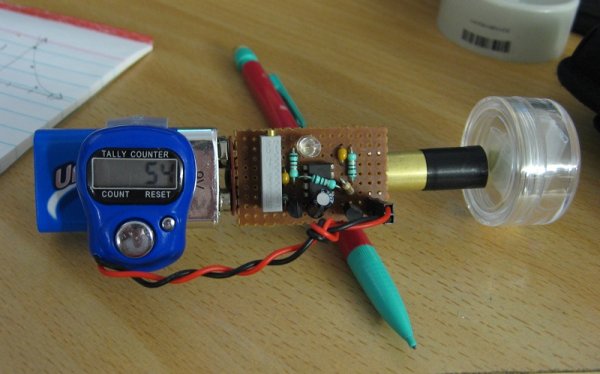
The circuit is simple, but as currently implemented has one major problem; poor temperature stability. As it is DC coupled right through to the comparator moderate temperature changes cause the threshold level to drift enough that the noise floor starts causing false triggering, or the sensitivity to less energetic radiation drops. Similarly DC shifts associated with battery voltage drop is also a problem. This is easily remedied by AC coupling the comparator stage. The unit shown has an extra output transistor driving the counter module, this is not required for the basic qualitative detector – it is implemented in much the same way as the counter interface of the ion chamber alpha counter. There is great similarity between the two circuits really, and one might build a dual gamma/alpha counter in a quite small package. (Note that there is also some sensitivity to higher energy beta.)
Construction is fairly non-critical. The sensor assembly was built using a mixture of SMD and through-hole components, with the BPW34 photodiode placed over the PN4117A JFET body. The completed sensor head was then placed in a small brass tube, with a thin piece of brass shim-stock foil closing one end to exclude light and offer some EM shielding to the sensitive front-end electronics. The other end was closed with wadding and liquid electrical tape. The detector module has three wires emerging from it and can be integrated with different electronics.
For more detail: Photodiode Gamma Ray Detector
- What is the primary advantage of this solid state device?
It offers the possibility of cheap, small and rugged radiation detectors of reasonable sensitivity. - How does the performance compare to GM-tube detectors?
This solid state device is not as sensitive as larger GM-tube detectors. - What is the major problem with the current implementation of the circuit?
The circuit suffers from poor temperature stability causing threshold level drift. - Can battery voltage drop cause issues with this detector?
Yes, DC shifts associated with battery voltage drop are also a problem. - How can the temperature stability issue be remedied?
It is easily remedied by AC coupling the comparator stage. - Is the output transistor required for the basic qualitative detector?
No, the extra output transistor driving the counter module is not required for the basic qualitative detector. - Does the detector have any sensitivity to beta radiation?
Yes, there is some sensitivity to higher energy beta. - How was the sensor assembly constructed regarding component types?
The sensor assembly was built using a mixture of SMD and through-hole components.
