
Summary of How to Choose the Right Power Supply for Your LED Lighting Project
This article explains how to select appropriate LED power supplies for various commercial and domestic applications. It highlights the complexity of choosing from numerous options regarding voltage, current, dimensions, and features like dimming. The text categorizes applications into retail, industrial, and architectural segments, emphasizing specific needs such as high reliability, efficiency, moisture sealing, and low heat dissipation, particularly for refrigerated displays.
Parts used in the LED Lighting Project:
- AC/DC converter modules from Emerson Network Power
- AC/DC converter modules from CUI Inc.
- Buck modules from RECOM Power
- Buck-boost modules from RECOM Power
- Boost boards from TDK-Lambda
- Boost boards from Microsemi
With the proliferation of high-brightness LEDs designed to provide replacement lamps for commercial and domestic lighting there comes an equal, if not greater, proliferation of power supply solutions. With hundreds of products from dozens of manufacturers, it becomes a question of how to make sense of all the permutations of input / output voltages and output current / power ratings, to say nothing of the mechanical dimensions / termination types and the many other features for dimming, remote control, and circuit protection that are offered. This article aims to unravel the mysteries of the different types of LED power supplies and how they operate in order to ease the selection process.
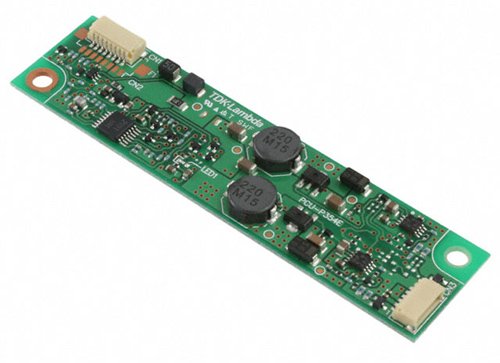
To help understand the various solutions, the article will reference a number of products readily available from Digi-Key, including AC/DC converter modules from Emerson Network Power and CUI Inc., buck modules and buck-boost modules from RECOM Power, and boost boards from TDK-Lambda and Microsemi.
Understand your LED lighting application first
In order to determine the type of power supply best suited for a particular lighting project, it is first necessary to understand the nature of the application, i.e. what form the LED lighting will take and where and how it will be deployed. There is no unique segmentation, but the ‘where’ usually relates to the broad market, while the ‘what’ or ‘how’ is more about the function or characteristic of the lighting. Typical market segments for lighting are retail, industrial, and architectural along with the terms ‘indoor’, covering commercial and residential use, and ‘outdoor’ for street lighting and building illumination. Already there is an overlap in these descriptions, so it is probably more helpful to explore a few examples in a little more detail to appreciate what they may require from a power supply.
Retail applications can range from space lighting to window, shelf, or display cabinet lighting including point-of-sale displays and signage. The lighting needs to be of high quality with a consistent color for showing products to best effect. Ambient lighting will provide unobtrusive background illumination, while accent lighting will be more obvious in highlighting a particular product or display area. Cabinet lighting usually needs to be concealed, so as not to detract from the product, whereas ambient lighting is less likely to be in the customer’s line of sight, e.g. illumination from ceiling fixtures. Lighting in retail outlets is often operating for long periods of time, so high reliability and good efficiency, to reduce running costs and temperatures, are important requirements for the power supply. Because of its reduced heat output, low-power LED lighting is proving popular in refrigerated display cabinets; clearly moisture-sealed supplies with low heat dissipation are likely to be equally important for powering such lights.
For more detail: How to Choose the Right Power Supply for Your LED Lighting Project
- What is the primary goal of this article?
The article aims to unravel the mysteries of different types of LED power supplies and how they operate to ease the selection process. - How should one determine the best power supply type?
You must first understand the nature of the application, including the form of lighting and where and how it will be deployed. - What are typical market segments for lighting mentioned?
Typical market segments include retail, industrial, and architectural, along with indoor and outdoor classifications. - Why is high reliability important for retail lighting?
High reliability is crucial because lighting in retail outlets often operates for long periods to reduce running costs and temperatures. - What power supply features are needed for refrigerated display cabinets?
Moisture-sealed supplies with low heat dissipation are likely important for powering lights in refrigerated display cabinets. - Which manufacturers provide AC/DC converter modules referenced in the text?
The text references AC/DC converter modules from Emerson Network Power and CUI Inc. - What components does RECOM Power provide according to the article?
RECOM Power provides buck modules and buck-boost modules. - What distinguishes accent lighting from ambient lighting?
Ambient lighting provides unobtrusive background illumination, while accent lighting is more obvious in highlighting a particular product or display area.
