
Summary of Digital Voltage Regulator Control Using PMBus
This article explains how digital control enhances DC-to-DC switching voltage regulator efficiency and describes the Power Management Bus (PMBus) as a standardized protocol for supervising multiple regulators via a centralized host. PMBus, based on SMBus and I²C, offers domain-specific commands for managing power supplies, batteries, sensors, and fans. The text outlines its history, ownership by the System Management Interface Forum, and adoption by major silicon vendors like Texas Instruments and Analog Devices to ensure interoperability without burdening host systems with multiple protocols.
Parts used in the Digital Power Control Project:
- DC-to-DC switching voltage regulator
- Centralized power system host control
- Digital communications bus (PMBus)
- Power Management Bus (PMBus) compatible chips
- Rechargeable battery subsystem
- Temperature sensors
- Fan controllers
- Voltage sensors
- Clock chips
Digital control optimizes the efficiency, line, and load regulation of a DC-to-DC switching voltage regulator. Engineers are able to adapt the regulator’s closed-loop response, for example, to perfectly match the demands of their product.
However, digital control really comes into its own in a more complex system that comprises several regulators. The individual devices can be supervised by a centralized power system host control via a digital communications bus such as the standardized Power Management Bus (PMBus). The host could be an IC dedicated to power system control, a general-purpose microcontroller, laptop computer with graphical user interface (GUI), or an ATE (used during the power supply or system testing process).
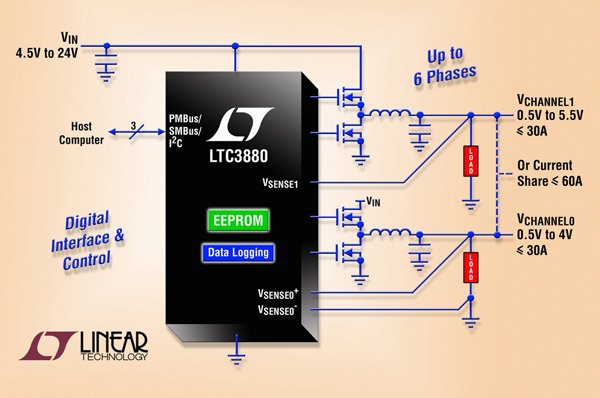
This article examines PMBus, describes how it works, and identifies some of the digital power chips that have embraced the technology.
The basics
PMBus is based on the System Management Bus (SMBus) typically found in computer motherboards for communication with the power source. However, while SMBus is designed for communication with low-bandwidth devices, PMBus is targeted at digital management of power supplies, components, and power-related chips such as a rechargeable battery subsystem or temperature-, fan- and voltage-sensors and clock chips.
SMBus itself was based on Inter-Integrated Circuit (I²C), the serial single-ended computer bus originally designed by Philips and used for attaching low-speed peripherals to a motherboard or other embedded system. As a result of this foundation, PMBus is a relatively low speed, two-wire communications protocol. However, unlike SMBus and I²C, PMBus defines a substantial number of domain-specific commands rather than just detailing how to communicate using commands defined by the reader.
In March 2005, version 1.0 of the PMBus specification was published. More recently a revised specification, version 1.2, was released. The standard is owned by the System Management Interface Forum (SM-IF) and is royalty-free. The PMBus sub-section of the forum comprises more than 30 adopter companies including major power chip silicon vendors such as Analog Devices, CUI, Emerson Network Power, Intersil, Linear Technology, Maxim, and Texas Instruments (TI). The organization claims adoption of an interoperable standard enables digital power control to be adopted without the need to unduly burden the host system with multiple protocols.
For more detail: Digital Voltage Regulator Control Using PMBus
- How does digital control optimize voltage regulators?
Digital control optimizes the efficiency, line regulation, and load regulation of a DC-to-DC switching voltage regulator. - What is the primary function of PMBus in complex systems?
PMBus allows individual devices in a complex system to be supervised by a centralized power system host control. - Can a laptop computer act as the host for PMBus?
Yes, the host could be a general-purpose microcontroller or a laptop computer with a graphical user interface. - Is PMBus faster than SMBus?
No, PMBus is a relatively low speed two-wire communications protocol like SMBus. - What technology did PMBus base its design on?
PMBus is based on the System Management Bus typically found in computer motherboards. - Who owns the PMBus standard?
The standard is owned by the System Management Interface Forum. - Does PMBus require royalty payments?
No, the PMBus specification is royalty-free. - Why is PMBus preferred over multiple protocols?
Adoption of this interoperable standard enables digital power control without needing to burden the host system with multiple protocols.
