
Summary of High Efficiency, Ultralow IQ A Sync Buck Regulator
The LT8610 is a high-efficiency synchronous step-down regulator integrating compact features like 96% efficiency, ultralow quiescent current of 2.5µA, and low dropout voltage. It supports input voltages up to 42V and load currents up to 2.5A while minimizing board space and EMI issues through high-speed switching.
Parts used in the LT8610 Step-Down Regulator:
- LT8610 IC
- Synchronous rectification circuitry
with Leonard Shtargot Staff Engineer, Power Products
The LT®8610 step-down regulator integrates key high performance features in one compact IC. It offers synchronous rectification, for efficiencies up to 96%. The low quiescent current of 2.5µA extends battery life and saves extra circuitry.
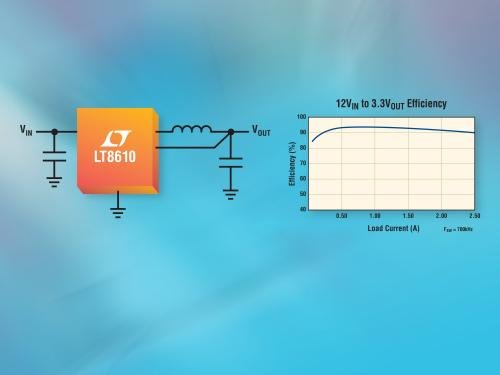
High speed switching minimizes board space and helps avoid EMI problems. A low dropout of 200mV at 1A load allows wide VIN range. The LT8610 is a great choice for many step-down applications requiring high input voltages up to 42V and load currents up to 2.5A.
For more detail: High Efficiency, Ultralow IQ A Sync Buck Regulator
- What is the maximum efficiency of the LT8610?
The device offers efficiencies up to 96%. - How much quiescent current does the LT8610 consume?
It has a low quiescent current of 2.5µA. - Can the LT8610 handle input voltages up to 42V?
Yes, it is designed for high input voltages up to 42V. - What is the maximum load current supported by this regulator?
The LT8610 supports load currents up to 2.5A. - Does the LT8610 help avoid EMI problems?
High speed switching helps minimize board space and avoid EMI problems. - What is the dropout voltage at a 1A load?
The dropout voltage is 200mV at a 1A load. - Is the LT8610 suitable for battery applications?
Yes, its low quiescent current extends battery life. - Does the LT8610 require extra circuitry due to its low IQ?
No, the low quiescent current saves extra circuitry.
