
Summary of Evaluating Different Approaches for Interfacing Touchscreens
This article explores touchscreen sensor technologies and their interfaces, focusing on resistive sensors which hold 75% market share due to low cost and simple electronics. It details the construction of analog resistive screens using PET film, glass or acrylic substrates, Indium tin oxide (ITO) conductive layers, and insulating spacers. The text highlights how these components enable pressure detection for portable applications via analog features and low-power modes.
Parts used in the Touchscreen Project:
- PET film membrane
- Glass or acrylic rigid substrate
- Transparent conductive film (Indium tin oxide)
- Insulating spacer along edges
- Spacer dots on inner surfaces
This article looks at the latest touchscreen sensor technologies and the wide range of interfaces that the different technologies use. It also evaluates the different approaches for interfacing such sensors for human interfaces from three, four and five wire to USB, covering sensors and interfaces from Atmel, 3M, IR Touch Systems, and NKK Switches.
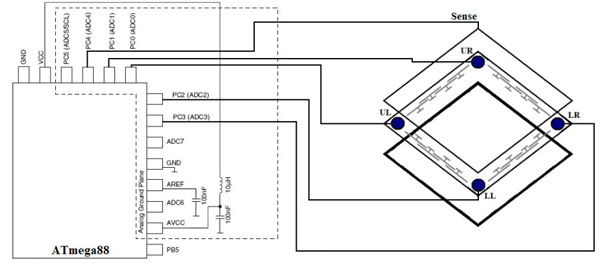
Resistive 4- and 5-wire touch sensors are the most popular and most common touchscreen technologies with about 75% market share, mainly due to their low costs and simple interface electronics.
The high volume of these screens requires a low-cost reliable interface, often with a low-power element. This can be provided through a range of analog features combined with low-power modes for portable, battery-powered applications.
Analog resistive touchscreens
Usually a resistive touchscreen consists of at least three layers (Figure 1). A flexible membrane made from PET film is suspended over a rigid substrate made from glass or acrylic, and both surfaces are coated with a transparent conductive film, usually Indium tin oxide (ITO). The conductive ITO layers are kept apart by an insulting spacer along the edges, and by spacer dots on the inner surface of the two ITO layers. In this way, there will be no electrical connection unless pressure is applied to the top sheet (PET film).
For more detail: Evaluating Different Approaches for Interfacing Touchscreens
- What is the most popular touchscreen technology?
Resistive 4- and 5-wire touch sensors are the most popular with about 75% market share. - Why are resistive touchscreens widely used?
They are mainly used due to their low costs and simple interface electronics. - How many layers does a resistive touchscreen usually consist of?
A resistive touchscreen usually consists of at least three layers. - What material is used for the flexible membrane?
The flexible membrane is made from PET film. - What conductive coating is applied to the surfaces?
Both surfaces are coated with a transparent conductive film usually made of Indium tin oxide. - How does the screen detect pressure?
There will be no electrical connection unless pressure is applied to the top sheet. - What type of interfaces are covered in the evaluation?
The article covers interfaces ranging from three, four and five wire to USB. - Which companies provide sensors and interfaces mentioned?
The text mentions Atmel, 3M, IR Touch Systems, and NKK Switches.
